Reasonable Words: Goethe

“Ohne Hast, aber ohne Rast.”

Goethe’s motto, and usually translated as “Without haste, but without rest,” but that makes it sound like you shouldn’t snooze on the job every now and then (something most poets would disagree with). My sense is more “without faltering.”

Randell Jarrell had this motto on his desk while he was translating Faust, which I am trying to make it through for the umpteenth time.

Poetry Daily: John Koethe, Crossing Seventh Avenue Below West Tenth

Today’s Poetry Daily selection is a prose-y, “I walk through New York City and ruminate” poem by John Koethe. A style (a genre?) I love, and that evokes Frank O’Hara (and James Schuyler, mentioned in the poem). Koethe’s folds out over greater length than O’Hara’s, but he still gets the light tone just right, that glancing touch of travelogue, reflection, and direct address that makes you feel you’re at his side.

Two wonderful bits, as a sample of the whole, itself well worth reading.

That’s the thing about time: it can take you anywhere,
And yet it takes you home. It leaves you the same person
In a different place, still always metaphysically alone,
But with friends that you can phone and tell your travels to.
I can’t tell you what it is, but I can feel it flow, and flow away,
Until a memory breaks its spell

I ought to decide where I’m going to eat tonight. In Hebdomeros,
Giorgio de Chirico’s novel in the form of an extended thought,
There’s a passage about “those men who eat alone in restaurants,”
Inhabiting “the infinite tenderness, the ineffable melancholy”
Of a moment “so gentle and so poignant that one doesn’t understand
Why all the personnel of the premises, the manager and cashier,
The furniture, the tablecloths, the wine jugs, down to the saltcellars
And the smallest objects don’t dissolve in an endless flood of tears.”
I think there’s so much freedom in that thought: you stroll out
Into the night as (!) into a wilderness of traffic lights and neon signs.
I love feeling lost in the Village: crossing Seventh Avenue
Below West Tenth I get confused, and I love feeling confused,

Do Ho Suh’s “Fallen Star”

Tipped off this morning about this extraordinary new sculpture on the UC San Diego campus.

From the site for the Stuart Collection, UCSD’s high-power collection of site-specific works (Jenny Holzer, Kiki Smith, and Nam Jun Paik to mention just a few).

Do Ho Suh’s Fallen Star is the 18th permanent sculpture commissioned by UCSD’s Stuart Collection. It reflects Suh’s on-going exploration of themes around the idea of home, cultural displacement, the perception of our surroundings, and how one constructs a memory of a space.

It’s also an audacious bit of engineering, so to set it on the roof of the engineering building is an added bit of genius.

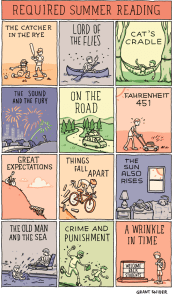
Non-Required Summer Reading

I hated required reading as a kid and college student–generally, would try to read anything other than what was assigned, although I finally capitulated. Now, looking at the Boston Public Library’s lists of required summer reading for the city’s school kids makes me paradoxically nostalgic. In the first case, I didn’t go to school in Boston, and summer time reading, like reading any time for me, was a journey, often whimsical, jumping from book to book, not a forced march down a list.

Still many choices on the Latin School Grade 12 list appeal; the fun of scanning enhanced by the one-line synopses by somebody clever (although somewhat spoiler happy.) To wit: “Beckett, Samuel Waiting for Godot Despite Godot’s failure to appear, Vladimir and Estragon endlessly hope for direction.” –A nice sentence, and easy to imagine coming from the mind of somebody who teaches high schoolers!

If you want to be daunted, check out the Latin Academy reading list of what is required to prepare for the AP Latin exam. How many students take it, I wonder? I’ll stick to my next pick from the first list, Oscar Hijuelos’s, The Mambo Kings Play Songs of Love.

The 30 Day Solution

Low-overhead advice on how to build a new habit from Google engineer Matt Cutts, who was inspired by Morgan Spurlock’s various short-term experiments. Try something for 30 days, and at a minimum get a new experience, perhaps a lifelong habit.

Daily things are a great pleasure of mine (a morning poem courtesy of Poetry Daily, and checking out the gentle adventures of Mooch and Earl in Mutts.) Of course, like everyone, I quickly hit the limit of just how many daily things can be crammed in (this despite working at home and having no kids, so hardly fair to gripe).

That said, I really want to try two things he mentions in his blog and in the video: no email after 9:00 p.m. for 30 days (in fact, I’d like a “no digital devices after 9:00 p.m.” challenge, but that’s probably going overboard, and 30 days of novel writing (or, as nanowrimo.org has it in their, tag line, “Thirty days and nights of literary abandon.” Sounds more like a clothing optional resort in Key West than being a writer, but then I mostly write proposals and curriculum, not Harlequin Romances. Thirty days to a new genre?

The Little Professor: A Droll Blog

Happened upon http://littleprofessor.typepad.com/ via a link on TLS’s list of blogs they like. A hangout for Miriam Elizabeth Burstein, an irreverent and witty English prof from SUNY’s Brockport College. I particularly love her “live blogging” of terrible 19th century novels she reads on Google Books. I’m seeing a new pastime here.

Washington Post on the Lasting Effects of the Mortgage Crisis on the Black Middle Class

Good reporting on a devastating topic:

http://www.washingtonpost.com/business/economy/for-black-americans-financial-damage-from-subprime-implosion-is-likely-to-last/2012/07/08/gJQAwNmzWW_story.html

The implosion of the subprime lending market has left a scar on the finances of black Americans — one that not only has wiped out a generation of economic progress but could leave them at a financial disadvantage for decades.

The Whitleys, Illinois homeowners, now face rebuilding credit damaged by the mortgage meltdown.”

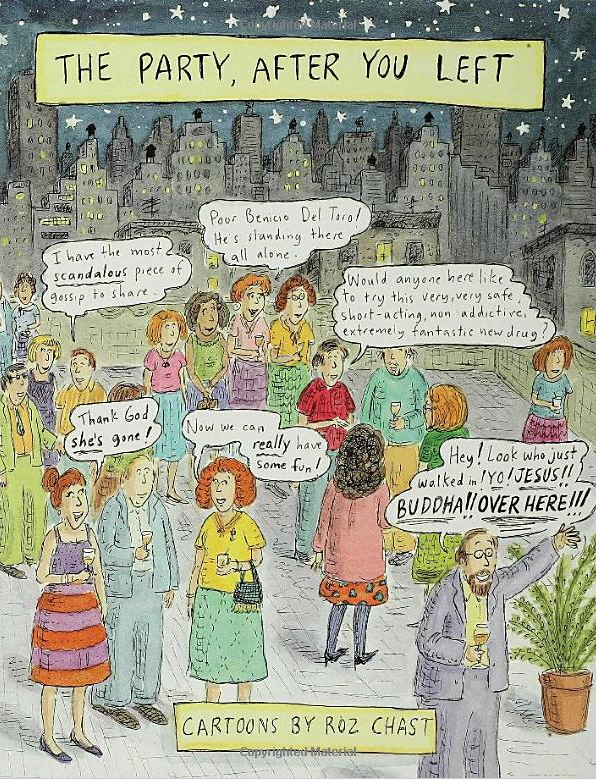
The Party After You Left

So, I lived in Somerville’s Union Square until 1999. After that, the hipness fairy descended on it and blessed it.

Here’s Wicked Local singing its praises,

It’s been well over a decade since Davis Square eclipsed Harvard Square’s hip factor. When the Museum of Bad Art was looking for a new home, it chose Somerville. And anybody who’s in the know these days will tell you that Union Square in Somerville in the new hip place to be with events like the Rock ‘n’ Roll Yard Sale, the Fluff Festival and The All-American Beard & Moustache Competition.

Now, I’ve just moved to Takoma Park in time to learn that as the Washington Post puts it,

It’s taken four decades, but Takoma Park may have finally started to leave the ’60s.

After years of flagging interest, the city recently killed its Free Burma Committee. Last month, it made a rare exception to its “nuclear-free zone” ordinance. The city’s corn silo still stands, and Takoma Park still refuses to buy bottled water, but the community tool library is gone, and many of the activists who once defined what has long been called the People’s Republic of Takoma Park are getting older.

Roz Chast has my number (like all her books, wonderfully wry and well worth checking out):

So You Think You Can Paint

Courtesy of the SF Weekly’s Blog, “The Exhibitionist,” nice video of a club-like event where you can go and paint. Happens for free every Thursday.

More evidence for my possibly crack-pot theory that as so many of us spend work lives, and increasingly personal lives, interacting via screens, the desire to do something that is tangible, not mediated digitally, and happens with people IRL grows. At least this is true for me as a teleworker.

More practically: Why do things like this always seem to start in San Francisco? Is that Oscar Wilde quote to blame (now attributed to Jack London, I hear).

“It’s an odd thing, but anyone who disappears
is said to be seen in San Francisco.
It must be a delightful city and possess
all the attractions of the next world”
― Oscar Wilde/Jack London

The World At Night: Innsbruck

Bad Astronomy tipped me off to a mesmerizing time lapse video of Innsbruck, Austria, by Christoph Malin, who spent 8 months there and took 35,000 photos.

Hard to believe The Milky Way could be that clearly visible from just outside the city. It’s spectacular, and watch for meteors paraboling through. Part of a larger effort called, “The World At Night.” From their web site:

The World At Night (TWAN) is an international effort to present stunning nightscape photos and time-lapse videos of the world’s landmarks against celestial attractions. The eternally peaceful night sky looks the same above symbols of all nations and regions, attesting to the truly unified nature of Earth as a planet rather than an amalgam of human-designated territories.