 AIGA’s annual contest for the best book cover of an English language book is now open to the public, and is being managed by Design Observer.
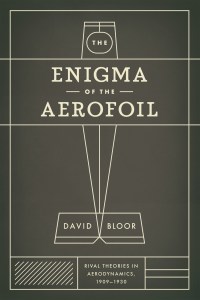
The current nominees (rather overstuffed with U of C Press titles) include a couple of nice ones.


A commonplace book
AIGA’s annual contest for the best book cover of an English language book is now open to the public, and is being managed by Design Observer.
The current nominees (rather overstuffed with U of C Press titles) include a couple of nice ones.
Oscar Wilde has it down. Here’s his reply to a newspaper that ran a scathing review of one of his plays, in which the writer flunked the first rule of fact-checking, get the playwright’s name right. From Letters of Note:

16 Tite Street
February, 1892
Sir,
John is an admirable name. It was the name of the most charming of all the Disciples, the one who did not write the Fourth Gospel. It was the name of the most perfect of all the English poets of this century, as it was the greatest English poet of all the centuries. Popes and princes, wicked or wonderful, have been called John. John has been the name of several eminent journalists and criminals. But John is not amongst the many delightful names (they included, besides Oscar, Fingal O’Flahertie Wills) given to me at my baptism. So kindly let me correct the statement made by your reckless dramatic critic in his last and unavailing attack on my play.
The attempt he makes to falsify one of the most important facts in the history of the arts must be checked at once.
Oscar Wilde
 Letters of Note (via the Sydney Morning Herald) dug up the writing tips of David Ogilvy (above), the advertising mastermind behind Ogilvy and Mather. It only takes a small adjustment of the vertical hold to apply these insights to other kinds of writing, particularly item 9.
Personally, I have never used booze and Handel to make it through a writing project, but do confess to exploiting the rousing character of the “Tannhäuser” Overture or Pilgrims’ Chorus to make it through the last push on a grad school paper now and then.
Perhaps some empirical research on which period of music (or individual piece for that matter) correlates to word count is in order? Do you have anything you put on to get the writerly juices flowing or sprint to a deadline?
April 19, 1955
Dear Mr Calt:
On March 22nd you wrote to me asking for some notes on my work habits as a copywriter. They are appalling, as you are about to see:
1. I have never written an advertisement in the office. Too many interruptions. I do all my writing at home.
2. I spend a long time studying the precedents. I look at every advertisement which has appeared for competing products during the past 20 years.
3. I am helpless without research material—and the more “motivational” the better.
4. I write out a definition of the problem and a statement of the purpose which I wish the campaign to achieve. Then I go no further until the statement and its principles have been accepted by the client.
5. Before actually writing the copy, I write down every conceivable fact and selling idea. Then I get them organised and relate them to research and the copy platform.
6. Then I write the headline. As a matter of fact I try to write 20 alternative headlines for every advertisement. And I never select the final headline without asking the opinion of other people in the agency. In some cases I seek the help of the research department and get them to do a split-run on a battery of headlines.
7. At this point I can no longer postpone the actual copy. So I go home and sit down at my desk. I find myself entirely without ideas. I get bad-tempered. If my wife comes into the room I growl at her. (This has gotten worse since I gave up smoking.)
8. I am terrified of producing a lousy advertisement. This causes me to throw away the first 20 attempts.
9. If all else fails, I drink half a bottle of rum and play a Handel oratorio on the gramophone. This generally produces an uncontrollable gush of copy.
10. The next morning I get up early and edit the gush.
11. Then I take the train to New York and my secretary types a draft. (I cannot type, which is very inconvenient.)
12. I am a lousy copywriter, but I am a good editor. So I go to work editing my own draft. After four or five editings, it looks good enough to show to the client. If the client changes the copy, I get angry – because I took a lot of trouble writing it, and what I wrote I wrote on purpose.
Altogether it is a slow and laborious business. I understand that some copywriters have much greater facility.
Yours sincerely,
D.O.
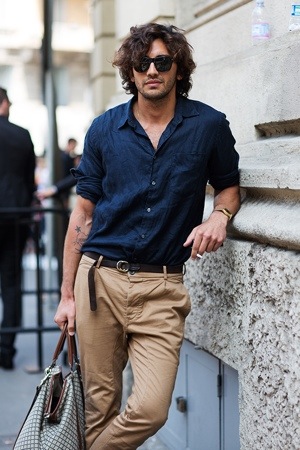
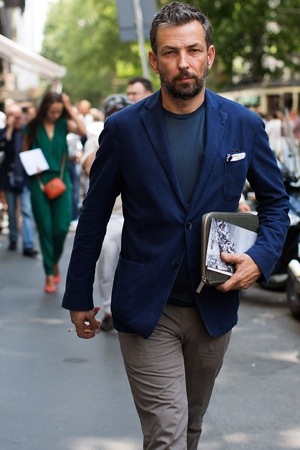
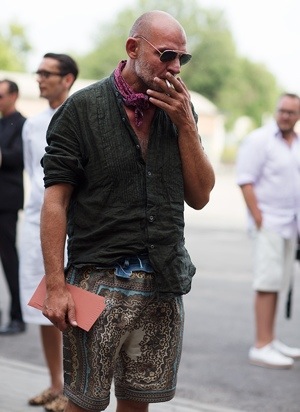
Odd but true, the fashions I am drawn to on The Sartorialist (a site I learned about thanks to my two fashion mentors, B&S) are often worn by men who are smoking and probably drive a fast red sports car. (That is, about as far on the fashion continuum from from a bike-riding Takoma Park nerd, such as myself, as possible.)
To wit:

The broadcast (audio only in the U.S.) is up for another week and well worth listening to if you are a musical lover or even if you’re not. It’s a dated show, yes, but what a score! (Stephen Sondheim notes that it is “the most entertaining musical I’ve ever seen (exclusive of my own, of course).”
The Proms semi-staged version boasts a luxury cast (and posh orchestrations from André Previn’s arrangement for the film.) The leads, Annalene Beechey and Anthony Andrews, are spot on, and Siân Philips’ Mrs. Higgins is knowing and droll (sympathetic to Eliza, and understanding more about Henry than he knows himself.)
The crowd goes crazy at the end, justified, and no doubt gratifying to the whole team who did a lot of work for a single performance.
 Some provocative thoughts from the Globe movie critic on the shooting. He starts with the imperative not to blame the film, the director, or the actors.
Our entertainment culture’s dreams of power are a drug that keeps us rapt in a cloud of promises: that we can win and that winning is everything; that we’ll be seen and heard for who we are if we’re thin enough or strong enough or have the coolest toys or the biggest guns. The fantasies lie, because the people who make the fantasies know we’re desperate to be lied to and willing to pay for it. And every so often, when we’re sold a fantasy that is so well made, that seems to tap so deeply into our very real sense of imminent catastrophe, and that seems so self-aware about the fantasy itself, certain people respond to it as if it’s the Truth. “The Dark Knight” movies are such a fantasy, and if they matter to you as anything more than extremely well-made and provocative entertainment, you really need to interrogate yourself (and maybe your friends) as to why.
Full piece at http://www.boston.com/ae/movies/2012/07/20/fantasy-masks-and-james-holmes-the-dark-knight-rises-killer/7xPjZWzV6WBWrXGb6Cz0dJ/story.html Likely to be in front of the paywall only today.
When I did a site about arts and controversy, video games were one of subjects of the debate. (Still are.) In that site, the writer noted that the Columbine killers were players of violent video games. James Au had this observation:
“Play a first-person shooter long enough and its morbid reality seems to descend over your awareness like a grid, accompanied by a kind of adrenalized hyper-awareness and euphoric rage. Grid, adrenaline and rage stay with you, far past the point when you exit to the desktop. Walk away from the computer, and they still persist. You find yourself stealing up on street corners as if preparing to strafe the adjoining block; you seem to see a crosshair traced across the bodies of passersby. For the overwhelming majority of us, with well-adjusted social lives…the grid recedes.”
–Wagner James Au, new media critic, Salon and Wired, from Salon, “Quake, Doom and Bloodlust,” May 1999.
Although Fred and Carrie are my heroes, I think the other actors on Portlandia, who often have to play deadpan straight men to their bemused requests (for instance for a cool wedding), are brilliant.
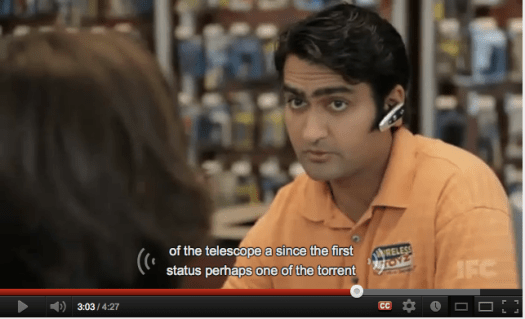
The cell phone store experience is spot on. Kumail Nanjiani unravels the skein of cell phone options to increasing befuddlement. (The masterplan of evil VP’s of sales who have mastered the art of tuning into the brain’s tendency to equate choice with quality and self-actualization. Dazzle them with choices and they won’t notice their signing a lousy deal that in fact impairs choice for months.)
Particularly wonderful is the list of ridiculous cell phone names on offer: Vitrio charisma, Revelation, Epiphany, Torque, Trick, Dazzle, Create, Max, Onus, Opus, Blast radius.
Any sillier than these actual products?
If you want an extra giggle, turn on the automatic captions on the Portlandia clip.
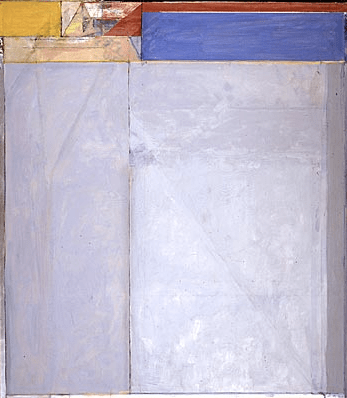 The great California artist Richard Diebenkorn’s “Ocean Park” series is on exhibit at Washington’s Corcoran Museum of Art. His paintings bring together color, light, a sense of place and the marriage of abstraction and representation (something that wasn’t supposed to be possible.)
The “Ocean Park” paintings caught my eye in the 70’s, more as emblematic of a look and a style than anything else. They were inspired by the artist’s daily walk through the park on his way to teach at UCLA. But somehow they captured what the decade looked like to my, then teenage, eyes, particularly the “delectable mountains” quality that Southern California had to a kid stuck on the Eastern Shore of Maryland. Later, I took another look when I wrote about “Ocean Park, #49” for “Sister Wendy’s American Collection,” a web site I produced for PBS in early 2001. (She was touring U.S. museums expounding on works selected seemingly at random. Thought I might get to meet her, but no soap.)
The Corcoran show, up through September 23, brings together around 80 of the works and got a perceptive review from the City Paper (which apparently still does art criticism, who knew?) The exhibit has a fee, except on free Saturdays in the summer. So hoping that will be my “see a fine picture” for today.
 Tipped from Daring Fireball, an engrossing Asymco.com piece about why Microsoft’s ability to win the big battles via software platform dominance is over. Check out the graphs for the period since the Mac, the, iPad, and the iPhone.
From the article:
The consequences are dire for Microsoft. The wiping out of any platform advantage around Windows will render it vulnerable to direct competition. This is not something it had to worry about before. Windows will have to compete not only for users, but for developer talent, investment by enterprises and the implicit goodwill it has had for more than a decade.
It will, most importantly, have a psychological effect. Realizing that Windows is not a hegemony will unleash market forces that nobody can predict.
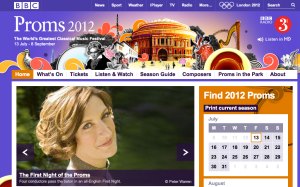 Today’s the day the “The World’s Greatest Classical Music Festival” kicks off, namely the BBC Proms (in their own immodest, but accurate, description). Running through September 8, it encompasses a huge range of music and many performances (Boulez to Wallace and Gromit and Kronos Quartet to “My Fair Lady” just for starters.
For the opener, tradition rules with an all-English program: works by Mark-Anthony Turnage (of fame for, among other things, his opera on Anna Nicole Smith), as well as these mighty worthies in the heart of the heart of the British repertory: Elgar, Delius, and Tippet. Delius’ song cycle, “Sea Drift, a magical piece was sung by Bryn Terfel.
All the audio broadcasts are free on the BBCi player. There have been noises about making the video player available in the U.S. on a subscription basis, but I don’t think it ever happened, (if you know otherwise, please let me know).
But even just listening to the audio makes an afternoon of cubicle work pretty wonderful.
 A Few Reasonable Words