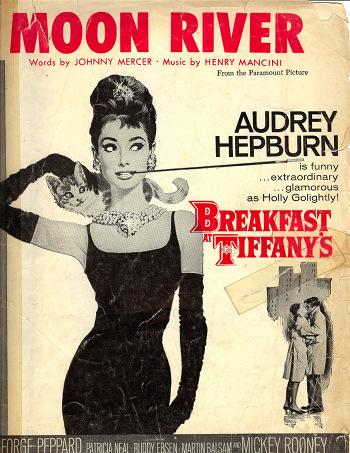
Today’s selection is Moon River, the 1962 song from the movie of the same name. It was a big hit (and Academy Award winner) for Henry Mancini and Johnny Mercer. A perennial favorite at our house–I can plunk through it relatively successfully.
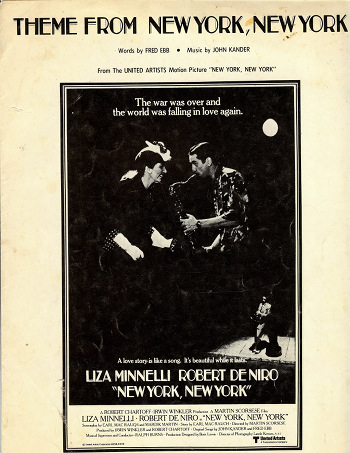
Another hit song from a mostly forgotten film. (Martin Scorsese + musicals, perhaps not a marriage made in heaven.) But the tune certainly has done well for itself.
Franco Zeffirelli’s opulent film of “Romeo and Juliet” was a blockbuster in 1968, in part thanks to Nino Rota‘s score and a theme song that became a Billboard hit. Here is my dinged up copy.
Judging by this excerpt, the film hasn’t aged all that well.
And here is Johnny Mathis crooning it.
Evokes the line, “The past is a foreign country: they do things differently there.”
From Rogers and Hammerstein to Rodgers and Hart, sweet apple cider to dry gin and vermouth. To wit: ‘Bewitched’ from Pal Joey, from that brittle musical of theirs to stories by New Yorker writer John O’Hara.
And here is the incomparable Ella Fitzgerald singing it. As Ira Gershwin said, in a sentiment I bet Richard Rodgers shared, “I never knew how good our songs were until I heard Ella Fitzgerald sing them.”
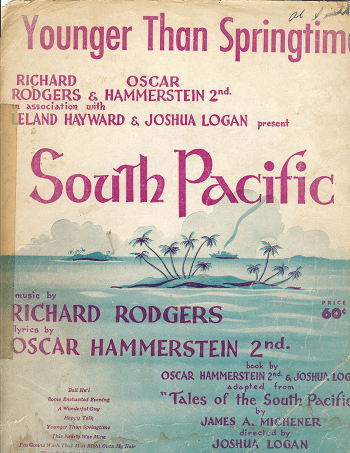
Today a wonderful old cover from “South Pacific,” for me the best of the Rodgers and Hammerstein shows. (Although perhaps I am still in thrall to that wonderful Lincoln Center revival of a few years back with Kelli O’Hara and Paulo Szot, directed by Bartlett Sher. That production’s power came from a reminder (in the perhaps unlikely setting of a theater) that we are at war. The original production premiered in 1949, only 4 years after the end of WWII, you remember that one, “the war to end all wars.” Oh, or was that WWI? or the war before that?
I promise to do better on the future scans, btw. As noted by loyal reader Sarah, quality control at this blog is not always top-notch, but even I can do better than that!
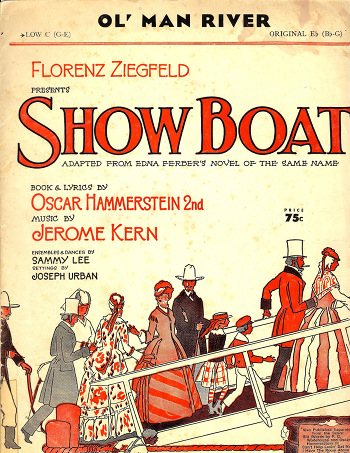
Just as Hemingway said Huck Finn was the well-spring of all American literature, it’s easy to argue that Show Boat, the 1927 Ziegfeld, Kern, and Hammerstein show on the story by Edna Ferber, gave birth to the American musical. (Take a look at what bowed that season on Broadway to see the context…Ziegfeld Follies, various “Scandals,” revues, and the Gershwins’ unsuccessful “Oh, Kay! spotting just a few.)
It wasn’t just that Show Boat‘s story unfolded through the music (rather than merely, “gee, I think I’ll sing a song now” a set up in so many earlier shows), or that it tackled the themes of race and what it means to be an American–core issues to be worked on in musicals from “Oklahoma” through “West Side Story,” it’s also that score! Jerome Kern knew his way around a tune, to wit, ‘Ol’ Man River,’ here performed by the great Jamaican bass, Sir Willard White (a notable Wotan among many other roles–which gives you a sense of the not inconsiderable vocal demands of SB, too.)
Funny story: Mrs. Oscar Hammerstein reportedly got peeved while attending parties when somebody would ask a pianist to play “Jerome Kern’s ‘Ol’ Man River.’ ” She shot back, “Jerome Kern didn’t write “Ol’ Man River,” he wrote, “Da-da, da-duh.” My husband wrote, “Ol’ Man River.” And not just the lyrics, he wrote the book too. So spare a moment for the great Oscar.
Another selection from the Sixties for today: “This Land is Your Land” was–perhaps to the shock of anybody under 30–something we sang in school assemblies when I was a primary school student in the 60s and 70s in the U.S. Its communal feel matched the spirit of the time, and although I can’t remember whether we sang the verses about private property and hunger, it wouldn’t have been out of place if we had. I hope kids are still singing it in school today.
The Wikipedia article about the song is worth checking out and opens with the info that Woody Guthrie’s inspiration to write “This Land” in 1940 was a result of his impatience with hearing Irving Berlin’s “God Bless America” belted out by Kate Smith over and over on the radio. The original manuscript shows an interesting progression in the text. He originally included the line “God Blessed America,” but this eventually became, “This land was made for you and me.”
Great cover (lousy scan, sorry).
I don’t know when or how we acquired this particular piece of sheet music. The design feels like the music, and takes me back to that era in an instant.
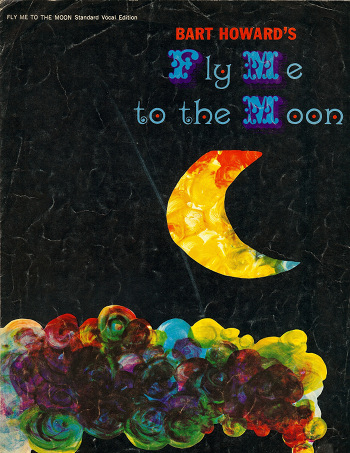
Yesterday’s sheet music selection was a classic from the “Great American Song Book,” one of the Gershwins’ best. Today, despite the astronomical theme of the song, we don’t really hit the musical heights. “Fly Me to the Moon,” is pretty thin musically, but I do love this cover. It may be because it uses that 1960s color palette so evocatively. Children’s writer & illustrator Brian Wildsmith used a similar approach in many of his books. I also have a soft spot in my heart for the main tune in this particular piece of lounge music lassitude, as I could pick it out on the piano years before I took a single lesson. It is just a basically a scale refracted through a gin fizz.
Seems like there really isn’t any other choice other than Frank Sinatra for a performance.
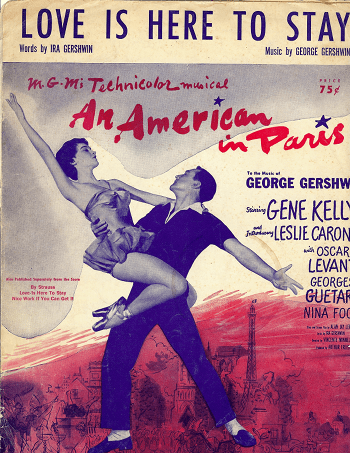
George and Ira Gershwin’s “Love is Here To Stay” was first written for a movie, but is remembered as one of the many wonderful songs in the rather silly “An American in Paris,” a movie starring Gene Kelly and directed by Vincent Minnelli. (The score is all Gershwin.) Oscar Levant has a scene-stealing role as pianist buddy of Gene Kelly.
Of course, the tune is marvelous. But I think the words are great, particularly that last verse, “In time the Rockies may crumble/Gibraltar may tumble/They’re only made of clay/But our love is here to stay.”
Here is Blossom Dearie’s performance, one of many worth exploring on YouTube or elsewhere.
My November gig is to raid my large collection of sheet music and post them for my own and possibly others’ amusement. I’ll say more about the collection as the month winds on–it came down mostly from my mother and father, both amateur musicians, as am I.
But to start, for people who may not know, sheet music is typically a single printed song with musical notation and lyrics. It was once the main way songs were distributed, with song pluggers in the early years of say Irving Berlin’s long career, selling sheet music on the street, not recordings. You would buy the music, go home and plunk through it on your piano. That world has changed needless to say (well not for so much for me) but the sheet music is still around. Much of it sitting on my piano right now.
The first selection is from Jerome Kern’s “Roberta,” a throwback in many ways (using smoking to evoke a romantic aura?), but still a lovely tune. Hit the link for a wonderful bit of dancing to the tune by Astaire and Rogers.






 A Few Reasonable Words