Courtesy of Bad Astronomy, a wonderous photo of Italy from the International Space Station:

Lo Stivale d’Italia. (The Boot!)

A commonplace book
Courtesy of Bad Astronomy, a wonderous photo of Italy from the International Space Station:
Lo Stivale d’Italia. (The Boot!)
My friend Paul Katz, a cellist and professor at NEC, reports on his frustrating, and white-knuckled, experience flying with his cello. Given that he, and many musicians fly all over to perform and teach, you’d think that airlines would figure this out.
I once witnessed a gate agent telling a fiddler she was out of luck as her violin was too big for under the seat. She could board at the very end and look for a spot in the overhead baggage compartment. If she couldn’t find any room, tough. She could check it, or give up on the flight. (Turned out, like Paul’s story, to have a happy ending.)
From Paul’s article in the Boston Globe (there’s also a WQXR podcast with Naomi Lewin).
So I do the unthinkable — hand my love of 45 years to a baggage handler, a nice guy who promises he will rope it down so it will not bounce, and it will be delivered to me by hand in Los Angeles.
The violent takeoff on a bumpy runway and ensuing turbulence — beverage service has just been discontinued — make me realize I have made one of the biggest mistakes of my life.
From the Portuguese poet and essayist (possibly should make that poets and essayists, as there are so many identities for him…), via a friend:
“O valor das coisas não está no tempo que elas duram, mas na intensidade com que acontecem. Por isso existem momentos inesquecíveis, coisas inexplicáveis e pessoas incomparáveis.”
“The value of things is not the time that they last, but the intensity with which they occur. So there are unforgettable moments, inexplicable things and incomparable people.”
Still having momentos inesquecíveis in Maine such as this ocean view from Lobster Cove.

View from Burnt Head about 9:00 p.m. last night.

Sounds like a painting title, no?

Blue sky after a fast moving gray ridge of clouds moved over the island, dumping half an inch of rain and then departing.
Probably not much blogging this week, as we’re on our annual pilgrimage to Monhegan Island, ME, for vacation. Putting down the computer, and fortunately neither the camera nor the telescope has a browser built in (yet).
Still, won’t be able to resist putting up a few pics:
Day 1: View of the town harbor as we walked off the boat from Port Clyde… Here’s to figuring out how to use my DSLR and processing software sometime this week.
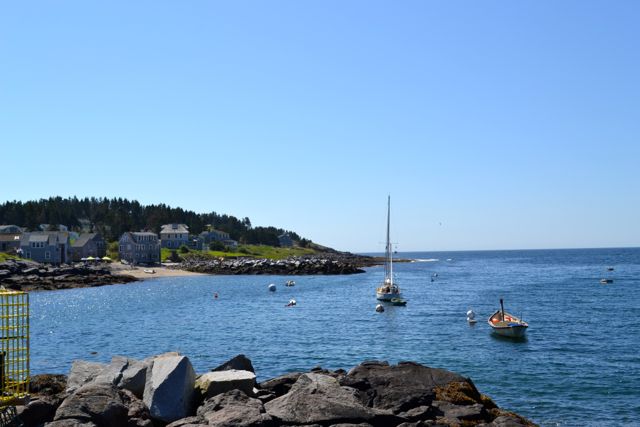
Not happening yet, unfortunately.
 Poetry Foundation has a nice feature on poetry about teachers and students. A little arch (PF mostly is), but still full of nice things, including an opening Frost quote:
Education is the ability to listen to almost anything without losing your temper or your self-confidence.
a good bit from another poet:
“Ars Poetica #100: I Believe” by Elizabeth Alexander
Poetry (and now my voice is rising)
is not all love, love, love,
and I’m sorry the dog died.
You can use the links as a kind of poetry play list to check out the poems.
 The Globe’s interesting and opinionated Brainiac blog tipped me off to more yet more ink being spilled (should that be ‘pixels being pushed?’) on the debate about whether IQ is an intrinsic characteristic, from which economic, and other kinds of success follow. Generally this whole area of controversy leaves me cold–it’s worse than the unceasing, yet ever less edifying, fights about teaching Huck Finn in U.S. high schools.
Still a couple of interesting points come out. Brainiac links to the piece by the editor of “The American Conservative” who slogged through data exhaustively. (How skillfully is uncertain, anybody from my social science posse up for an analysis?) He came to the conclusion that the independent and dependent variables are switched. IQ depends on economic and other factors, not the other way around. It’s not “genetically determined” (a fairly meaningless term when it comes to social traits but that’s a soapbox for another day). He cites the issue of American and Israeli Jews with strong shared genetic heritage, yet marked differences in IQ (American Jews have high IQ’s relative to other groups, significantly higher than Israeli Jews). Another example: if economic status is the independent variable, as it improves, so should IQ. This is what has happened to the IQs of Latinos in the U.S. whose socioeconomic status has increased.
Fair warning: the piece is overly long (who edits the editor?). Lots of shaky points: the cross cultural stuff, including various biases, makes these head to head comparisons dubious, identical twin studies are a methodological mess with very small N’s, the multiple intelligences concept is ignored (whether it’s unwelcome in the halls of The American Conservative or just too messy, I don’t know.) And there are oodles of measurement and instrument problems. (He’s doing ‘meta-meta analysis’ so actual instruments and data are pretty far upstream.) Still, worth scanning if this is one of your hobby horses. The comments are lively.
Found in Ian Frazier’s Humor Me: An Anthology of Funny Writing, the opening of Michael O’Donoghue’s How to Write Good:
A long time ago, when I was just starting out, I had the good fortune to meet the great Willa Cather. With all the audacity of youth, I asked her what advice she would give the would-be-writer and she replied:“My advice to the would-be-writer is that he start slowly, writing short undemanding things, things such as telegrams, flip-books, crank letters, signature scarves, spot quizzes, capsule summaries, fortune cookies, and errata. Then, when he feels he’s ready, move up to the more challenging items such as mandates, objective correlatives, passion plans, pointless diatribes, minor classics, manifestos, mezzotints, oxymora, exposés, broadsides, and papal bulls.
And above all, never forget that the pen is mightier than the plowshare. By this I mean that writing, all in all, is a hell of a lot more fun than farming. For one thing, writers seldom, if ever, have to get up a five o’clock in the morning and shovel manure. As far as I’m concerned, that gives them the edge right there.”
She went on to tell me many things, both wonderful and wise, probing the secret of her craft, showing how to weave a net of words and capture the fleeting stuff of life.
Unfortunately, I’ve forgotten every bit of it.
It peters out after that great opening… now off to work on my signature scarf, accompanied by my delight in the new found fact that the plural of oxymoron is really oxymora!
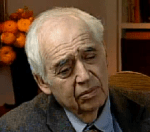 Harold Bloom, explicator of so much of literature, gets a starring role in a droll poem by Joel Lewis. The 1,000 pages a day must be true, and given his bibliography, he must write 50 a day too. How on earth is it even possible to do that and follow the Yankees?
How Harold Bloom Chills Out
Right after
Professor Harold Bloom of Yale
explained his
1,000 pages-a-day
reading habit as
“perhaps a neo-Lamarckian
inheritance from an unknown
Talmudic sage ancestor”
the C-Span interviewer asked:
“I’ve heard you are
a baseball fan”Bloom’s Jabba the Hutt-meets-Falstaff face lit up.
“Oh yes, I’ve supported the Yankees since 1936,
when an uncle took me to a game.In fact, when this interview is concluded, I shall
turn on this television set to see
‘how the Yankees are doing.'”JOEL LEWIS, from Surrender When Leaving Coach
 A Few Reasonable Words