Assignment #3 was learning your way around the WordPress Reader, and also thinking about your blogging in the context of others you read. The other bit was following five new blogs and five new tags. Useful prompt–I haven’t used the Reader that much (I just follow stuff on FB), and I didn’t know that you can just use it for RSS feeds, so have hooked in my favorites. Interesting to think about how varied the content of the blogs I follow is, and how catching a particular voice is what grabs me.
Also a reminder that tying into the (vast) community of WordPress is partially dependent on tagging and categorizing. My self, my meta data.
The vast expanse of WordPress.com blogs. (Well, actually it’s Big Meadows at Shenandoah National Park, but they’re both big!).
Taking a break from the “Blogging 101” stuff to share an Abbey Simon track I encountered (or probably re-encountered) last night.
This is his performance of an arrangement from Gluck’s opera Orfeo ed Euridice. (The arrangement is more than a tad old-fashioned, but the piano sound–and the way he gets from phrase–gentle, golden, and singing).
And another lovely take on it–maybe even more haunting–gets a little of the operatic darkness too. Plus the bonus of being able to see the video of performer, Yuja Wang who, like many a great pianist, somehow barely seems to be moving her fingers from the top of the key to the bottom. (What did we do before ‘keyboard cam?’)
Wang’s power at the keyboard is astonishing–I’ve heard her live twice, and out comes this tiny person who thunders and sings through big pieces, for instance the Tchaikovsky Piano Concerto #1 with the high beams on, and the curves taken thrillingly fast, but with calm confidence. She’s incredibly strong, but what impresses is the delicacy. Going back to Simon, he was once asked “whether strength matters in piano technique?” and here are his reasonable words, applicable to other instruments and genres.
Abbey Simon: I don’t think [muscle strength] comes into it. You have to realize you don’t play a musical instrument with your fingers. A musical instrument is played by the ears. My own theory is that what sets apart the great artist from the competent one is that he hears differently. When people say, “The sound of Rubinstein,” Rubenstein played the same old piano that everybody else played. It was that he had a different conception of sound. The miracle of Horowitz is not the octaves. Conservatories are churning out people who can play octaves even faster than Horowitz can play them. The miracle of Horowitz is the color, the ability to change color. It’s all of those things, and those are things that are governed by the hearing. The wonderful sound that Heifitz had is because Heifitz heard differently. In addition to that brilliant ability, he heard things differently. All of these great artists hear things. They have an extra talent, an extra technique, and it’s the hearing technique because in the most elementary way our ears tell us we played a wrong note. We have to practice so that we don’t play a wrong note. From then on, it’s a constant refinement. The ears demand refinement — play faster, play louder, play softer, do this or that; you didn’t phrase that nicely. Some people’s ears become more sensitive and more demanding, and they’re the ones who are the great artists.
Today’s assignment is “take control of your title and tagline.” Mine perhaps needs some help.
My title is: A Few Reasonable Words
And the tagline is: “One should, each day, try to hear a little song, read a poem, see a fine picture, and, if possible, speak a few reasonable words.” — Goethe
With my usual tendency to over explain things, I see that I have used up the tagline space to gloss the quotation. Time to dump that (or do the explaining elsewhere). (Oops, already do.)
But, what to use as a tag instead? My blog is probably more often a Commonplace Book than anything else, also sort of a library reference desk display rack–things of (possibly infinitesimal) interest. “More information than you require” would work, but that has been taken by the droll John Hodgman.
Some bloggy riff on “Books you Don’t Need in Place You Can’t Find” might fit the bill (that’s the motto of the Montague (MA) Bookmill). “Bits and bites you don’t need on a blog you can’t find…”
I think I will go with that for now. The beauty of the interwebs means I can change it tomorrow, of course.
And for good measure, a few famous taglines from a previous content delivery medium, newspapers:
“All the news that’s fit to print,” “the seven most famous words in American journalism” according to the the BBC. And inspiration for a perhaps legendary sign in the Times compositing room, “All the news that fits, we print.”“Light for all,” a nice tagline, and the changes in the Sun’s vignette are a mini-history lesson.In an era in which newspaper barons were equivalent to the tech giants of today, Robert “Colonel” McCormick loomed large. I’m not sure if he named the Trib “world greatest newspaper,” but that was the motto for many years. It also gave his flagship radio and TV stations, “WGN,” their call letters.
There’s another one I couldn’t find an image for, but I love: the San Francisco Examiner’s motto, “The Monarch of the Dailies” –the flagship paper of the monarch of the press lords, William Randolph Hearst.
Although I’ve been blogging for three years, I finally have gotten around to taking WordPress.com’s Blogging 101, a kick start for a new blog, or a way to rev up an existing one (something I’m ready for).
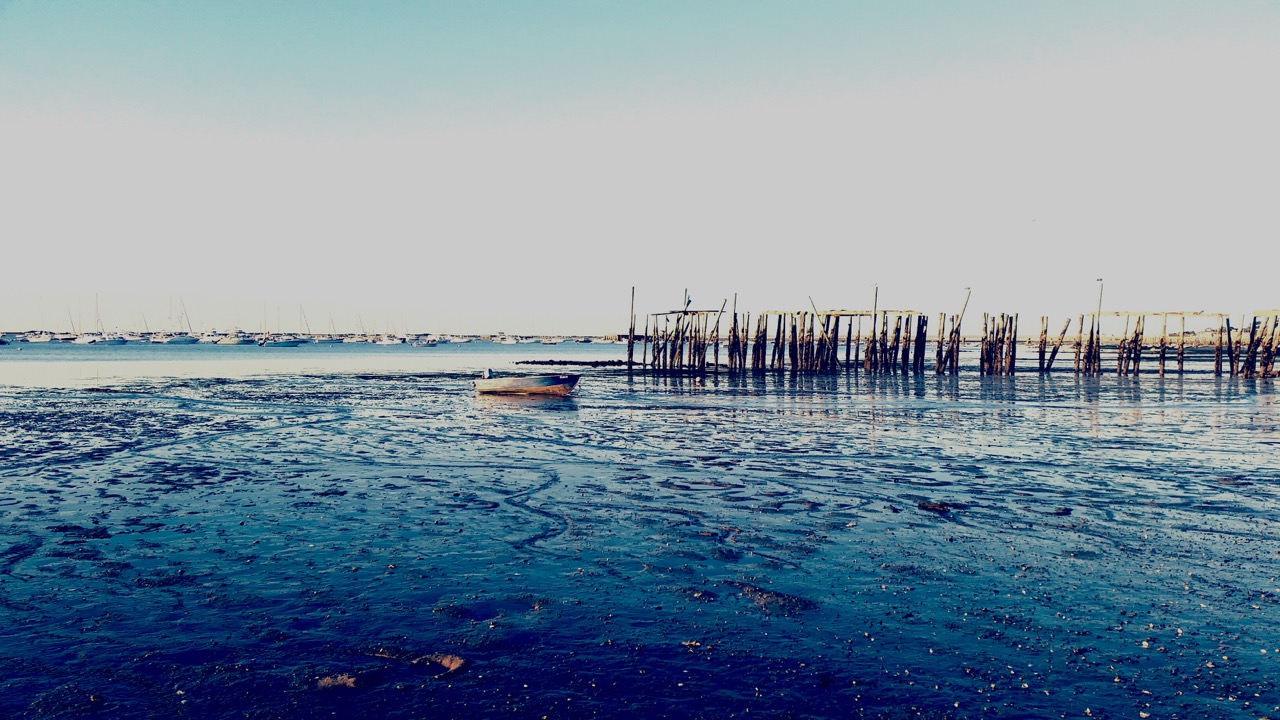
Today’s assignment (which I wrote while riding back from Maryland’s Eastern Shore (Chesapeake Bay shot below), write a post introducing yourself, “Who I Am, and Why I’m Here…”
Easy-peasy, lemon-squeezy: I’m a writer, media producer and sort of WordPress developer/would-be techie. I’ve been involved in editorial this and that for 30+ years, hanging around libraries, museums, performing arts organizations, and public media. Did my first website in 1995, most recent one last week. A couple that a lot of people visit, this one…not so much!
Why I’m here: have always interested in the intersection between content and technology (what happens when they duke it out?). I also like open software, design, and fiddling with things, and god is WordPress fiddly. It also seemed to be a nice way to train up in a platform that over 20% of the web is using. So mostly I’m here to learn WordPress, and share a bit content that caught my eye.
So that’s me in a nutshell. More soon.
View from the Chesapeake Bay Bridge, Labor Day 2015
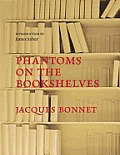
Still dipping into Phantom of the Bookshelves, one of those charming books on books that show up from time to time. Chapter 7 addresses a phenomena that many readers encounter.
Chapter 7
Real People, Fictional Characters
“The best bacon omelettes I have eaten in my life have been with Alexandre Dumas.” — Jacques Laurent
Hundreds of thousands of people live in my library. Some are real, others are fictional. The real ones are the so-called imaginary characters in the works of literature, the fictional ones are their authors. We know everything about the former, or at least as much as we are meant to know, everything that is written about a given character in a novel, a story, or a poem in which he or she figures. This character has not grown any older since the author brought him or her into existence, and will remain the same for all eternity. When we hold in our hand the text or texts in which such a person appears, it feels as if we are in possession of everything the author wanted us to know about the character’s acts, words and sometimes, thoughts. The rest doesn’t matter. Nothing is hidden from us. For us, a novel’s characters are real. We may be free to imagine what we don’t know about them, though we know quite well that these are just guesses. And we are free to interpret their words or their silences, but again these will just be interpretations. We know quite a lot about Odysseus, Aeneas or Don Quixote, correspondingly little about Homer, Virgil or Cervantes. Sometimes characters are even deprived of an author as if their creator had discreetly sipped away. Who made up the first version of Don Juan? Who invented Faust? And while we feel sure that Harpagon, Tartuffe or Monsieur Jourdain undeniably exist, what do we know in the end about a certain Jean-Baptiste Poquelin, whose stage name was Molière. Not very much, not even whether he really wrote all the plays attributed to him.
[…]
Authors are just fictional people, about whom we have a few biographical elements, never enough to make them truly real people. Whereas the biography of a literary character, even if it is incomplete–and explicitly so–is perfectly reliable: it is whatever its creator decided.
A real map of a fictional place, R.K. Narayan’s Malgudi, which is nonetheless a place that was very real to me when I fell in love with his books in my twenties.
“Two communities outside Birmingham, Alabama, are
still searching for their dead.” — News Telecast
And tomorrow morning at 8 o’clock in Springfield, Massachusetts,
my oldest aunt will be buried from a convent.
Spring is here and I am staying here, I’m not going.
Do birds fly? I am thinking my own thoughts, who else’s?
When I die, don’t come, I wouldn’t want a leaf
to turn away from the sun — it loves it there.
There’s nothing so spiritual about being happy
but you can’t miss a day of it, because it doesn’t last.
So this is the devil’s dance? Well I was born to dance.
It’s a sacred duty, like being in love with an ape,
and eventually I’ll reach some great conclusion, like assumption,
when at last I meet exhaustion in these flowers, go straight up.
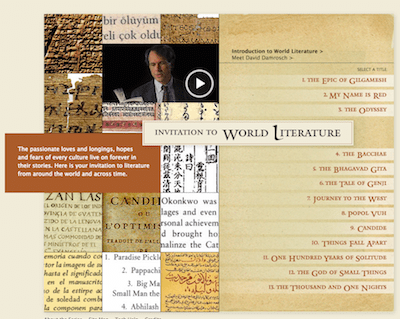
“The 13 works are well-chosen, clearly reflecting the aims of the producers. I won’t list them, as if you click on the pic of the interface you’ll get a more easily readable version. I suspect that, like me, you have a passing knowledge of a few titles (The Odyssey, Candide, The Thousand and One Nights), but what do you know about Popol Vuh? Quite a fascinating mixture across the ages, I’m sure you’ll agree. Always tricky to choose something contemporary, of course, but a goodly sample of bibliophiles would at least grudgingly agree with The God of Small Things (Arundhati Roy), I would claim. The other recent title, My Name is Red (Orhan Pamuk), is likely less well known (unless you’re Turkish!), but maybe here I’m just displaying my appalling ignorance of world literature.
The interface is clean and inviting, and the material and background resources well-chosen and lovingly presented. You can delve via the ‘Watch’, ‘Read’ or ‘Explore’ menus, each simple to navigate.”
Deep thanks, David!
A few additional tidbits to note: all the videos are online, but they are also sometimes on public television in North America (granted, they probably air at 6 a.m. on Sunday morning, that’s sort of the story of my producing life, but you can TiVo it people!).
Also, there is lots more, a college degree’s worth of courses and then some, at Learner.org from Annenberg. They have a two-fold aim, provide well-produced media-based online courses for college students (and life-long learners), and provide materials for teaching training. I have worked on many projects in both categories, and they were great experiences.
And back to World Literature–truly one of the great things, one of those “before and after” moments in my reading life–was reading Monkey, for the project, a book I didn’t know. It’s a Buddhist parable, an insight into Chinese history and culture, wacky and funny, and also profound. For me, finished on a bitterly cold night on Cape Cod six New Year’s Eves ago, it was an invitation to think about my being as both monkey and monk in a way that has kept me company ever since.
Encountered a book called “Letters to a Fiction Writer”–an anthology rustled up by the late Frederick Busch, whom I have always liked (although I do seem to get my Busch and Bausch novelists mixed up). It may be one of the Bausch brothers I like so much.
The letter that caught my eye, somewhat surprisingly, is one by Joyce Carol Oates, mostly “write your heart out,” but it opens thus:
“To a Young Writer:
All that a man has to say or do that can possibly concern mankind, is in some shape or other to tell the story of his love,–to sing; and, if he is fortunate and keeps alive, he will be forever in love. This alone is to be alive to the extremities. –Henry David Thoreau, Journal, 6 May 1854
(Yet keep in mind Thoreau’s other, more sardonic aside in the first chapter of Walden:
I have lived some thirty years on this planet, and I have yet to hear the first syllable of valuable or even earnest advice from my seniors. They have told me nothing, and probably cannot tell me anything, to the purpose. Here is life, an experiment…untried by me; but it does not avail me that they have tried it…One generation abandons the enterprise of another like stranded vessels.
How achingly true this seemed to me when I was a young, adolescent writer, and seems so still!)
If it’s your ambiguous destiny to be a writer, you already know that no one can tell you what to do; how to behave; still less how to think, and how to feel about yourself….
The letter also has this observation a bit later,
Don’t be ashamed of being an idealist, of being romantic and “yearning.” If you yearn for people who won’t reciprocate your interest in them, you should know that your yearning for them is probably the most valuable thing about them. So long as it’s unrequited.
Reminds me of something I read years ago by Robert Penn Warren about no experience in life being wasted on a writer.
That this resonates with me surprises, as, although I’ve always been impressed by Oates industry, I haven’t really clicked with her writing — at least the fiction. But she is apparently a wonderful mentor. To wit, this this recollection by Jonathan Safran Foer:
JSF: She [Oates] wrote a letter to my house in DC during one break, and she said, “We talked a lot about your work in the context of the class and now I would like to talk about it a little more personally. “You appear to have a very strong and promising talent coupled with that most important of writerly qualities, energy.” And man is she right! Energy is the most important writerly quality. In any case, she gave me a reading list. It was a very Joyce Carol Oates thing to do. She gave me suggestions for what avenues to pursue. And somebody took me seriously. It was a revelation for me. The revelation was not just that—the smaller revelation was that a writer of Joyce’s caliber would like my writing. The much larger revelation was that there was such a thing as my writing. It had never occurred to me.
Then moved o’er the waters by might of the wind
that bark like a bird with breast of foam,
till in season due, on the second day,
the curved prow such course had run
that sailors now could see the land,
sea-cliffs shining, steep high hills,
headlands broad. Their haven was found,
their journey ended. Up then quickly
the Weders’ clansmen climbed ashore,
anchored their sea-wood, with armor clashing
and gear of battle: God they thanked
for passing in peace o’er the paths of the sea.









 A Few Reasonable Words