Tipped by a NYPL blog entry on world literature, I’m engrossed in An Unnecessary Woman, a novel in the first-person about a reclusive reader and translator, Aaliya, holed away in an old apartment building in Beirut who starts out every Jan 1 on her new translation project. Something, when complete, she just shoves in a box and stores.
The novel is a love letter to reading and listening: full of references to books, writers, composers and musicians whose works make up Aaliya’s real world. In this passage, she has just put on an LP of Bruckner’s Third Symphony:
Here’s a charming tale about Bruckner that I love, though I believe it
Anton Bruckner
must be apocryphal. When he conducted the premier of this same third symphony, the audience abhorred it. Personally, I can’t imagine why. Not only is it beautiful, but if it has a flaw, it may be that it’s a little melodramatic and kitschy, two attributes that audiences tend to love. But who can account for tastes? The audience booed violently and stormed out of the hall. I imagine the composer looking back in abject sorrow at the honeycomb of heads in the theater before exiting and locking himself in the conductor’s room, alone as he would always be. Forlorn and forsaken. Bruckner remained by himself until everyone had left the building, at which point he returned to the pit for a last farewell. He saw a young man still sitting in his seat, a young composer so overcome that he’d been unable to move a muscle since the symphony began, not a twitch. The young Mahler had been cemented in his seat for more than two hours, weeping.
I am not a young Mahler. Today the music doesn’t move me, and I do not find it soothing.
Wave after wave of anxiety batters the sandy beaches of my nerves. Oh, that’s a bad metaphor if there ever was one. Just horrible.
Nothing is working. Nothing in my life is working.
Giants of literature, philosophy, and the arts have influenced my life, but what have I done with this life? I remain a speck in a tumultuous universe that has little concern for me. I am no more than dust, a mote—dust to dust. I am a blade of grass upon which the stormtrooper’s boot stomps.
I had dreams, and they were not about ending up a speck. I didn’t dream of becoming a star, but I though I might have a small nonspeaking role in a grand epic, an epic with a touch of artistic credentials. I didn’t dream of becoming a giant—I wasn’t that delusional or arrogant—but I wanted to be more than a speck, maybe a midget.
I could have been a midget.
All our dreams of glory are but manure in the end.
I used to imagine that one day a writer would show up at my door, someone whose book I had translated, maybe the wonderful Danilo Kiš (The Encyclopedia of the Dead), before he died, of course. He the giant, me the speck with midget dreams, but he would come to thank me for caring about his work, or maybe Marguerite Yourcenar would knock on my door. I haven’t translated her, of course, because she writes in French. And what French. In 1981 she was the first woman inducted into L’Académie française because of her impeccable language. She would appear to encourage me, to show solidarity, us against the world. I, like you,isolated myself. You in this apartment in this lovely but bitter city of Beirut, I on an island off the coast of Maine. You’re a forsaken, penniless translator who’s able to remain in your home by the grace of your landlord, Fadia, while I am an incredible writer whose girlfriend, heir to the Frick fortune, owns the entire island. I am respected by the world while you are mocked by it. Yet we have much in common.
It’s a spectacularly beautiful day in D.C.; feels more like the height of summer than the first day of fall, but I’m ready for my fall music.
First, listening a lot to to BR-Klassik these days, and recently they did an hour on the Bulgarian soprano Anna Tomowa-Sintow, a somewhat overlooked singer of the 80s and 90s. This cut of her singing Adriane’s glowing, if gloomy, aria “Es gibt ein Reich” from Strauss’ Adriane auf Naxos caught my ear. Not fall music perhaps on the face of it, but so much of what Strauss wrote seems steeped in shadow. Check out the harmonic modulation at the end and how she glides through it effortlessly.
Anna
Next, Lotte Lenya singing Weill’s “September Song.” Weill was lucky with his collaborators (although I guess he loathed Brecht with the force of a thousand suns). Here the graceful lyrics are by the playwright Maxwell Anderson, and the song comes from a mostly forgotten musical called Knickerbocker Holiday. Lenya’s dusky voice is the opposite of Tomowa-Sintow’s gleam, but at the same, her singing makes you think she’s sitting right across from you in a Berlin cafe, beguiling you through the cigarette smoke.
And now, just because it caught my interest on the Gramophone music site. Decca has just released “The Lost Songs of St. Kilda” an effort to preserve songs from a tiny island off Scotland, uninhabited since the 1930s, and 3 hours from Skye (that’s a ways out there!). They made a video of a trip to the island to bring the music back, complete with composer James MacMillan and his piano. Both composer and instrument survived the trip.
The front of the building has been opened up (it was largely admin before and concrete bunker-like things blocked the view). Now there is great lighting and windows.
In what seems like an engineering feat to my (naive) eyes, the structure of the walls inside the building has been opened up so you have a feeling of long lines and beautiful corridors. Some how it feels like there are far fewer walls (and I wonder what happened to the load bearing ones?)
An example of one of these opened up spaces. (Red is all over.)
On the downside, following a trend in a lot of libraries, shelves are half size (fewer books, better security I suppose) and the “bookstore” style signs “Romance” “Urban Lit” etc. turn me off. (Although I’ll note that all the books still have call #’s on the spines at least.)
In the head scratching dept., there is going to be a TV studio on the first floor of the library. Wasn’t quite complete.
Front entrance, obligatory touchscreens, sort of shopping mall/casino feel.
Still some books around! A cart near the Foreign language stacks, with Rimbaud in French a good sign.
This is a try at a panorama shot around the atrium. This to me is a 100% improvement on the dreariness of the old building, in which the atrium, despite Johnson’s intentions, always seemed like the central hall of a prison yard. This is all the more amazing in that it seems like it was mostly accomplished with lighting and color (there were fewer structural changes on the upper level as far as I could tell.) This is now a much more inviting space to read, write, and browse.
Did I mention red? There is a lot of it. Some full height stacks remain, but the inevitable question of how much they weeded the collection comes up.
There are big spaces for a children’s library and this room for teens (blurry photo through glass door, sorry). The area at right I think is trying to evoke a booth in a diner. I assume teens today would mainly need plugs to charge their devices and good wi-fi. Banana splits, bobby socks, and a wise-cracking soda jerk not so much.
As a contrast, here is the main reading room, Bates Hall, in the old building. I try to be as open to library 2.0 and beyond as anybody. Still if you say, “reading room” to me and this is what is elicited. Even though what I mostly have done here over the years is write.
And in comparison with the entry way to the new building, here’s the basilica-like front hall from the McKim. (The requisite lions are out of the shot, but rest assured they are on either side of you as you walk down the stairs.)
On one of my recent work jaunts to Boston, I checked out the nearly complete renovation of the Johnson Building of the Boston Public Library. First opened in 1972, the building was named after its architect, Philip Johnson, and meant to complement the McKim building, build in 1895.
The older building has been beautifully restored in all of its Renaissance Palazzo knock-off glory, now a less dingy and far more comfortable place to be. (The crazy Sargent murals are still in place on the top floor.) But the essential dignity and grandeur remain.
The Johnson Building makeover was perhaps a harder case. The original building was a bit fortress-like in a 1970s style that isn’t much missed, with a giant empty atrium at the center (generally with painting visibly peeling off the ceiling window casements in my memory at least). That said, it worked well enough for me (and I’m a fairly intense library patron), had a good collection, but was not someplace I ever warmed to.
The redesign seems to be heading towards an answer to what a future-friendly library might be. (Something that lots of places are wrestling with, as I’ve posted about, and we are about to get a big dose of in DC with the renovation of MLK Library at Gallery Place.) I don’t know any more than they do about what the future of libraries will disclose, but a few impressions above courtesy of an evening visit earlier this month, with cell phone snaps. Some beautiful things…others a little headscratching…
A couple of Commonplace Book Entries that resonate with one another across a century and a culture. Bertolt Brecht on the anonymous workers who drive history (but are forgotten) and George Eliot on ordinary lives.
Questions from A Worker Who Reads
Bertolt Brecht
Who built Thebes of the seven gates?
In the books you will find the name of kings.
Did the kings haul up the lumps of rock?
And Babylon, many times demolished.
Who raised it up so many times? In what houses
Of gold-glittering Lima did the builders live?
Where, the evening that the Wall of China was finished
Did the masons go? Great Rome
Is full of triumphal arches. Who erected them? Over whom
Did the Caesars triumph? Had Byzantium, much praised in song,
Only palaces for its inhabitants? Even in fabled Atlantis
The night the ocean engulfed it
The drowning still bawled for their slaves.
The young Alexander conquered India.
Was he alone?
Caesar beat the Gauls.
Did he not have even a cook with him?
Philip of Spain wept when his armada
Went down. Was he the only one to weep?
Frederick the Second won the Seven Years’ War. Who
Else won it?
Every page a victory.
Who cooked the feast for the victors?
Every ten years a great man.
Who paid the bill?
From an interview with Prof. Simon Reader (could there be any better name for an Eliot scholar?) at the New York Public Library blog.
Q: The subtitle of Middlemarch—“A Study of Provincial Life”—seems to be a direct description of her project and her method: an almost scientific examination the everyday. Was this approach to fiction avant garde at the time?
A: Certainly. Eliot was one of the first major English novelists to be concerned with representing reality as it was, in a kind of documentary fashion, as unadorned as possible. English Realism had already existed earlier in the century with Jane Austen, as well as Thackeray, although he’s dubiously realistic, and Dickens—again, kind of realistic, kind of not. Eliot really held herself back from introducing any kind of overly romantic, or sensational, or supernatural elements into her fiction. At the end of Middlemarch, she gives what could be construed as a thesis statement, saying “the growing good of the world is partly dependent on unhistoric acts; and that things are not so ill with you and me as they might have been, is half owing to the number who lived faithfully a hidden life, and rest in unvisited tombs.” She’s trying to elevate everyday life, to elevate the life of the common person in all of their hidden obscurity, to magnify the value of small, ordinary actions.
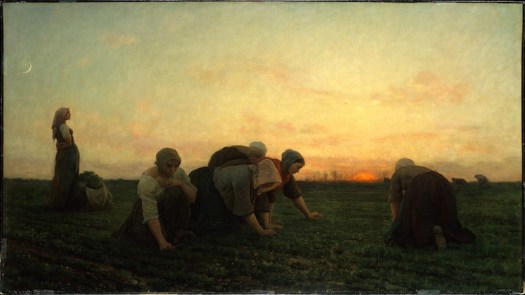
And last, ordinary lives in painting (was looking for Millet’s “The Gleaners” but found Jules Breton’s “The Weeders” at the Met’s site.) Similar theme and style.
Get yourself over to the BBC Radio 3 website where you can listen to every concert of the world’s greatest classical music festival, The Proms. Tonight’s opener is Tchaikovsky, Prokoviev, and Elgar (his luminous cello concerto).
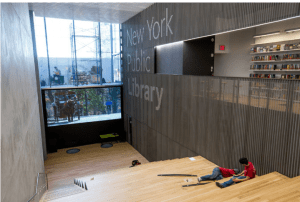
New York Public Library has just re-opened its 53rd Street branch (replacing the old Donnell Library). Justin Davidson in New York Magdoesn’t much care for it…
Glance in from the sidewalk, and the eye falls on a set of blond-wood terraces that go cascading into a cave, between walls of metal slats and raw concrete. The vibe mixes the slovenly with the dictatorial. On the steps, felt discs — four per row, not really plush enough to qualify as cushions — demonstrate where to place one’s behind, but in the end most people sprawl or hunch. Neither is especially comfortable. This narrow buried amphitheater gives library patrons a split-level vista: above, a rat’s-eye view of the street and passers-by; below, a wide screen playing a promotional slideshow for New York and its libraries. Architects love choreographing such chance urban spectacles, but this one enjoys a special kind of pointlessness.
The Times was less critical adopting a wait and see stance and pointing out that the community space function of the library might be very well served by the innovative design.
As a bookish type, I share some qualms about thinning the collection out during a renovation (but it’s been happening for decades and probably centuries). On the other hand it looks like an intriguing space to me, perhaps pointing towards some new directions of what a library can be. As John Cage said, “I can’t understand why people are frightened of new ideas. I’m frightened of the old ones.” I’m looking forward to checking it out when I’m up there next, and seeing how it compares to the plans for the new MLK Library in D.C.
Great piece at NY Mag about the reinvention of the Washington Post, including some fine-grained reasoning on just what is or isn’t clickbait.
“Some Post journalists worry that the Amazonian values of growing an audience by giving the customers what they want could conflict with journalism’s civic mission to report on unpleasant truths. “There’s gallows humor: Are we selling our soul for traffic?” says one longtime Post staffer. Veteran Post journalists have been spared traffic quotas, but junior employees who blog for the website feel the pressure to produce with great frequency. Baron disputes the criticism that the Post has employed so-called clickbait to juice readership. “The way I would define it is, it has a headline that tries to trick you to read the story and when you get to the story there’s nothing of any substance. I don’t think we have any of that,” he says. “I know what’s generated the traffic here. And it isn’t clickbait.” Clickbait or not, it’s clear that the Post is playing a volume game, publishing a vastly higher number of stories than its competitors. According to a recent analysis, the Post, which has a newsroom of about 700, generates 500 stories per day, compared to 230 at the Times, whose newsroom has about 1,300 employees. That’s also about twice what BuzzFeed publishes daily.”
We could use a “Citizen Bezos” just now…
The whole thing is worth reading; makes the point that in addition to the gee-whiz stuff, there is an old story, namely an immensely rich person buying and retooling a newspaper.
A friend pointed me to Allan Kozinn’s take on a recent dust up in the little world of classical music criticism in newspapers. A reviewer filed a notice of a production of a rare Rossini opera, liked most of the singing, disliked the production, got a couple of trivial things wrong, one a straightforward photo credit (whether that was him or not is unclear), and then things spiraled out of control.
A blogger before his time?
The opera company PR person asked the paper to correct the errors, and this escalated to charges and counter charges, with the review disappearing and then reappearing on the web, with accusations against the editor, complaints about the critic, attacks on the company for meddling with coverage, and finally the resignation by the reviewer.
Most of this is neither new or newsworthy. In thirty years of writing reviews on and off (and a couple decades more of reading them), I can remember incidents–a couple uncomfortably personal–of PR flaks complaining, something they have every right to do. I also know first hand that editors change reviews, one hopes for the better, and spike reviews, including probably the most damning (but amusing) one I ever wrote. Something they too have a complete right to do.
It’s easy to forget that reviews are a (admittedly somewhat oddball) species of journalism, and that even critics are ultimately subject to the authority of editors. The best professional decorum would be not to complain publicly on either side. Certainly, artists rarely gain from complaining about subjective opinions–something Berlioz, himself a critic was on to–nor do I think writers stand to gain from publicly complaining about their editors, no matter the merits of the beef. Gripe privately, but abjure public second guessing about what should or shouldn’t have been done. To talk about “sides” is to talk past the issues a bit, and seems to me to indicate the game has already been lost. But if you have to draw them up, to me at least, the editor isn’t completely on the writer’s side, nor the source’s side, nor even the reader’s side, but stands in the middle of these and other forces, including standards and practices of the publication.
And judging from this story, and the disdain everybody–including the flak–is eager to drop on the hapless editor, the thing that most strikes me is the front row view of what a crappy job it must be to be an arts editor of a print publication. For starters, you are manning your oar solo in the leaking boat of print journalism. In this case, it doesn’t like sound the editor was equipped to know whether the concerns about the reviews in general were valid. He wasn’t experienced on this kind of desk–but I can’t imagine getting anything but a blank stare if I approached an editor at a major daily and said “what do you make of opera company x’s take on our coverage and their claim about our reviewer’s dislike of Regietheater?”) Maybe once upon a time that could have been a discussion about what was interesting about the question, reasonable and fair for the coverage, and maybe a feature or interview might have grown out of it. Now? Don’t make me laugh.
What the editor did do is make the point that he would like to cover the arts and perhaps tapping media was away to increase interest beyond the passionate few. That is the way forward. Classical coverage’s death in news papers is lamentable (but not that lamentable) and hot diatribes, whatever else they do, don’t make it any less dead. But as the piece points out, rich media-based reviews could draw on a new generation of journalists and might–God help us–actually get some of a new generation of audiences interested. There are questions about the technology, rights, and attitudes of the performers. These are non-trivial, but the fact that tens of millions of people view media-based reviews of films and video games on YouTube suggests that at least some of the technical obstacles are surmountable, and some artists are doing this for themselves. No doubt, some bloggers and web publications are already on it as well, and on the front-end, arts producers and presenters have started using media creatively for education and outreach. (For me, reviews always had a “back end” educational goal anyway. I write a lot of program notes, which are reviews in reverse and with out the snark.)
That newspapers are past their sell-date makes me sad. And reading my morning Post gets more and more like some kind of exercise in historical reenactment. (“How did you get your news in the olden days, gramps? Well, sonny, this person delivered a parcel of rolled up paper to our door and we sat in a chair turning pages as we drank our coffee and shared amusing items with one another.”) But having written hundreds, I’m certainly not going to mourn the demise of the overnight review. If its death hastens a better way to cover music, and engage people, bring it on.
Nice essay on the value of the humanities by the lit prof, Arnold Weinstein, with this gem,
“How much do you know about Shakespeare,” I once asked a friend who has committed much of her life to studying the Bard. She replied, “Not as much as he knows about me.” Remember this the next time someone tells you literature is useless.”

 Unnecessary Woman, a novel in the first-person about a reclusive reader and translator, Aaliya, holed away in an old apartment building in Beirut who starts out every Jan 1 on her new translation project. Something, when complete, she just shoves in a box and stores.
 Next, Lotte Lenya singing Weill’s “September Song.” Weill was lucky with his collaborators (although I guess he loathed Brecht with the force of a thousand suns). Here the graceful lyrics are by the playwright Maxwell Anderson, and the song comes from a mostly forgotten musical called Knickerbocker Holiday. Lenya’s dusky voice is the opposite of Tomowa-Sintow’s gleam, but at the same, her singing makes you think she’s sitting right across from you in a Berlin cafe, beguiling you through the cigarette smoke.



 evel vista: above, a rat’s-eye view of the street and passers-by; below, a wide screen playing a promotional slideshow for New York and its libraries. Architects love choreographing such chance urban spectacles, but this one enjoys a special kind of pointlessness.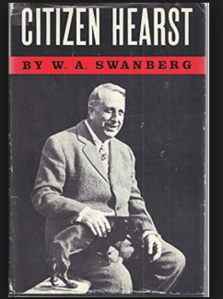


 A Few Reasonable Words