The Sensor Society: Invisible Infrastructure

So much about the Internet age has turned out to be vexing–a far cry from my enthusiasm a generation ago, shared by many nerds, for a utopian future of connectivity and a library of one’s dreams.

“I would not open windows into men's souls.” — Attributed to Queen Elizabeth IHard to know where to start with the disappointments and fears, but one that particularly nags is the feeling that we are building (with our eyes closed and tacit consent) an infrastructure that monitors our every move, encasing every one of us in a personal surveillance state, in return for the convenience of carrying a connected device everywhere we go.

Australian Prof. Mark Burdon has termed this the “Sensor Society,” the notion that passively, without our knowledge or consent, and for unknown purposes, everything we do becomes raw data for commercial discovery (and possibly for government snooping). This follows inevitably from the “always on/always connected” world, but is it too high a price to pay?

The entire interview is worth reading, but herewith a few bracing bits:

Q: What are the implications if sensors completely permeate society?

A: Well, it’s not necessarily just about the complete permeation of sensors. Rather, the greater implications regard the emergence of pervasive and always on forms of data collection. The relationship between sensors, the data they produce, and ourselves is important to understand.

For example, sensors don’t watch and listen. Rather, they detect and record. So sensors do not rely on direct and conscious registration on the part of those being monitored. In fact, the opposite is the case. We need to be passive and unaware of the sensing capabilities of our devices for the sensors to be an effective measurer of our activity and our environments.

Our relationship with our devices as sensors is consequently a loaded one. We actively interact with our devices, but we need to be passively unaware of the sensors within our devices. The societal implications are significant—it could mean that everything we do is collected, recorded and analysed without us consciously being aware that such activities are taking place because collection is so embedded in daily life.

Q: How would you recommend someone learn more about the impact of living in a sensor society?

A: Look at your everyday devices in a different way. Behind the device and the sensor are vast and imperceptible, invisible infrastructures. Infrastructures of collection enable the explosion of collectible data and infrastructures of prediction enable understanding and thus give purpose to sensors. Otherwise, sensor-generated data without an analytical framework to understand it is just a mountain of unintelligible data.

The sensor society, therefore, redirects us towards the hidden technological processes that make data collection capture, storage, and processing possible. This, in turn, highlights the importance of understanding relations of ownership and control of sensors and the infrastructures in which sensors operate. So when you’re at home with your devices, realize that you are not alone and just think about those invisible infrastructures that are also present with you. Then question to ask then is: What data is being collected, by whom and for what purpose?

Our metadata, ourselves… how are we ever to be left alone? He’s got a good TedX talk as well.

“[The framers] sought to protect Americans in their beliefs, their thoughts, their emotions and their sensations. They conferred, as against the government, the right to be let alone-the most comprehensive of rights and the right most valued by civilized men.”  — Louis Brandeis

Roll Your Own Film Series

Washington’s Building Museum, one of the city’s often overlooked gems, recently had an Architecture & Design Film Festival that I unfortunately missed.

I have already seen Columbus, which I recommend design minded, about the meaning of a city and outlining low-key relationships that rang true. (It helps perhaps that I have been to some of those buildings in Columbus, IN, and they are remarkable.)

In the process of looking up the others, found that all of Workplace, Gary Hustwit’s film about the creation of new quarters for NYC’s R/GA (a big deal ad agencies/design firms) is available, if and you liked Huswit’s Helvetica (which I loved), you’ll enjoy it. It starts a bit like an RG/A infomercial, but clearly Hustwit got editorial control. The principals say their piece (including candid meeting footage with Norman Foster) and so do those people who can’t believe what is being foisted on them!  Crisply done and worth a watch if you are interested in architecture and design.

The Gluck Berlioz connection

Composers frequently find touchstones in earlier composers, but few seem to manifest as direct a lineage (or in some ways as surprising) as Hector Berlioz’ connection with the music Christoph Willibald Gluck, whom he venerated above all opera composers.

“There are two supreme gods in the art of music: Beethoven and Gluck. The former’s realm is that of infinite thought, the latter’s that of infinite passion; and though Beethoven is far above Gluck as a musician, there is so much of each in the other that these two Jupiters form a single god, and all we can do is to lose ourselves in admiration and respect for him.”

In his study and scholarship on the Gluck scores (already old-fashioned in Paris during Berlioz’s era),  a musical revolutionary composer found common cause with a master of classical equilibrium. Here is Gluck from Iphigenie en Tauride, Regine Crespin singing “Cette nuit … O toi qui prolongeas mes jours“) (Iphigenia always brought forth magic from him–he pretty much owns the doomed classical heroine fach.)

And then, from Berlioz’ The Trojans (as classical a theme as Gluck could have wished for), the duet for Dido and Aeneas that closes Act III. More doom, more beauty and radiance.) A performance with Susan Graham and Gregory Kunde.

“I assure you, dear sister, that the music in Les Troyens is something noble and elevated; it is also compelling and truthful, and if I am not much mistaken there are a number of novelties which will arrest the ears of musicians throughout Europe and perhaps make their hair stand on end. It seems to me that were Gluck to come back to life, he would say of me on hearing the work: “Here in truth is my son.” Hardly modest, you will say. But at least I am modest enough to admit to be lacking in modesty.”

Commonplace Book: Anne Enright

The Irish novelist Anne Enright, with a meditation on Genesis and the evolution of blame. Excerpt below.

She goes on to evoke everything from Milton to Twitter, with her usual lightly worn, but amazing wit and erudition. The whole thing is worth a read.


From the Metropolitan Museum

The story of the Fall is one of the most enduring stories we have, and it is never fair. You could use it as a template for a certain kind of novel: put a choice in there, tip the balance, make the consequences so disproportionate we doubt our sense of cause and effect, make them suffer, make them into better human beings. Visually, the narrative is brilliantly successful, for being so easy to hold within a single frame. There is nothing static about the way the viewer sees an image of the first couple considering apples. It is a moment of great tension, and they are wearing no clothes. So, to the rules for writing a successful fiction, we might add, pretend that it is not about sex, make the world symbolic, expand the small asymmetries. Here are two human beings who are slightly, but perhaps disastrously, anatomically different. She likes something long, he likes something round – what could possibly go wrong?

The story is a riddle about authority and predestination that has survived the theological palaver of generations because, simple to the point of transparency, it is also impenetrably self-enclosed. It is held in a brilliant web of balance and contradiction by a few hundred words; so it is worth looking at those words and what they actually mean.

Just to be clear: there was no seduction. There was no devil, nor any mention of Satan, who was, at this stage, an unimportant figure. Although he played a sporadic role in the torment of Job, or in the temptation of Christ in the desert, Satan was not a mythical force before the bestiary of Revelations, and the rebellious Lucifer was some other angel until Milton came along. The idea of a great battle between light and the forces of darkness did not get going until early Christian times, possibly because this small, persecuted sect needed to find a great spiritual enemy against which to pit themselves. The creature in Genesis was just a snake, and though he was crafty, he didn’t seduce, nor did he ‘tempt’ Eve – this last term means ‘to test’ and is used only once in Genesis, when God tests Abraham, requiring the sacrifice of his son Isaac. So Eve did not tempt Adam, either, nor was he seduced by her nakedness. There is, in fact, very little sex in the story. Our readings of it are all subtext, all interpretation, all error.

Fred, Ginger, and Frank

When it’s all too much–a mode I fall into more and more, & alas not without reason, I happen on something like this, which offers a glimmer of hope.

Somehow makes me think of a line by the poet Frank O’Hara,

“I can’t even enjoy a blade of grass unless I know there’s a subway handy, or a record store or some other sign that people do not totally regret life.”

You can’t imagine Fred and Ginger regretting life.


How Long is the Coastline of Britain?

I’m reading a charming “slow travel” memoir by Dan Kieran, and came across this passage (reflections during a period that he and two friends took a milk float across southern England) about the paradox of measuring the coast of the island, and pointing the way (although Kieran doesn’t mention it) to fractals.


At the time I was going slightly mad, but when I got home a friend pointed me towards the paper called ‘How long is the coast of Britain?’, published in 1967 by a mathematician named Benoît Mandelbrot. It suggests that the depth of your journey–in terms of how closely you perceive it–really does increase its length in mathematical terms. The answer to the question posed by the paper is that there is no answer. It’s a paradox because the length of a coastline depends entirely on the way you measure it. It comes down to context, and the context in which you perceive something is a function of the brain.

To explain the coastline paradox you first have to accept that there is a definitive geological coastline of Britain, which would depend on high or low tide and all manner of other variables. Assuming you’re prepared to accept this, you then have to imagine measuring this coastline with a three-foot ruler. You would, eventually, come up with the coastline’s length. But what if you then repeated the experiment with a one-foot ruler? The smaller ruler would give you a greater distance because you would be able to get into lots of nooks and crannies that the three-foot one would have to stretch across.

Now you’re probably thinking, ‘Well, fine, but if you went down to a one-inch ruler you get an even greater distance. At least that would be accurate though, because you can’t get smaller than a one-inch ruler.’ The problem is, of course, that you can. You can shorten the ruler over and over again, going deeper and deeper, getting smaller and smaller, and the length of the coastline will increase each time. So there really is no definitive answer to the question. It’s a rather disconcerting thought, isn’t it? We all work on the assumption that the real world is defined according to measurable things, but once you begin to focus on it, the act of measurement itself becomes fraught with uncertainty.

Teaching as a Craft: Bansho-Keikaku

On and off in my life, I’ve been engaged in what might be called ‘comparative pedagogy’ –that is, looking at different ways of teaching and learning topics, most typically math, which, in addition to being a favorite subject of mine, has been the subject of intense educational reform battles my entire life.

I’m not going to wade into those fights, but am sharing one fascinating thing in comparative math teaching that I learned about doing a project a few years back on problem solving (an explicit part of the much debated Common Core standards).

Teaching problem solving in a typical U.S. classroom, indeed even what we think of as a problem for math class, can differ from what is presented in other countries. In Japan, problems, even at early grades have more conceptual richness, requiring a ‘puzzling out’ period, not just an application of a procedure. And when a teacher works with a class to teach a problem, he or she plans out how the entire problem will be written out progressively on the board (using chalk, not an overhead) and taking a substantial portion of the class time.

By the time this interactive work is complete, the group’s thinking about the problem will be visible on the board it its entirety.  Part of the planning for this, is the teacher’s planning how to present it, Bansho-Keikaku, and it is part of the lesson study that Japanese education is so well-known for.

A guest post on Larry Cuban’s great blog explains more about this board writing and what it accomplishes.

It isn’t just math class that relies on this practice, but the humble chalk and chalkboard when used with skill intention brought coherence to other disciplines too. A representative quote.

“Most importantly, teachers carefully preserved a lesson storyline as they progressed across the board. They added elements in a strategic sequence that helped bring coherence to the lesson, and rarely erased content unless they reached a major instructional transition.”

I have seen (although never had) teachers in the U.S. who had this kind of skill and approach, but it does seem like a rarity here, and a missed opportunity.

Commonplace Book: Alexander McCall Smith

Alexander McCall Smith (of theThe No. 1 Ladies’ Detective Agency series among many other books) has penned a gentle tribute to W. H. Auden. He’s an enthusiast rather than a scholar in my view, and these “How writer x can change your life” usually leave me cold (is there nothing that can’t be instrumentalized into self-help, even reading for pleasure?)  But this effort charmed me. Here he is recalling a trip to a speaking engagement in Perthshire, Scotland, a beautiful landscape that sets up his claim for the central role books play in the Scottish character.


The library lay at the end of the Roman Road, surrounded by fields in which wheat and barley were yet to ripen—lush green paddocks half-hidden by unruly hedgerows. Rioting nettles, clumps of blackthorn and rowan, wide-leafed docken grew along the side of the road until suddenly we reached an old schoolhouse and an ancient graveyard of weathered gray stones. The organizers appeared and introduced themselves, and I was taken to see the library before the guests arrived.

Belief in the word can assume the qualities of a religious faith. At the time when Lord Drummond built this place to house his precious collection of books, Scotland was prone to outbreaks of lawlessness and fierce local enmities. The lives of many were lived under the heel of powerful local clan chiefs who administered rough justice. Life was hard in every respect: this was not the rich landscape of settled England—Highland Scotland was a place in which people scraped a living and more often than not went to bed hungry.

It was a place of strong religious views. The Scottish Reformation was late but had been passionate and had brought with it a commitment to the setting up of a school in every parish. What later came to be seen as a strong Scottish commitment to education had its roots in the late sixteenth and early seventeenth centuries. Books were the instruments of truth. Books were the means by which the poor could free themselves of what Auden once described as “the suffering to which they are fairly accustomed.” This attitude toward books has stubbornly survived in Scotland, mirroring, perhaps, the Irish attitude to music: both are consolations that will, in their individual way, always see one through.

Bad Reviews: John Simon

I’m long, and gratefully, out of the arts reviewing game. (Despite an occasional lapse).

When I was doing it regularly,  an editor once told me my positive reviews were, atypically, better than my negative ones. Don’t know why, certainly for me the really bad review is a guilty pleasure, probably for others too. (Seems like it keeps Anthony Lane employed at the NYker. I’m not sure he honestly knows that much about movies, but the man knows how to pan a film.)

One of the great ‘left it for dead’ masters was John Simon of New York Magazine, who really let you know when he hadn’t liked something.

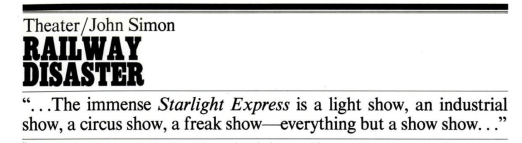
Here he is from 1987 on Andrew Lloyd Webber’s Starlight Express (the one with the roller skates). This is a piece, like Tom Shales interview of Phyllis George, that newspaper folk handed around to one another. Lodestones that point towards a not particularly admirable compass point, but point they do.

It would be best if children remained small,’ concludes Erich Kästner’s charming poem ‘A Mother Takes Stock.” This is even truer of model trains, which should not exceed the size of a small puppy and definitely should not be anthropomorphized as they are in the ghastly juggernaut of a musical from Britain, “Starlight Express.’

The conceit (in both senses of the word) is to put seeming adults on roller skates and make them pretend they are trains competing in a trans-America race imagined by a child, whose taped voice narrates the event. The repetitious preliminary heats and self-contradictory main races cannot be followed; the story is ludicrous and confused. Just when the trains veer into humanity, they become derailed into nonsense; just when the humanoids achieve some trainlikeness, they become choo choo cute.

Also immense and monstrous. The set—really an environment—is a huge, three-tiered track that winds across lowering and revolving bridges, around platforms that rise from a central declivity where most of the action takes place, and along winding paths that encircle two pockets of spectators but do not have the decency to envelop the entire audience (as they did in London) and thus at least occasionally be visible only on small TV monitors. Here the entire vertical three-ring circus is always in full, fulsome view, bespangled with garishly colored lights to put the brashest discotheque to shame, with characteristic bits of American cities from coast to blinking coast flaring up fitfully. And the often deafening sound is the most denatured, unnatural, dehumanized clangor ever to hit Broadway. Starting with that child, a mere computerized voice (the real boy, Braden Danner, has the good sense to be the live Gavroche up the street in ‘Les Misérables’), everything sounds canned. Hordes of performers whizzing about on skates have to be lip-synching, but even on the occasions when someone stands still long enough for a viva voce song, elephantine electronics make it all clank and clatter like a can tied to the Great Bear’s tail. [ARS: what would Simon make of today’s Broadway amplification?]

Witnessing ‘Starlight Express’ is to feel trapped inside a gargantuan tape deck while watching a Brobdingnagian Erector Set go through the most elaborate mechanical gyrations. The human performers railroaded into the show have to be actors, singers, dancers, roller skaters, and, considering the danger to life and limb, Evel Knievels, which is too much to expect of anybody, and so no one quite manages to huff and puff up to snuff.

The plot is simplemindedness itself. The insomniac child envisages a race through America for a shining silver dollar. There are trains from various countries, e.g., a Japanese bullet train, an Italian espresso (that’s the humor of it), etc., but the musical and dramatic possibilities of multinationality are promptly dropped as we concentrate on Rusty, a nice American steam engine that competes against a nasty American diesel called Greaseball and a campy, outer-space electric train, Electra, both of whom steal his pretty but fickle female tender, Pearl, as they try to trip and elbow him out of the race, sometimes using the services of the treacherous and androgynous Red Caboose, a cross between the Joker of ‘Jeu de cartes’ and Anybody’s from ‘West Side Story’—but, then, everything here is really from somewhere else.

Since the concept and music are by Andrew Lloyd Webber, who, as we know from ‘Cats,’ likes to go metaphysical on us, there is also God. Assuming the disembodied gospel-singing voice of Poppa, Rusty’s earthly father, this is the eponymous Starlight Express, appearing as a light show in the starry sky, who might as well be called I Am That I Amtrak. The mentality of the piece, as written by Lloyd Webber and his doggerelist Richard Stilgoe, is resolutely reactionary. Steam wins out over diesel and electricity (a curious position for a show that depends wholly on computers and state-of-the-nonart electronics), and women are neurotic or simpering tenders, sleepers, dining or smoking cars, the male locomotives’ subservient playthings or prostitutes (“I’m a sleeper with a heart of gold”) who, in a typical dance sequence, get kicked in the rear by Greaseball, for whom they bend over backward.

Lloyd Webber’s tunes are scavenged from all over, not least from Lloyd Webber, though here and there a patch of melody fleetingly pleases. Stilgoe’s lyrics tend toward things like “Was I corroded/Or overloaded?” “The coach I thought was going with me,/She up and joined electricity,” not to mention grating repetitions of “Freight/ Is great.” John Napier’s scenery and costumes here lean toward excess, as in “Cats,” but Meccano lovers should exult in them; David Hersey’s lighting just about twists itself inside out to come up with fancier effects (some compelling, some merely frantic), and the skating and break dancing by Arlene Phillips, though not up to what one sees in the streets outside the theater, has its moments. Trevor Nunn’s direction is pretty obvious here, and among the performers, only Reva Rice, Jane Krakowski, Greg Mowry, Steve Fowler, and Andrea McArdle come off passably [A few names that have continued in lights since then]—but, then, no one has much of a chance with an orchestra piped in from a “specially designed ‘orchestra room’ off stage” and very possibly on Mars.

“Starlight Express” is a tale told by an idiot with son and lumière. It is a light show, an industrial show, a circus show, a freak show—everything but a show show. It belongs in a sports arena, exhibition hall, or oversize discotheque; all it can do in a theater is cheapen it. But the audience palpitating around me was entirely apposite: They looked and behaved like people who had never been to a theater, and “Starlight Express” is guaranteed to do nothing to change that. Perhaps the most characteristic thing about it is a sign reading RALIEGH [sic], for this is postliterate or, at any rate, illiterate theater.