Beautiful Pictures: Hugh Mangum

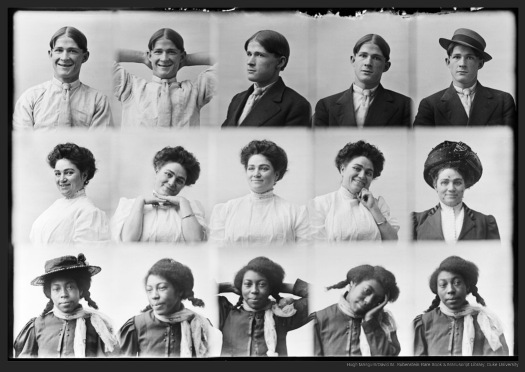
The NYTImes Lens blog has a feature on an unknown Reconstruction-era photographer named Hugh Mangum, who took “penny pictures” of ordinary people.  I thought the title came from sitters paying a penny for a photo, but apparently it refers to the camera itself.

His portraits, presented many on a page, are full of life. I couldn’t help wondering about the stories of the individuals and the relationships.  A nice find.


Screen Shot 2013-09-07 at 3.25.55 PM

Here’s the type of camera he used.

The “Penny Picture Camera.”


And there are more of his photos at Duke University Libraries’ Digital Collections.

Beautiful Music: Two Symphony Broadcasts

The BBC Proms are wrapping up: “Last Night at the Proms,” usually a rowdy blast of a concert, is tonight in London at 7:30 pm, that is, now, and available live and for 7 days on the BBC site. Joyce DiDonato is the star, with everything from Handel to “Over the Rainbow,” which she added for political reasons.

Screen Shot 2013-09-07 at 2.14.46 PM

Promises to be a great show.

The All-Star Orchestra is kind of an all-state for grown ups, and bows on PBS tomorrow. It’s the brain child of conductor Gerald Schwarz and seems, atScreen Shot 2013-09-07 at 2.17.44 PM first glance a least, to be less of a sure bet. Although any effort to get classical music on television in good in theory,  neither Tony Tomassini’s take in the Times, “Schwarz…. no one’s idea of a probing maestro,” and the premise itself–that bringing a bunch of first chair stars together is a recipe for something special–does much for me.  Still, I’ll give it a try, and report back.

Poetic Words: Library Verse

Given my love of libraries and poetry (and the fact that there was at least one great poet, Philip Larkin who was also a librarian), odd that I haven’t posted anything on the intersection of these worlds.  But here’s a nice one by American poet Rita Dove.

Maple Branch Library, 1967

For a fifteen-year-old there was plenty
to do: Browse the magazines,
slip into the Adult Section to see
what vast tristesse was born of rush-hour traffic,
décolletés, and the plague of too much money.
There was so much to discover—how to
lay out a road, the language of flowers,
and the place of women in the tribe of Moost.
There were equations elegant as a French twist,
fractal geometry’s unwinding maple leaf;

I could follow, step-by-step, the slow disclosure
of a pineapple Jell-O mold—or take
the path of Harold’s purple crayon through
the bedroom window and onto a lavender
spill of stars. Oh, I could walk any aisle
and smell wisdom, put a hand out to touch
the rough curve of bound leather,
the harsh parchment of dreams.

As for the improbable librarian
with her salt and paprika upsweep,
her British accent and sweater clip
(mom of a kid I knew from school)—
I’d go up to her desk and ask for help
on bareback rodeo or binary codes,
phonics, Gestalt theory,
lead poisoning in the Late Roman Empire,
the play of light in Dutch Renaissance painting;
I would claim to be researching
pre-Columbian pottery or Chinese foot-binding,

but all I wanted to know was:
Tell me what you’ve read that keeps
that half smile afloat
above the collar of your impeccable blouse.

So I read Gone with the Wind because
it was big, and haiku because they were small.
I studied history for its rhapsody of dates,
lingered over Cubist art for the way
it showed all sides of a guitar at once.
All the time in the world was there, and sometimes
all the world on a single page.
As much as I could hold
on my plastic card’s imprint I took,

greedily: six books, six volumes of bliss,
the stuff we humans are made of:
words and sighs and silence,
ink and whips, Brahma and cosine,
corsets and poetry and blood sugar levels—
I carried it home, past five blocks of aluminum siding
and the old garage where, on its boarded-up doors,
someone had scrawled:

I can eat an elephant
if I take small bites.

Yes, I said, to no one in particular: That’s
what I’m gonna do!

———————————————————

Turns out Larkin did pen one:

 Library Ode

New eyes each year
Find old books here,
And new books, too,
Old eyes renew;
So youth and age
Like ink and page
In this house join,
Minting new coin.
 
————————————
 
Although, as a heavy user, I have multiple suppliers, for many years my main library was the Somerville Central Library, quirky but with its own kind of hipster grandeur. Somerville Library

Happy Labor Day

Hope your Labor Day was enjoyable–and free of labor!


Screen Shot 2013-09-02 at 5.37.09 PM

MadeInAmerica-Forever-Block12-BGv1

More about the holiday at the Smithsonian Blog: http://blog.americanhistory.si.edu/osaycanyousee/2012/08/the-making-of-labor-day.html.

“Labor Day, in its origins a 19th century celebration of the dignity of work, swiftly evolved into today’s pleasant pause at the end of summer before the coming of new, chillier seasons and life indoors. Arguably a response (in the United States, Canada, and an assortment of other countries) to the widespread socialistic celebration of Mayday, which coincides with the age-old rituals of spring, Labor Day sets off the New World, or at least North America, from the traditions of the Old.”

Remembering Seamus Heaney

Reading the many obits and tributes for Seamus Heaney has been occupying my time. The NYTimes obit is great; herewith, a few choice bits:

The eldest of nine children of a cattle dealer, Seamus Justin Heaney was born on April 13, 1939, at Mossbawn, his family’s farm in County Derry, west of Belfast. The farm’s name would appear throughout his work. Mr. Heaney’s intoxication with language, he said in a 1974 lecture, “Feeling into Words,” “began very early when my mother used to recite lists of affixes and suffixes, and Latin roots, with their English meanings, rhymes that formed part of her schooling in the early part of the century.”

Later in the lecture, he ventured an alternative scenario: “Maybe it was stirred by the beautiful sprung rhythms of the old BBC weather forecast: Dogger, Rockall, Malin, Shetland, Faroes, Finisterre; or with the gorgeous and inane phraseology of the catechism; or with the litany of the Blessed Virgin that was part of the enforced poetry in our household: Tower of Gold, Ark of the Covenant, Gate of Heaven, Morning Star, Health of the Sick, Refuge of Sinners, Comforter of the Afflicted.”

More on Heaney from around the web:

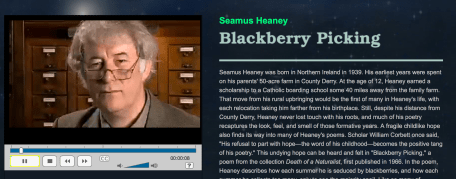
From WGBH/PBS’s Poetry Everywhere, a Poetry Break with the poet reading “Blackberry Picking.”
Screen Shot 2013-09-02 at 9.43.07 AM

And a long, rewarding ramble of a piece by Andrew O’Hagan from the LRB about a trip he, Heaney, and Karl Miller, the founding editor of the LRB and long-time friend and publisher of Heaney, took around 2000 I think. They set out to drive around the Celtic Lands, drinking attending to the “ground of literature” and the ground itself. One of the best things I’ve ever read in the paper: given the LRB’s level of writing, that’s saying something.

One of many fine bits:

We passed by Offaly and Seamus asked me if I knew what a Biffo was.
‘No.’
‘It means a Big Ignorant Fucker from Offaly.’
I was looking out at the landscape as we drove beyond the Irish midlands. If you come from a Protestant country, where the hedges are trimmed and evened-up to within an inch of their lives, the mad tangle of Irish hedges is striking. I imagine Scotland’s hedges speak of order and repression, of a land heavily demarcated, parsed and owned, but in Ireland a certain bucolic anarchy obtains. Ireland presents itself as an entity that might again revolt against the people. The landscape appears to have a mind, a vengeful one, an Old Testament one, if you think of the potato famine.
Karl and Seamus were discussing the notion of writers being either ‘branch men’ or ‘head office’. This came from a story Seamus was telling about T.S. Eliot. Lloyds Bank decided to throw a party a few years ago for Mrs Eliot, and Seamus went as the representative poet. Some knight or other was giving a speech and he said that Eliot wasn’t the only poet ever to work for Lloyds. Cardiff’s Vernon Watkins gave a lot of time to his writing but refused to take days off, preferring to come to his desk. Then again, the gentleman said, ‘Watkins was a branch man and Eliot was very much head office.’
We stopped for lunch at a favourite place of Seamus’s called Moran’s. They gave us a table to ourselves in the snug. There was a nice bottle of Alsace and we all three had chowder. Seamus once wrote a poem after coming here, called ‘Oysters’:
We had driven to that coast
Through flowers and limestone
And there we were, toasting friendship,
Laying down a perfect memory
In the cool of thatch and crockery.

Worth reading every bit, and not behind the paywall.

And to close, a poem of his called, appropriately, Postscript. Screen Shot 2013-09-02 at 9.49.21 AM

Postscript

And some time make the time to drive out west
Into County Clare, along the Flaggy Shore,
In September or October, when the wind
And the light are working off each other
So that the ocean on one side is wild
With foam and glitter, and inland among stones
The surface of a slate-grey lake is lit
By the earthed lightning of a flock of swans,
Their feathers roughed and ruffling, white on white,
Their fully grown headstrong-looking heads
Tucked or cresting or busy underwater.
Useless to think you’ll park and capture it
More thoroughly. You are neither here nor there,
A hurry through which known and strange things pass
As big soft buffetings come at the car sideways
And catch the heart off guard and blow it open.

Haydn by two

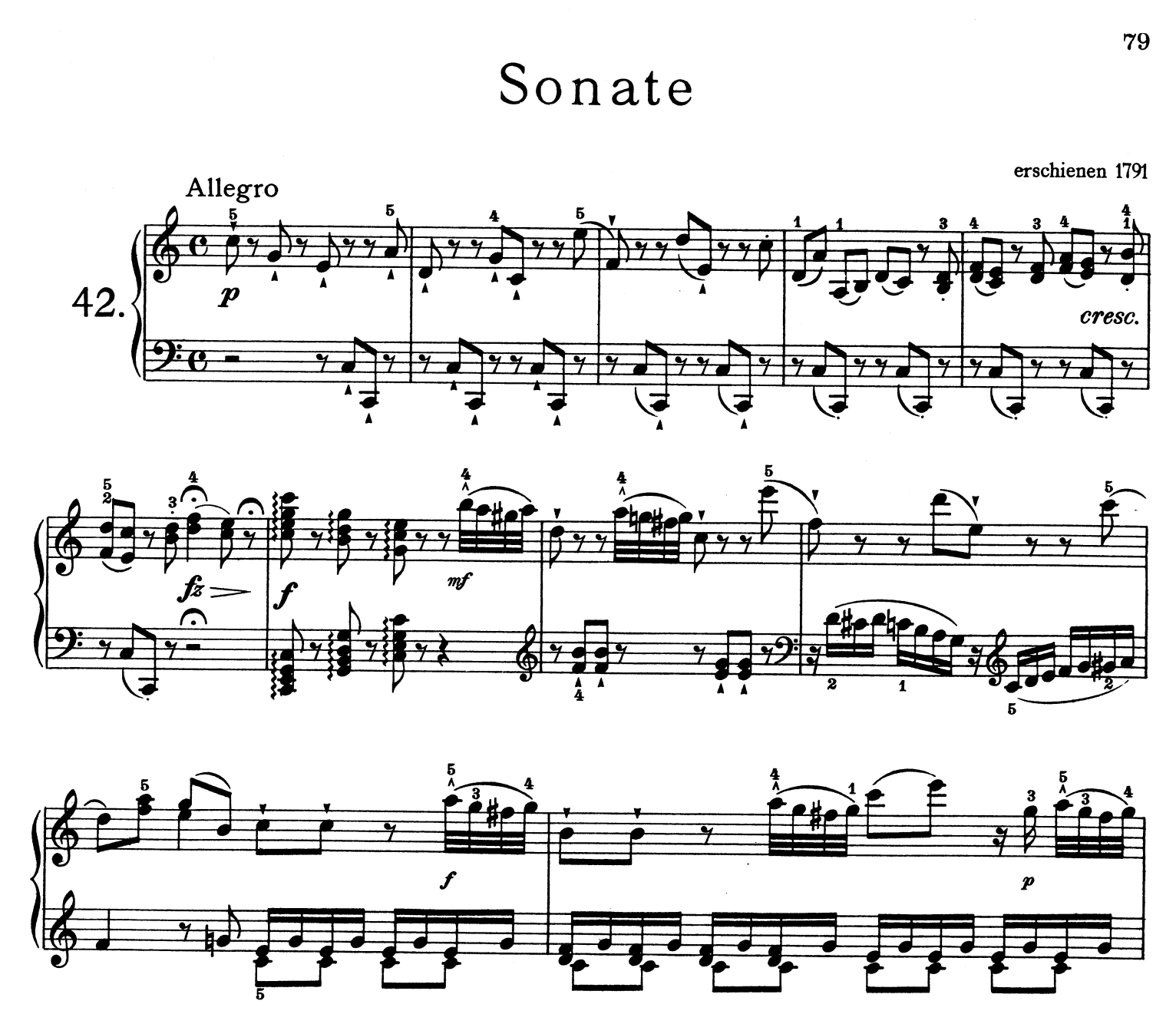
Haydn Sonata in C

Reading an interesting piece by pianist Alfred Brendel summing up his decades of making recordings, I noticed that he singled out a Haydn disc as one of his favorites. A particular delight for him was  Haydn’s Sonata in C major, Hob. 16/50. Given that I’m on a Haydn Sonata binge myself (but alas no Brendel), I thought I would check it out, quickly found the score on IMSLP and trotted through it. Brendel finds it funny, for me it’s the endless dazzling invention that engrosses, sometimes just a madcap throw away ornament or gesture.

Here is Brendel’s performance of the first movement, wonderful sleight of hand tricks at every turn, and dapper from first note to last. Overall, evinces such clarity of articulation and expression…something he was superb at and his student Paul Lewis is carrying on as a pianistic ideal.

For a contrast, listen to Sviatoslav Richter (the titan of the piano of my youth, and still a god to most classical pianists). Richter’s take on it is less droll, big sections rather than little detail. If Brendel illuminates Haydn the (merry) classical trickster, Richter gives us a Romantic and ardent Haydn, driving the same notes and (mostly the same) ornaments, a little faster and with more 19th century intensity.


Both are fine performances, and if I prefer Brendel’s (by a hair) that’s maybe because I love a good joke. Also Brendel’s playing has always had a human dimension that an amateur pianist (or at least this amateur pianist) can relate to. Richter, and others at his level, seem to be engaged in a completely different activity!

MOOC Words: Philosophers Respond

A philosophy blog I read, Leiter Reports, has an interesting thread on MOOCs and their discontents. Rebecca Kukla, a Georgetown Prof, and guest blogger, opened the topic as she is doing a MOOC at her institution.

Many familiar issues from other reporting and commentary on MOOCS: IP and editorial control/ownership, equity, future of f2f, pedagogical concerns,, but exceptionally well expressed. One of the comments mentions David Gelerntner predicting a lot of this in 1984–a claim I need to research. Anand Vaidya, among the profs who objected to the distribution of the Michael Sandel Justice course via Harvardx, weighs in too.

The thread is here http://leiterreports.typepad.com/blog/2013/08/ethical-reflections-on-mooc-making.html

Some interesting bits:

Kukla’s prompt:

In short, I think that when it comes to MOOCs we need to be having hard conversations about intellectual property, ownership of the means of production, privacy, and other complicated issues in applied ethics. And I am sure there are other hard conversations to be had as well. Mostly, my sense is that our technological capacity here is outpacing our capacity to establish thoughtful practical norms and ethical constraints on the use of this technology. Thoughts?

Part of Vaidya’s post

One point of our letter (whether or not it was clear) is that faculty with the relevant expertise in an area should have the right to be involved in the conversation and decision over whether using a MOOC at their institution for the purposes of educating the students at their university is in fact a good thing. We were not consulted in an advisory capacity over whether Justice should be taught through a MOOC, nor were we asked to make one as a way of improving education. We are against the idea that university administrators should have the power to override faculty expertise and consultation in determining course content for students. Faculty are charged with the task of debating and deciding what is best for the student population…

One thing that occurs to me is that somehow MOOCS have become a sort of “fetish object” for a range of disparate issues in education, and maybe even society at large. They are interesting in themselves, I admit, but the intensity and volume of discussion seems to me wildly disproportionate. They are vessel into which a bunch of worries, about ethics, the purpose of higher education, ownership, control, access, technology can be poured, most avidly by those who haven’t ever taken or taught an online course and have no intention of ever doing so. I’m guessing Stanley Fish falls into that category, and he added his bleating, amusing if garbled, to the fray in a NYTimes op-ed a few days back.

He closes by railing generally against social media courtesy of a bad 90s film:

Screen Shot 2013-08-29 at 5.56.47 PM

“See how isolating and empty modern life has become is the acidly comic message of the director [of Denise Calls Up]. Isn’t that great and can we please have more of it is the messianic message of Daphne Koller. O brave new world.”

I guess he won’t be accepting my FB effort to friend him any time soon. 😦

Beautiful Picture: Vintage Type on Tumblr

Some nice images courtesy of a tumblr called “Type Hunting.”

Screen Shot 2013-08-25 at 7.58.46 AM
Pre-digital typefaces, and not a single stroke of Comic Sans in sight.

Poetic Words: Anthony Hecht

Screen Shot 2013-08-25 at 7.13.11 AMReading a lot of the American poet Anthony Hecht, prompted by a long and engrossing piece on his recently published letters by Colm Tóibín in the LRB, and also an upcoming poetry book group at our neighborhood bookstore, Politics and Prose.

Tóibín puts Hecht in the genealogy of war poets (unlike Jarrell, he saw action in WWII and was deeply affected by it.)

From the review

Of the many things Jarrell said about the war, the one that seems most true came at the end of his review of Marianne Moore. ‘The real war poets are always war poets, peace or any time.’ This remark applies more perhaps to Anthony Hecht, who was born in 1923 and had published no poems before he went to war, than it does to anyone else. Hecht studied at Bard College then served in the US Army from 1943 to 1946. He saw action in Germany and Czechoslovakia in 1945 and was later stationed in Japan. After the war he studied at Kenyon College with John Crowe Ransom and William Empson (Jarrell had earlier been on the faculty; Lowell had been a student there), and in New York with Allen Tate. In the early 1950s he lived in Italy, where he became friends with Auden; later he taught at Bard College, Smith College, the University of Rochester and Georgetown. His first book of poems, A Summoning of Stones, was published in 1954. In 1968 he won the Pulitzer for his next volume, The Hard Hours. His Collected Earlier Poems were published in 1990; his Collected Later Poems came out in 2003, a year before his death.

Here is Hecht’s “Death the Poet: A Ballade-Lament for the Makers,” a poem that does not, for me at least, fit into a war poetry tradition. Belongs instead to the long list of old poets’ looking back–“laments for makers” being an idea that goes back centuries in poetry. Hecht himself notes John Skelton. The collection it’s in, Flight Among the Tombs, also has a wonderful poem mourning James Merrill.

Death The Poet
A Ballade-Lament for the Makers

Where have they gone, the lordly makers,
Torchlight and fire-folk of our skies,
Those grand authorial earthshakers
Who brought such gladness to the eyes
Of the knowing and unworldly-wise
In damasked language long ago?
Call them and nobody replies.
Et nunc in pulvere dormio.

The softly-spoken verbal Quakers
Who made no fuss and told no lies;
Baroque and intricate risk-takers,
Full of elliptical surprise
From Mother Goose to Paradise
Lost and Regained, where did they go?
This living hand indites, and dies,
Et nunc in pulvere dormio.

Old Masters, thunderous as the breakers
Tennyson’s eloquence defies,
Beneath uncultivated acres
Our great original, Shakespeare, lies
With Grub Street hacks he would despise,
Quelled by the common ratio
That cuts all scribblers down to size,
Et nunc in pulvere dormio.

Archduke of Darkness, who supplies
The deadline governing joy and woe,
Here I put off my flesh disguise
Et nunc in pulvere dormio.

Quotable Words: A Philosophical Job Description

Droll quote I encountered on the web in Philosophy: A Commonplace Book by Gerald Dworkin:

Screen Shot 2013-08-20 at 10.14.55 AM

On what philosophers do: You make a few distinctions. You clarify a few concepts. It’s a living.

Love the shrug at the end!