Happy holidays to everyone! Here is a bit of Christmas piano music that keeps haunting me. I first heard it on Naxos in a piano CD by Jeffrey Biegel, then QXR was playing it, and then it was pervading a shopping center. Odd musical message from the universe or just the availability heuristic?
Anyway, here it is: eccentric composer-pianist Percy Grainger’s setting of the Mummers’ Carol.
Still have a few more things to vapor on about for my “30 Days” music series, didn’t get to my November quota. Tempted to delay that yet again, given that it’s so hard to resist parsing the sad comedy at The New Republic. Then again I couldn’t possibly be funnier than embattled owner Chris Hughes and CEO Guy Vidra‘s own vouchsafing their steadfast stewardship of the TNR in these parlous times. I doubt they will manage, based on the ineptitude of these self-inflicted injuries and the wobbly ideas they have for advancing the paper. But they’ve become the most talked about and loathed leadership team in journalism, and that’s saying something. It ain’t much, but maybe it’s a strategy?
Anyway, </snark> and on to music.
Over the years, I have mused a good bit about practicing, and herewith put together part I of some thoughts on the topic. In addition to my own puzzle over my piano and voice practice (and more often lack thereof). This also responds to the fact that I get the occasional question from parents or adults who are thinking about taking up or reviving music lessons. These are along the lines of how to help your kids keep at it, how to do it yourself? Any tips and tricks?
To start with, I am hardly any model of a great practicer and have never been. Through luck of the draw, I found I was reasonably fluent at sight-reading music from my earliest lessons (I started piano rather late, 5th grade, and this may have had something to do with it). I don’t recall a time when I couldn’t sight read music of intermediate complexity adequately–we’re not talking about reading a Strauss orchestral score at sight at the piano the way a music brain like Renee Fleming’s can–but poking through Rodgers and Hart selections, or even a Mozart sonata–this I can manage.
Tunnel Vision
I bring up sight-reading because it has worked against my first advice about practicing. Namely, that it is all about small scale focusing in (Nancy O’Neill Breth uses the term “tunnel vision” in her useful pamphlet on practicing techniques). Lots of aspects of music and the pleasures therein are the opposite of this: taking in how a whole piece comes together emotionally, layers of melody and harmony, etc. But to get these watch parts to move, you have to take them apart and put them back again. That means breaking things down to ever smaller units, a section, a measure, or the shift of one hand from one position to the other, until you can find a successful approach.
I truly hate this kind of work, but it seems to me a question of cognitive style as much as anything else. Working at really intense level of detail, and being able to turn down the gain on everything except the matter at hand is a probably as much a native talent as any other aspect of musical ability. Oddly, it’s the complete opposite of what a music critic–something I used to be–needs, namely an intuition for the big picture. Still, that piece work is key to practicing–not its entirety–and finding a functional approach to achieving that focus is good. Interestingly, if, like me, this isn’t how you work, then you probably need to practice that kind focus in itself. It’s exhausting for those of us who don’t think that way.
Divergent Thinking
I’m indebted to a great book called “The Musician’s Way” by Gerald Klickstein, for the next insight. Namely, his observation that musical problems are “divergent” in nature, rather than fixed. By this he means that there will be many responses–theoretically infinitely many–to a particular musical problem, be it technical, rhythmic, expressive, whatever. This has helped me in particular because I always assumed two things about my piano playing until recently. 1) There was a correct fingering–some kind of platonic ideal, and 2) Whatever it was, I wasn’t doing it. This stems from a belief the problems in practicing were kind of like math exercises, 2+2=4, or learning your times tables. Sad to say, a view that my earliest piano teachers certainly seemed to endorse. But musical problems really aren’t fixed like that–even things as seemingly cut and dried as rhythms–and thinking about them that way is unproductive. Instead, trying to figure out what is going on, and going wrong, in the section–to see practicing as problem solving, is really helpful. (Klickstein’s book is loaded with other good advice, some other tidbits of which are related here.)
But It Sounds Terrible!
Accept that you don’t always (or even often) sound good or interesting when you are learning and practicing. This may be a problem that is unique to me, but I have always hated that when you are practicing it sounds to you–and to anybody who is unfortunate enough to be listening–like you can’t even play the piano while you are doing the work. You may be repeating things over and over, with no changes that are audible. It’s not uncommon for things to sound like they are getting worse rather than better as you pick apart and then resolve problems. Tolerating the emotional frustration that comes with that is hard for me, particularly since I can play a lot of other music fluently, and why not just play that?
No less a keyboard wizard than Shura Cherkassky talked about very slow practice in which he concentrated solely on whether he was putting his fingers exactly in the center of each key and that his hand motion was perfect. This was painstaking (see tunnel vision above) and required a level of ‘zooming in’ that no bystander else would understand. Yet, his results speak for themselves. (He’s 86 in this video, by the way!)
Oddly enough, I’m guessing this kind of issue comes up in anything that requires breaking down things into these ever tinier pieces. Is watching somebody practice 1000 chip shots interesting? Revising thirty, forty or a hundred drafts of a sonnet? I revise writing to the point of ludicrous obsession, sadly, without literary results equivalent to Shura’s musical ones!, and that is sort of fun. Still not there with the piano.
In part II, such things as dailiness, setting goals, and whether demanding that a kid practice ever helps.
A TLS review of a new music book caught my eye, as it began, “Everything you know about the history of popular music is, in the view of Greil Marcus, most likely wrong.”
Paul Genders follows with a nice precis of Marcus’ argument:
[The] official, non-secret history referred to is the strictly chronological one: of jazz, blues and country giving rise to Elvis Presley, who gave rise to The Beatles, who changed everything – and the evolution has continued, with next year’s sounds emerging out of this year’s, in neat linear fashion. The problem is, of course, that the music itself doesn’t work nearly as prosaically as that narrative suggests. A great piece of popular music is less a “progression of the form” from an earlier work than a “rediscovery of a certain spirit”, or even a “step out of time”; this is an artistic medium best understood not as a sequence of forward manoeuvres but as “a drama of direct and spectral connections” between performers at different moments in history. We have “no reason to be responsible to chronology”, says Marcus, when considering something that moves as mysteriously as rock ’n’ roll.
I love this, and would only add that it’s as true of “classical” music as it is of rock ‘n’ roll. Although the time span goes on a little longer, the official history is still peddling a similar progression: baroque, to classical, to romantic schools, with Beethoven, who gave rise to Wagner, who “changed everything” serving as Elvis and the Beatles.
In fact, progression in music– maybe in any art form?–isn’t ‘forward’ –it’s multidimensional, and performers and composers are always waging restoration and revolution on their predecessors and successors. Does Stravinsky’s “Le Sacre” sound old or new? Is it still new primitive or is it old primitive now? Or consider his once derided opera “The Rake’s Progress,” which converses spectrally with Hogarth, Auden, Kalman, classical and bel canto musical forms, mid-20th century harmony, and, among others, via the medium of Dawn Upshaw, one of the great singers of yet another era.
Here is her performance of the soliloquy, “No Word From Tom,” at once an old-fashion scene and aria, and music that could have been written yesterday or tomorrow.
Rosa Ponselle, considered the greatest soprano of the 20th century. She was no Wilhelmine Schröder-Devrient,
Longing for the “good ole days” is particularly prevalent in opera. I’ve come to see such nostalgia as silly, even corrosive in large amounts. After all, “the end [of opera] has always been nigh,” as Rupert Christiansen put it in a recent issue of Opera, going on to point out that “in 1834, Richard Mount Edgcumbe was unmoved by Pasta or Malibran and complained that he ‘never expected to hear again…any new music, or new singers, that will make me amends for those which are gone’; in 1906 (considered the heart of one of opera’s many golden ages), W.J. Henderson was lamenting ‘that the race of beautiful singers is diminishing with every year, and in its place there is growing up a generation of harsh, unrefined, tuneless shouters.” Guess that included Ponselle, who was 6 in 1905, Caruso, who was at the height of his powers, Claudio Muzio, Farrar, Journet, McCormack, et al and many more. Now of course these singers are dubbed the best who ever lived, and used to spank the current crop as, “tuneless unmusical shouters” or worse.
Well, there are spectacular talents in our midst; here is one I heard just recently at the Kennedy Center, the young South African soprano Pretty Yende, getting her coloratura on in a Rossini scena.
She is a natural on stage, totally communicative, and it’s also remarkable that her voice is not only fluent and supple, but huge. (Coloratura sopranos often trade agility for tonal richness and full sound, Yende, like many of the greats she is compared with and may well take a place beside, has both). She also communicates things via singing that you don’t get any other way, and believes every moment.
So much classical musical blather is about how “it used to be better.” I have done my bit in this department, and to atone will wrap up this month with wonderful performers who are active now. Today, for example, I encountered this delight, by pianist I didn’t know, Antonio Pompa-Baldi, from a tribute album to Poulenc and Piaf.
Here’s the album, talk about music with a subtle smile, and charm and style for days.
The cult of the operatic diva is one of the things that makes outsiders to opera a little curious (or put off, even). Although smitten in my past with certain singers, I am mostly past that stage, for better or worse. By midlife, you sort of find yourself saying, “they don’t make divae like they used to.” Even if this is perhaps not an entirely bad thing, when one of the genuine articles departs, it’s something to note.
The soprano Magda Olivero was one of these inimitable ones. She died this September at age 104, and Ira Siff captures what she was all about in his Opera News appreciation, well worth reading. Here is an excerpt from his tribute, describing her Met debut at an age when many opera singers are long since out to pasture in Bloomington or some such place.
But it was not until 1975, at the instigation of her great admirer Marilyn Horne, that the Met finally invited Magda Olivero for three performances as Tosca. She made her debut soon after her sixty-fifth birthday. Although the audience was wildly demonstrative, this was no mere nostalgia event. After a few minutes to warm up and conquer nerves, Olivero’s voice was astonishingly fresh, shedding decades by Act II. At the second performance, this listener was treated to the most touching, spectacularly sung “Vissi d’arte” of his experience. During Act III, Olivero’s ascent to a spectacular, lengthy high C and plunge down two octaves into chest voice on the line “Io quella lama” earned her a spontaneous ovation. This old-school audience response was inspired by the artist’s old-school stage deportment; it was an evening that, in the best sense, turned back the clock whenever she was onstage. Olivero’s total belief in the reality of the drama prevented her performances from ever being reduced to shtick. And her prodigious technique and breath control spoke of a bygone era, but one in which she was unique among veristas, none of whom matched her vocal capabilities.
You can find a pirate of the Vissi d’arte in question online, as well as the NYTimes notice.
Oddly, I found this bit of “The Cherry Duet” from L’Amico Fritz from some Italian TV show more touching, not least for the smile in her voice that her sweet toned tenor evokes.
It’s all a bit odd, and not voices that you’d cast today; (nor would you hear an opera duet on a general interest TV show for that matter.) But you feel with her, and with him too, that you know a bit about them through their singing, and that bit you know is authentic.
Yes, I realize I have got to catch up with my daily posts, and for today a terrific performance of Astor Piazzolla’s “Libertango” arranged for 4-hand piano by husband and wife team Alessio Bax and Lucille Chung.
Four-hand keyboard music, although great fun to play, is often anything but fun to listen to for others. The piano is, after all, a percussion instrument, and getting the rhythm perfectly in sync–particularly for pianists, who, let’s face it, can be a little wayward in the counting department–is tricky.
But this is a model of how it’s done. (And also of the intimacy of 4-hand, which made it such a stand in for flirting in 19th century fiction).
Another magical piece in this repertoire is Ravel’s Mother Goose Suite, here with the starry pair of Lang and Argerich.
Cost is often something that scares people away from classical concerts. The “brand” for lack of a better word, seems pretty tony, and people automatically assume that tickets for live performances will be out of reach.
Although some tickets for famous performers at big venues are indeed pricy (although not necessarily more so than those of other live events), there are lots of ways to hear classical music less expensively. Here are a few I use, and I’m sure there are others.
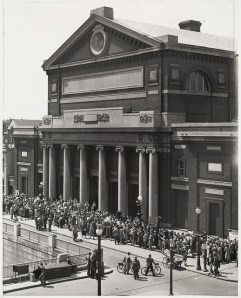
Symphony Hall: Famous Friday afternoon concert “Rush Line” waiting chance for unreserved seat
Reduced-cost “day of” tickets. Many classical organizations have rush or discount tickets and if you can spare the time to get to the venue early, you may get a very good seat for less than a movie ticket. I attended a lot of Boston Symphony Orchestra concerts this way. Check the web sites for the policies (often called “rush tickets” and sometimes limited to students).
Meet-Up and Online Newsletters In DC, there is a very active classical music Meet-Up, which frequently has offers for discounted tickets. Through that resource, I found out about a Kennedy Center mailing list you can join for notice of last minute deals for unsold tickets and sometimes deep discounts on advance sales. Look for these kinds of resources in your areas: in addition to Meet-Ups, these sort of resources can be associated with a venue, an individual company, or a presenter. Of course, they want your email in return and the right to market to you, but if it’s relevant info, it’s a perhaps a reasonable trade.
Ushering/volunteering This is not particularly my thing, as I’m fairly promiscuous in my musical tastes and don’t want to spend say every Thursday at the symphony. But people I know have found it a practical way to hear a lot of good music (or see theater for that matter).
Trusting to luck Just showing up an hour early at a hall and seeing if somebody has a ticket to give away is a risky practice. I would not recommend it for a concert you have your heart set on. But it has worked for me. Ticket resale is sort of a murky practice at many venues, but giving away an extra is kosher, so some people prefer to do that, even for sold out shows.
Conservatories and Music Departments’ OfferingsIf there are musical education organizations in your community, check out their free concerts. Elite outfits, like Indiana University and its world class opera program, or the amazing string faculty at New England Conservatory give performances that are deeply satisfying experiences. But even if you aren’t lucky enough to be near programs like those, it’s likely that there will be music worth hearing in your community, be it at a school, a religious or community organization, or another non-profit. They will be happy to have you: musicians want to perform!
Roll your own I have turned from a critic to a participant over the years, and now play chamber music with friends and sing in amateur ensembles more often than attending concert. Opportunities abound and they are rewarding in themselves, and also frequently lead to chances to hear other concerts. Even if you are not a musician yourself, informal house concertsare cropping up all over, and these can be nice ways to experience music.
With all the money you save going to free or low cost shows, you can consider funding that once-in-a-lifetime concert going experience. Most music lovers have a “dream list.” A friend of mine wants to go the New Year’s in Vienna concert at the Musikverein. I’m content with watching that one on TV, but if you know a cheap way to get to La Scala, Bayreuth, Teatro Colón, or the Berliner Philharmoniker, let me know!
“If a literary man puts together two words about music, one of them will be wrong.”–Aaron Copland, (author of some books of his own on music, plainspoken style but still very readable). Elvis Costello also put in his two cents, “Writing about music is like dancing about architecture.” (At least that’s a possibility…)
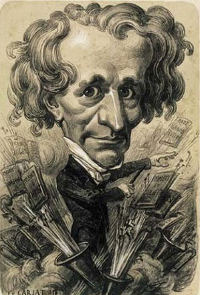
But there is one writer on music who is dancing all the time and a marvel of style, Hector Berlioz, who was also a critic, author of a book on orchestration, and avid correspondent (as was Verdi, whose letters are a treasure).
Berlioz wrote a long, rollicking, and moving memoir. (If not factually reliable in all regards about the man, it still captures truth about the composer.) It is also a ring-side seat for a lively era in music history, with a chatty wit, who was full of opinions and who knew everybody and traveled everywhere for a companion.
You can dip in anywhere, but here is his account of the first performance of his earth-shattering Requiem, and the near disaster that befell one of his most wondrous effects, the entrance four brass choirs that create the sound of the “last trumpet” in the Dies Irae.
Now listen very carefully.
My performers were divided in a number of groups at some distance from each other. This is necessary for the four orchestras of brass instruments which I have used in the Tuba mirum, and which must each be placed at one corner of the large mass of singers and players. At the point where they make their entry, at the start of the Tuba mirum which follows the Dies irae without a break, the tempo broadens to half its previous speed. All the brass instruments enter in the new tempo, first all together, then in dialogue with each other in successive entries each a third higher than the previous one. It is therefore of the utmost importance to indicate clearly the four beats of the bar at the moment when they come in. Without that, this awesome musical cataclysm, so carefully prepared, where exceptional and tremendous means are used in proportions and combinations never attempted before or since, this picture of the Last Judgement, which will, I hope, live on as a great landmark in our art – all this is in danger of resulting in an enormous and dreadful cacophony.
Because of my habitual suspicion, I had posted myself behind Habeneck. [The conductor] With my back to his, I was watching the group of timpani players, which he could not see, as the moment approached when they were to take part in the general mêlée. There are perhaps a thousand bars in my Requiem. At precisely the point I have been speaking of, when the tempo broadens and the brass instruments launch their awesome fanfare, in the one bar where the role of the conductor is absolutely indispensable, Habeneck lowered his baton, quietly pulled out his snuff box and started to take a pinch of snuff. I was still looking in his direction. Immediately I pivoted on my heels, rushed in front of him, stretched out my arms and indicated the four main beats of the new tempo. The orchestras followed me, everything went off as planned, I continued to conduct to the end of the piece, and the effect I had dreamed of was achieved. When at the last words of the chorus Habeneck saw that the Tuba mirum was saved: “What a cold sweat I had, he said, without you we were lost! – Yes, I know very well,” I replied, looking straight at him. I did not add a word … Did he do it on purpose?… Is it possible that this man, in concert with M. XX. who hated me, and the friends of Cherubini, could have dared to plan and attempt such a despicable deed?… I do not want to think about it… But I have no doubt. May God forgive me if I am doing him an injustice.
The success of the Requiem was complete, in spite of all the conspiracies, cowardly or criminal, official and unofficial, which had tried to prevent it.
Although that is one of the great moments in music, you need it in context, and for a taster, here is Berlioz in another mood, his “Harold in Italy,” a wandering musical journey for viola and orchestra.
The memoir is a wonderful read, and I’m partial to the Cairns translation.


 I bring up sight-reading because it has worked against my first advice about practicing. Namely, that it is all about small scale focusing in (Nancy O’Neill Breth uses the term “tunnel vision” in her


 A Few Reasonable Words