A relatively unknown conductor (in the U.S. at least) has been named the next music director of the Berlin Philharmonic (the Mount Everest of classical music jobs). It’s Kirill Petrenko (a good last name for classical music, Vassily no relation, is a fine conductor in the UK and Sweden and Mikhail, also no relation, is an outstanding operatic bass.)
Kirill is, judging by YouTube excerpts and the press he has received for work in Munich and Bayreuth (hardly small-time jobs), an extraordinary music-maker. He is also about as far from the persona of the media-savvy maestro as it would seem possible to get. (This is no disrespect to the Dudamels, Nézet-Séguins, Alsops, and the rest–merely an observation.) As Tom Service notes in a smart Guardian piece, it’s an admirable & bold choice on the Berlin Phil’s part: few orchestras, and surely no US groups, would hire a chief on musicianship and musical leadership alone. (When Barenboim left Chicago, he complained about the amount of non-musical work, including schmoozing for money, was required.) Kirill doesn’t give interviews, and describes himself as shy. Not a term I’d apply to many conductors. )
Here is a trailer of a concert with his future band in the music of Rudi Stephan (a new name to me and a composer he champions).
Reading a sweet book about coming back to pianos and piano playing in mid-life (a story I, a perpetual musical ‘advanced beginner’ can relate to). Thad Carhart turned his back on corporate life, and wandered into The Piano Shop on the Left Bank where an enigmatic, brilliant piano technician and dealer (he calls Luc) puts him together with a baby grand, with cinematic results.
This time at the atelier I did bring sheet music, and Luc nodded approvingly when he saw me set it on the music stand. I’ve never been comfortable playing in front of others, but somehow this was different; his presence seemed encouraging as we listened together to the particular voice of this instrument among so many other pianos. I played for perhaps ten minutes, pieces I knew reasonably well and could listen to while I sight-read: some Beethoven bagatelles, a few of Schumann’s pieces for children, an early Mozart fantasy. I was not disappointed The Stingl’s resonance filled the room with tones at once clear and robust, and a sharp sense of pride welled up at the prospect of owning this distinctive piano, of seeing and playing it daily, of living with it. Good God, I thought, this is a kind of love; and, as in love, my senses amplified and enhanced the love object, all with an insouciance and willing enthusiasm.
A magical performance of the Arabeske in C major by Wilhelm Kempff (with less than magical camera work).
Model cars at the Museum of Fine Arts Boston. Photo by ARS.
Have been on a jag listening to all the Beethoven Piano Trios. (A lacuna in my musical education: beyond the Ghost Trio, I didn’t really run across them before, and am now stumbling through them as an amateur chamber musician.) Not as epic as his quartets, but lots of interesting and experimental music, as well as some things that seem like Beethoven parodying Beethoven, including this irresistible (and earworm creating) finale to the Piano Trio in C minor, Op. 1, No. 3, – IV. Prestissimo: one of his great car chase scenes. Something about c-minor released the whirlwind in him, but here, unlike say the finale of the Moonlight, it’s more keystone cops than galloping furies.
A nice performance by what I’m guessing is a faculty group at SMU.
Continuing my ( occasional) posting on bite-size intros to opera, today a quick consideration of Gilbert and Sullivan. This refers to a collection of comic operettas written by Arthur Sullivan and W. S. Gilbert over about 25 years in the last quarter of the 19th century. Very topical in their time, these tuneful pieces sent up everything from the “aesthetic” movement of Wilde et al, “A languid love for lilies does not blight me!” confesses the faux aesthete in Patience to the do-nothing politicians that seem to plague any era, “The House of Peers, throughout the war/Did nothing in particular, And did it very well” (From Iolanthe).
There are all kinds pleasures big and small in the G&S oeuvre worth pointing out, but I’ll keep it to a couple that relate to opera directly, first in re the old debate about words and music. G&S provides an object lesson of how both can work together, a requirement for a successful opera, which is, despite its reputation a theatrical not a purely musical form. There is probably not much profit in trying to analyze of why or how exactly it works (in G&S no less than in Mozart and DaPonte), but somehow when the wedding is successful you hear the narrative, dramatic, and expressive, ideas of the music realized in the words, and vice versa. The whole gains moral force some how. There is also the need for attention to the sounds of the words as a aspect of the music in itself, something which Gilbert managed, while also managing to let off quite a lot of comic firecrackers.
In capsule: in opera, ideally words and music work together, melding meaning as well as sound.
Then to character: The other thing that G&S shares with opera is the use of an aria to introduce and illuminate a character. (This is not unique to opera, Shakespeare has “aria” like introductions for some characters, and movies and plays introduce characters, whether simple ‘types’ or more nuanced. Sondheim’s <em>Into the Woods</em> does this almost schematically, something thrown into unfortunate relief by the recent film.)
However, opera gets some special kung-fu from the opportunity it offers a protagonist to come out on stage, say “welcome to me!” and proceed to show his or her vocal and theatrical stuff. To wit (chosen from many good examples):
Kevin Kline in the Public Theater’s production of The Pirates of Penzance from the late 70s; he certainly offers a winning self-introduction!
As is my wont every April and November, I am going to do a 30-day series (give or take a few, seeing that it’s April 5 already). In 2013 it was poetry about music and in 2014 it was great first lines.
For this month, a painless intro to opera in 30 or so bite-sized nuggets. As somebody who has been an opera-lover since my teen years (a future post will reveal the sensational “how I was recruited into the opera lifestyle” story), I no longer recall what it is like to feel daunted by it. Yet many are; just today a friend, considering a trip to see an opera said he thought it would take such concentration, to say nothing of the preparation, that he was permanently discouraged. The idea that it might be something one attended for fun was not a premise he had considered. Rather, like learning a foreign language, or training for a marathon, it might be a worthy task for self-improvement, but not a source of innocent merriment.
One way to back away from this “self-improvement project” (or the even worse “cultural litmus test”), is to sneak in the back door by considering things that share DNA with opera, but don’t have the baggage, in fact, are generally just plain fun. I mean, of course, musical comedies and Gilbert and Sullivan.
The musical comedy tradition, one of America’s indigenous art forms, grew out of operetta and vaudeville—sharing a genealogy with opera: at their root they are story plus music, as is opera
Whether your taste in musicals runs to Spring Awakening and Matilda, or South Pacific and My Fair Lady, they all share the key characteristic that a dramatic narrative is embodied in music for the voice. The infinite ways this can be accomplished, and, tbh, the equally infinite numbers of ways it can go wrong, have given music theater (and opera before that) its characteristic ability to reinvent itself.
The creators of musicals often (although not invariably) work with a combination of spoken dialogue, songs (typically verse and refrain) duets, larger ensembles and choruses. All of these have precedents in opera, but to get our feet wet with the idea of how music and drama work together, I offer three examples. (I am afraid that my examples will tend towards the classic Broadway shows—I’m the last one to wallow in nostalgia about the ‘way it used to be’ brilliant musicals are being written today–but the examples I have to hand are these.
First: the “Tonight Quintet” from West Side Story.
This is really a dazzling piece of work. If you are not familiar with West Side Story (and you should be) it is based on Romeo and Juliet, and this ensemble brings together the voices of the main protagonists, each anticipating the fateful dance. Each line introduces a musical and a dramatic point of view, building in turn into an ensemble (with the lovers’ lines soaring above.)
So this is an ensemble (meaning a piece that uses multiple voices), a classic operatic form. It illuminates opera’s ability to play with time: Just as movies rely on narrative techniques like flashbacks or epics use frame stories, operas often stop time during an ensemble, as the action goes inward and we learn what everybody is thinking via the music we can hear (but which isolates the characters). Although, this is possible in spoken drama or novels, but in those the trick is hardly worth the candle, setting it to music gives it a rhetorical dimension that is far more powerful. (Later this month, if I remember, I will post the stunning example of this stopping of time and multiple perspectives in Barber’s Vanessa.)
The next example is “You’re Nothing Without Me” from City of Angels.
Duets are all over the place in opera, most often of the love variety, but running the gamut of dramatic purpose. Love duets are staples of musicals as well, but Cy Coleman. David Zippel, and Bart Gelbart’s loveletter to film noir, City of Angels offers a different take. Here, which the writer who has created a famous detective faces off with his creation as the double narratives that drive the show come to a fizzy head. It’s a show-stopper, a great first act closer for an altogether wonderful show.
Finally, the solo song. This is probably the oldest form in opera, perhaps in music and it taps the atavistic power of the story-teller. Here is an example from South Pacific, in which Emile de Becque (in the Tony winning performance of Paulo Szot) reflects on the love he believes he has lost.
So solos, duets, ensembles, here are the basic building blocks of operas. If you found yourself enjoying these, you are on your way. Next, Gilbert and Sullivan, truly a gateway drug to opera.
So much “spring” music to choose from, but my mind has turned to American Maverick (and bricolagist) Charles Ives, whose Concord Sonata is a like a rambling early 20th century novel.
Here is pianist Jeremy Denk playing the third Movement, “The Alcotts,” which opens with the evocation of the first bars of Beethoven’s Fifth Symphony, as played on an out-of-tune piano in a New England home sometime in the 19th century.
For more about the piece, to give it its full title, Piano Sonata No. 2, Concord, Mass., 1840–60, you can start with the Wikipedia article, and explore from there, including Ives own intro.
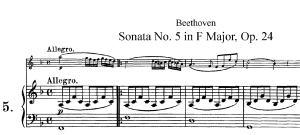
Am trying (with, at best, mixed results) to learn the piano part to Beethoven’s “Spring” Sonata for violin and piano. Although not as difficult as many other of B’s works (talking about you, “Kreutzer Sonata”), it’s still plenty challenging. The title “Frühlingssonata,” which he did not use, comes from the relatively sunny disposition of the first movement. Like the even-numbered symphonies it is full of good spirits and earthy humor.
I will probably never be able to play this piece very fluently, but it is fascinating to learn, particularly the compelling way it is built around pushing up against (and over) the bar lines (listen to the very first phase with that agogic accent). Throughout, the piece keeps unfolding implications of a sort of “head over heels” character–one idea moving to the next. (“A” becoming “B” as a German scholar wrote of Beethoven, rather than “A” becoming more perfectly “A” in Mozart.”)
And yes, it does evoke the happiness of spring, which seems, finally, to be here.
Here is a lovely performance by violinist David Oistrakh and pianist Lev Oborin,
There is also a spectacular recording of the complete sonatas by Isabelle Faust & Alexander Melnikov, which they discuss here (perfs not on YouTube) including some interesting comments about the melody in the sonata.
Nice piece over on the Gramophone magazine blog about Mozart’s knowledge of Handel. As musicologist Lindsay Kemp points out, knowledge of older musical eras and styles was not as typical of 18th century composers as it became later, but Mozart’s encounter with baroque music was profound. From the blog piece:
Above all, the realisation of the expressive potential of Baroque music found voice almost immediately in Mozart’s own music, at first in the grandiloquent choruses of the great Mass in C minor, but also in a four-part fugue, also in C minor, that he composed for two pianos in 1783, and which five years later he arranged for strings and prefaced with an Adagio much in the style of an overture by Handel (K546). This is no mere exercise in pastiche, but a piece of almost terrifying cumulative power, an acknowledgement of earlier genius that is deeply, almost disturbingly personal.
Here’s a performance of the Adagio and Fugue he mentions:
It may be too facile, but there does seem to be as much that looks ahead to the massive fugues of Beethoven as back to Bach and Handel. Four parts + minor key + 6 minutes + Mozart = more dramatic intensity than most operas or movies for that matter.
I went to tenor Matthew Polenzani and pianist Julius Drake’s recital last night at the Kennedy Center’s Terrace Theater, and as I said to a friend as I left–concerts like that make you believe in art song again. One in the series presented by Vocal Arts DC (full disclosure: for whom I write and volunteer) comes on the heels of fine performances by this season’s previous singers–including an adventuresome concert focused on music of WWI in December.
Sometimes things click at a level that goes beyond fine performance, however, and a recital becomes a complete experience through some alchemy of musicianship, vocal and instrumental polish, nuanced understanding of great repertoire and that x-factor, call it charisma that connects performers and listeners. What ever the mix of these and other ineffable factors, they were aligned last night and the result was the most artistically satisfying recital the series has presented in years (maybe ever), and I’ve been going since its inception in the early 90s.
It helps that Polenzani has a gorgeous voice and Drake a golden piano tone (yes, I am of the view that individual pianists can summon distinct colors, whatever the instrument–I realize that’s a controversial position). But they both have even more gorgeous artistry. This came out in countless ways, the gentle and unfussy approach to Liszt’s rich piano textures (the note per measure coefficient to this music is a big number and the results are often thick and showy, but not in Drake’s hands). And for Polenzani: one remarkable thing after another–two picked among many would be the ease with which he spun out soft lines, and his ability to unfolded and refold a perfectly calibrated mesa di voce, where the voice gathers outwards and then inwards getting louder and softer with no loss of beauty or richness. It takes breath control, plus superb technique, and many singers learn to do it more or less, but it’s not something I have heard used with this kind of meaning and expressiveness on the recital stage in a very long time.
And finally, words…a song recital is a species of poetry reading: the sounds and meanings of the words are realized in music and illuminate an idea. (That’s true in opera too, but there is so much falderal going on and the words are so often risible that you end up not really noticing them unless they are by DaPonte ). There wasn’t one unimportant word last night–nothing fluffed, forgotten or missed, in a program that was sung from memory. In particular, the French selections, Liszt, Ravel, and Satie, were a wonder. “Oh! Quand je dors,” a Hugo setting with arching ardor and quiet embraces seemed to stop time–and for once was a conversation, not some over emotional greeting card. The Satie songs, which personified a bronze frog and the Mad Hatter, and told the quirky tale of a tree with sorrowing birds were a little like zen stand up comedy. Barber’s “Hermit Songs” closed the program, and they too were like being let in on a set of subtle secrets, pulling you in to a private world where things are said to the wind, or the cat.
Performances like this happen when you pay attention to the details, are not afraid to sing and play softly, drop your worry about presenting “the voice” or “bringing off the big moments” and just open the palm of your hand and make music–your audience gets to stop worrying about listening for “the voice” as well. You don’t miss anything, as you are present and inside listening for something that is being said this way, just this once.
The first of three encores, “La barcheta” of Hahn embodied this inwardness to an almost giddy degree. Every moment was subtle, sung with long tapered breaths that curled around the seductive lines with ease, and conjured a lingering dream of Venice on a cold DC night. Bravo!
Arthur R. Smith is a mostly recovered music critic who still relapses occasionally. He is also a program annotator for Vocal Arts DC.
Nice profile by Fred Cohn of bass-baritone Luca Pisaroni in the Feb. 2015 Opera News.
The paragraph on the unique nature of the solo vocal recital caught my attention:
In recent years, Pisaroni has embarked on a series of recital tours, concentrating on German lieder — a rare choice for an Italian singer. “We don’t have a song culture, and the few that we have, the song helps showcase the voice,” he says. “The thing that fascinates me about the lieder repertoire is the dialogue between the voice and the piano. That’s the thing I love about the collaboration [with his pianist, Wolfram Rieger]. I have a phrase and give it to him, then he completes it and hands it back. To learn a recital program is the most difficult task ever, but it’s the most rewarding thing I do. There is nothing that gives you pleasure more than ending a song and feeling the audience has not taken a breath. It feels like time is standing still. There is no opera in the world that gives you that feeling.”
When he was in DC he sang German lieder by Liszt (German was in fact Liszt’s mother tongue), and had us all rapt, particularly in Die Lorelei, the arch-Romantic legend set by the arch-Romantic composer.
His is not on YouTube, but here’s a nice rendition by Kiri Te Kanawa (of the peaches and cream voice).
and another great recitalist in lieder, Ian Bostridge, in Schubert:




 A Few Reasonable Words