Reminded today of one of my favorite, and not very often heard, symphonies today. Borodin’s Second. A professional chemist and avocational composer who left us a small number of wonderful works. Check out particularly the elegiac slow movement that begins at 12:21.
Here in a performance from Amsterdam, a bit rough and ready perhaps, but still enjoyable.
Ravel’s piano music is known for its colorful palette, and its staggering technically difficulty. One piece that is within the reach of mere mortals is the Mother Goose Suite, a set of five character pieces for piano four hands (and later orchestrated as was often the case with Ravel). Although it was originally written for children, it has found a lasting place in the concert hall as well in the hearts of amateurs. (I even performed it in college as part of a student-faculty recital.)
Here it is in a nice performance from Cleveland with pianists Orion Weiss and Roman Rabinovich (who was just in town playing superb Rachmaninoff and interesting if not totally convincing Chopin). Although it is not impossible to imagine a six and seven year old (the ages of the original dedicatees) getting their fingers through this pieces, it isn’t really a beginners’ piece. The subtle touch, and reticent style that these two bring to it, not to mention the impeccable control, are things it seems you’d need some life experience to conjure.
As a long-time choral singer, I appreciated these tidbits that came across my reading last week:
1) Philosopher J.D. Trout on one way he managed to stay out of trouble during a tough adolescence.
The Tanglewood Festival Chorus, the all-volunteer group that supports the Boston Symphony Orchestra
I was able to steer clear of trouble in part because I was involved in activities that crowded out a lot of the unpleasantness that kids face. Choral singing is incredibly wholesome, and doing it well imposes a discipline that frustrates the temptations of idleness in a permissive world. I know that sounds Victorian, and it is, in a way. But it is also a contingent fact about humans that they form (mal)adaptive preferences, learning to like the often objectively bad practices in their orbit. Staying busy with work and singing, and having thoughtful, captivating, and funny friends, left little time or desire for idle, pointless wondering about whether my life could be better if I learned to steal money, enjoy cocaine, or sleep till noon. None of that ever sounded very fun to me, nor was I much in the orbit of its pull.
2. Daniel Pink, who has praise for choral singing in his new book on timing, When.
Q: Share with us a striking insight from your research on timing.
Pink: Let me offer two:
People are twice as likely to run their first marathon at age 29 as they are at age 28 or age 30. Forty-nine-year-olds are three times more likely to run a first marathon than 50-year-olds. Endings—simply being aware of an end—dramatically shape our behavior.
Choral singing is the new exercise. Research shows that the benefits of singing in a choir (not singing alone, but singing together) are massive: higher pain thresholds and reduced need for pain medication, increased production of infection-fighting immunoglobulin, reduced symptoms of depression, increased sensitivity toward others, improved mood, and much more. There’s something about synchronizing in time with others that is profoundly human.
First, the autumnal glow of the Romance for Violin and Orchestra, in the capable hands of Kyung-Wha Chung and Riccardo Muti’s Philadelphians. (Sorry about the bad break in the file…when it goes to 2 of 2.)
Next, the folk-inflected slow movement of his Sonatina for Violin, played by violinist Josef Suk, Dvorak’s great-grandson, and Rudolf Firkušný, not a household name, but revered by pianists.
And the third movement from his Symphony No. 8, Allegro Grazioso, a tender dance, gentle shimmering nostalgia, Manfred Honeck and Frankfurt Radio Symphony Orchestra.
Gramophone (a classical music monthly from England) devotes its cover story to Debussy this month, and mentions in passing a wonderful performance of one of his most familiar pieces, Prélude à l’après-midi d’un faune, reminding me of Doriot Anthony Dwyer, the principal flute of the Boston Symphony, one of the first female principals in any orchestra and a magical player.
Composers frequently find touchstones in earlier composers, but few seem to manifest as direct a lineage (or in some ways as surprising) as Hector Berlioz’ connection with the music Christoph Willibald Gluck, whom he venerated above all opera composers.
“There are two supreme gods in the art of music: Beethoven and Gluck. The former’s realm is that of infinite thought, the latter’s that of infinite passion; and though Beethoven is far above Gluck as a musician, there is so much of each in the other that these two Jupiters form a single god, and all we can do is to lose ourselves in admiration and respect for him.”
In his study and scholarship on the Gluck scores (already old-fashioned in Paris during Berlioz’s era), a musical revolutionary composer found common cause with a master of classical equilibrium. Here is Gluck from Iphigenie en Tauride, Regine Crespin singing “Cette nuit … O toi qui prolongeas mes jours“) (Iphigenia always brought forth magic from him–he pretty much owns the doomed classical heroine fach.)
And then, from Berlioz’ The Trojans (as classical a theme as Gluck could have wished for), the duet for Dido and Aeneas that closes Act III. More doom, more beauty and radiance.) A performance with Susan Graham and Gregory Kunde.
“I assure you, dear sister, that the music in Les Troyens is something noble and elevated; it is also compelling and truthful, and if I am not much mistaken there are a number of novelties which will arrest the ears of musicians throughout Europe and perhaps make their hair stand on end. It seems to me that were Gluck to come back to life, he would say of me on hearing the work: “Here in truth is my son.” Hardly modest, you will say. But at least I am modest enough to admit to be lacking in modesty.”
Inspired by the quiz during last Saturday’s Met b’cast, here is a quick explanation of “Tenore di Grazia,” that is, graceful tenors, not the heroic breed required for Wagner or heavy Verdi, but rather the elegant, perfectly controlled sound that makes bel canto music shine. (Tenors of any kind are a rare breed, and a true tenor di grazia is a particular treasure.) Javier Camerana, one of the current ideals of this type, named three of his favorites during his quiz appearance. Here’s a sampling of all three:
The German tenor Fritz Wunderich, golden sound, perfect production with evenness of tone across the whole range, and attentive to the words. Here in a deceptive simple Handel aria. If you don’t have a feel for cantilena, the long singing line, this number falls flat.
Talk about a long line, and not one moment of vocal pressure!
Next, the great Spanish tenor Alfredo Kraus, spectacular range, sensitivity to text and ability to inflect it to a ‘part per million’ and the fearlessness required to sing softly when the piece calls for it. (Harder than singing loud for most opera singers, and why “can belt-o” is so applicable in the opera house, or for that matter in Broadway musicals.) Here he is in Roméo’s aria from Gounod’s Roméo & Juliette, a role he owned during his very long career.
Finally, a tenor from an earlier generation also beloved by Javier and many others, Cesare Valletti. Here he is in an aria from Massenet’s Werther, exhibiting an almost superhuman poise, while singing in the highest range of voice. You hear the heartsick obsession of the young man, it seems to pour out of him in a single breath. And this was live on the radio!
Finally, for good measure, here is Javier himself, who set me off on this enjoyable visit to tenore di grazia of yesteryear. An excerpt from his performances in Rossini’s Semiramide currently at the Met (live March 10 on the radio).
Wonderful line, agile, warm sound, with a smile in his voice. Love that in the great tenor tradition, he has to stand on a box so as not to be shorter than his love interest. (Tenors, dear reader, on the whole are shorter than those they woo. It’s just how it goes. I know whereof I speak.)
One of the many benighted opinions of my youth was a certain disdain for Franz Josef Haydn. Somehow I bought into a line of thinking that Haydn was the epigone of Mozart (just as Dvorak was the epigone of Brahms), with the result that their glories were overlooked. Now I couldn’t live without either one of them.
Part of that is because of Alfred Brendel’s (and others’) advocacy of the piano sonatas. Here he is in a favorite.
The conductor Christopher Hogwood had a nice line about Mozart versus Haydn in a radio interview I heard years ago. To CH, Mozart was like a great master chef, whose mysterious ways were hidden in a kitchen you could not see, you received these fantastic meals of impossible polish and technique and couldn’t figure out how such a thing could have been devised. Haydn let it all hang out, he cut up the ingredients right at the table, and cooked all the food in front of you–no cosmic mystery, it’s all right there, and you listen along as he has his, often humorous way, with everything–you included.
The result, delightful, moving, and well crafted, is deeply satisfying and soul enriching to listen to.
Of great pianists there never seems to be any end. One of my favorite of the current roster is Polish pianist Piotr Anderszewski, restrained and poetic whether in Chopin or Szymanowski.
He has just released the second in a series of Mozart Concerti recording. Tipped off by a rave in Gramophone, I listened to trailer on YouTube and even these little bits enchant.
And here are two movements from Bach’s French Suite #5, from a 2000 performance in Miami (probably one that wouldn’t meet his current standards, if he doesn’t like his performance he gets the urge to walk out–and sometimes does).
He’s recorded this entire Bach Suite, with magical results, and also is the focus of an interesting documentary by Bruno Monsaingeon. Only the trailer is on YouTube, but if you have a public library card, you may be able to find it on their site.
Author Dan Pink has a new book out, When, his synthesis of research about timing in our lives. He makes reference to research on singing in a chorus (everyone doing something at exactly the same time). Some results suggest that its health benefits rival vigorous exercise.
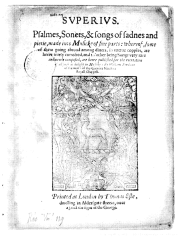
I spent a little time trying to find the original data on this, and although I didn’t chase down the exact studies, I did find some interesting stuff. In a volume that rounds up recent research on music generally, Music, Health, and Wellbeing, the chapter on choral singing points out that Renaissance composer William Byrd was a strong fan of singing for health.
Here’s the relevant bit:
An early reference to the idea that singing can be good for health and wellbeing is found in the writings of William Byrd (1543-1623). In the preface to his Psalmes, Sonets & songs [of sadnes and pietie], published in 1588, Byrd outlined eight reasons ‘to perswade every one to learne to sing’. Four of these reasons resonate with contemporary views on the ‘therapeutic’ benefits of singing. Singing, he asserted, helps to maintain health, by being ‘delightfull to Nature’ (i.e. giving pleasure and joy), by exercising the musculature of the chest, by expanding the lungs and by helping to reduce stammering and improve voice quality.
Byrd summed up his advocacy for singing in a well-known couplet:
Since singing is so good a thing, I wish all men would learne to sing.
Remarkably, it is only now, over 400 years later, that scientific attention has begun to assess the merits of Byrd’s insights.
Everybody should learn to sing, although few do it with the elan of this gang, Voces8 in an arrangement of the folk song Shenandoah.


 Composers frequently find touchstones in earlier composers, but few seem to manifest as direct a lineage (or in some ways as surprising) as Hector Berlioz’ connection with the music Christoph Willibald Gluck, whom he venerated above all opera composers.
 contemporary views on the ‘therapeutic’ benefits of singing. Singing, he asserted, helps to maintain health, by being ‘delightfull to Nature’ (i.e. giving pleasure and joy), by exercising the musculature of the chest, by expanding the lungs and by helping to reduce stammering and improve voice quality.
 A Few Reasonable Words