Poetic Words: The Adirondacks

Can’t resist one more shot from our Adirondack weekend:

Blue Mountain Lake, Labor Day weekend 2014.

Adirondacks: Late Summer 1948

The spruce are dense above the lake.
A thick, gray driftwood, sharp and bent,
Margins the shore with heavy lines.
The overhanging aspens shake
Their dry, deciduous sediment
Into the cool, reflected pines.

There is a limit here of tree
And water: form has gained its end,
Lost in the continual reflection.
Through shade the glossy visions flee
And in a darker calm distend
Downward in shadowy perfection.

Across the lake at evening, wild
And distant, like unhallowed ghosts,
The loons converse. Rotten and dank,
The logs jut rudely: split and piled
They slant into the dusk like posts
Unearthed and cast against the bank.

W. Wesley Trimpi

Reasonable Words: Commonplace Book

A few nice bits encountered in this week’s reading:

First, the opening bit from Jorge Luis Borges “This Craft of Verse” (the book form of his Norton Lectures on poetry from 1967-68, once thought lost, but lovingly transcribed from audio tapes and published by Harvard University Press).

“1. The Riddle of Poetry

At the outset, I would like to give you fair warning of what to expect–or rather, what not to expect–from me.  I find that I have made a slip in the very title of my first lecture. The title is, if we are not mistaken, “The Riddle of Poetry,” and the stress of course is on the first word, “riddle.” So you may think the riddle is all-important. Or, what might be still worse, you may think I have deluded myself into believing that I have somehow discovered the true reading of the riddle. The truth is that I have no revelations to offer. I have spent my life reading, analyzing, writing (or trying my hand at writing), and enjoying. I have found the last to be the most important thing of all. “Drinking in” poetry, I have come to no final conclusion about it. Indeed, Every time I am faced with a blank page, I feel that I have to rediscover literature for myself. But the past is of no avail whatever to me. So, as I have said, I have only my perplexities to offer you. I am nearing seventy. I have given the major part of my life to literature and I can offer you only doubts.”

Echos of Mark Strand‘s

“There is no happiness like mine.
I have been eating poetry.”

If Borges thought he was “trying his hand at writing,” there’s not much hope for the rest of us.


and a great lead to James Wade’s TLS review of Lawrence Warner’s THE MYTH OF PIERS PLOWMAN, a sort of bibliographic true-crime thriller about the brouhaha over medieval text Piers Plowman and its questionable provenance.


If Piers Plowman offers a vision of human life in its entirety – a “fair feeld ful of folk” – Lawrence Warner’s study The Myth of Piers Plowman veers towards humanity’s rougher edges: insane scholars, hapless librarians, drunk students, depressed antiquarians and tyrannical monarchs, not to mention rebels, prostitutes, con men, forgers, heretics and, perhaps worst of all, very dull academics.


Warner assembles this motley crew of rogues and oddballs to serve up a rollicking tale of how an entire field of study came to be created, or rather, fabricated. This latter term is one Warner shies away from in the book’s subtitle, but its range of connotations is fundamental to his understanding of archive formation. When it comes to the long history of amassing the raw material of “Langland Studies” or “Piers Plowman Studies”, a history this book traces (or fabricates), it turns out to be neither possible nor necessarily productive to always distinguish between those who created, those who copied, those who corrected and those who just made things up.


Turns out life (or at least literary life) is more like Borges than perhaps even he suspected.

“Drunk history” is an internet meme (even a TV show), but drunk bibliographic collation? Could be the next big thing…


A page of a Piers Plowman manuscript from the British Library's site. Love those pilcrows!
A page of a Piers Plowman manuscript from the British Library’s site. Love those pilcrows!

Poetic Words: Angie Estes & the Scottish Poetry Library

Reading Poetry Daily, a nice habit I’m restarting, has a dazzler today from Poetry London. Here are the first few lines of Angie Estes “Deep Field,”
hs-2014-27-a-web

He telleth the number of the stars; he calleth them
all by their names
: tutti-frutti, Cimabue, bracelets
of Cartier, chock full o’Giotto spilled
onto a black sky like Jujubes
during a matinee. Anna-Eva Bergman…

Read the full poem here.

In other poetry news, I happened upon the Podcasts for the Scottish Poetry Library recently and, through them, got introduced to Caroline Bird, worth listening to if you are a poetry fan, particularly somebody fond of writers like Carol Ann Duffy and Jackie Kay or, from an earlier generation, Frank O’Hara. Bird has a fresh, gentle/sharp way, and her poems are often disarmingly funny.

podcast

Reasonable Words: Two Inspiring Videos

Trying to catch up on posting…a lot in the backlog.

But for now, two videos from the week’s surfing that stayed with me.

The first comes from the Hay Festival of Literature & the Arts, where Sherlock, er, I mean, Benedict Cumberbatch, among others, was on hand to read a group of inspiring letters. There were many wonderful readings apparently, but the finale, Kurt Vonnegut’s letter to the Drake School Board–the famous “I am very real” letter–was something special.

The other inspiration is in the form of good advice from mezzo Joyce DiDonato, delivered during her commencement speech to this year’s graduating class at Julliard, which she disarmingly admits she wouldn’t have been admitted to.

The text of the speech is on this page, with video embedded at the end. JoyceDiDonato

“[You are] now servants to the ear that needs quiet solace, and the eye that needs the consolation of beauty, servants to the mind that needs desperate repose or pointed inquiry, to the heart that needs invitation to flight or silent understanding, and to the soul that needs safe landing, or fearless, relentless enlightenment.”

I certainly find safe landing in this, her gorgeous singing of “Ombra mai fu,” one of those Handel arias of unearthly beauty. (There are so many!)

Selah and have a great weekend.

Reasonable Words: Farley Mowat

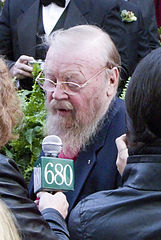
161px-Farley_MowatWriter and environmentalist Farley Mowat (probably best known in the U.S. for Never Cry Wolf, which was made into a fine film a generation ago) died May 6, age 92. There are lots of things to remember and honor about him, but this line in particular has stayed with me.

“I have tried to fulfill the function that is in me, that of storyteller.”

Reasonable Words: Wonderful Diaries

I have been savoring Ronald Blythe‘s The Pleasures of Diaries, a compilation of wonderful excerpts, collected by a fine writer in his own right, and one with a great ear. So many tidbits worth sharing. For example, here’s Blythe’s intro to Samuel Johnson’s diary.

Johnson’s Diary evokes compassion. Here, simply exposed, is the pathology of a virtuous and brilliant man. His Dictionary says that a diary has to be ‘an account of the transactions, accidents, and observations of every day’–which suggests something less profound than what he attempted. Yet no one heeded more the advice he gave to his friends when he urged them to keep diaries in which ‘the great thing to be recorded is the state of your mind.’ His own diary is above all the troubled record of a greatly troubled mind.

Here is an excerpt from the diary itself (Tetty, refers to the middle-aged widow whom Johnson married when he was 27, and was devoted to, somewhat to the mystification of his friends.)

18 September 1760. Resolved D. j. (with God’s aid)

To combat notions of obligation

To apply to Study.

To reclaim imagination.

To consult the resolves on Tetty’s coffin.

To rise early.

To study Religion.

To go to Church.

To drink less strong liquors.

To keep Journal.

To oppose laziness, by doing what is to be done.

To morrow

Rise as early as I can.

Send for books for Hist. of war.

Put books in order.

Scheme life.

Embed from Getty Images

Johnson, Goldsmith and Boswell, scheming life.

Poetic Words: Two War Poems of Robert Graves

Goodbye to All ThatI’ve just finished Good-bye to All That, the autobiography of poet and classicist Robert Graves (an anchor paperback purchased for a book club meeting 26 years ago. Didn’t go to the bc meeting as I hadn’t read the book–book clubs are too regimented for me usually.) Groves wrote it in 1929, when he was in his early 30’s, and much of it is candid, unvarnished description of his WWI service.  Like Siegfried Sassoon, his good friend and fellow war poet, he came to see the war, its aftermath, with a grim patriotic disgust. He was a good soldier, and proud of his service in some ways. But also thought it was a terrible waste, and resolved nothing.
 
It’s  an engrossing read, like opening up a box of photos from your great grandparents, and sent me looking for his poetry–which it seems he wrote even while in the trenches in France. Here are two.


RETROSPECT: THE JESTS OF THE CLOCK.

He had met hours of the clock he never guessed before—
Dumb, dragging, mirthless hours confused with dreams and fear,
Bone-chilling, hungry hours when the gods sleep and snore,
Bequeathing earth and heaven to ghosts, and will not hear,
And will not hear man groan chained to the sodden ground,
Rotting alive; in feather beds they slumbered sound.

When noisome smells of day were sicklied by cold night,
When sentries froze and muttered; when beyond the wire
Blank shadows crawled and tumbled, shaking, tricking the sight,
When impotent hatred of Life stifled desire,
Then soared the sudden rocket, broke in blanching showers.
O lagging watch! O dawn! O hope-forsaken hours!

How often with numbed heart, stale lips, venting his rage
He swore he’d be a dolt, a traitor, a damned fool,
If, when the guns stopped, ever again from youth to age
He broke the early-rising, early-sleeping rule.
No, though more bestial enemies roused a fouler war
Never again would he bear this, no never more!

“Rise with the cheerful sun, go to bed with the same,
Work in your field or kailyard all the shining day,
But,” he said, “never more in quest of wealth, honour, fame,
Search the small hours of night before the East goes grey.
A healthy mind, a honest heart, a wise man leaves
Those ugly impious times to ghosts, devils, soldiers, thieves.”

Poor fool, knowing too well deep in his heart
That he’ll be ready again if urgent orders come,
To quit his rye and cabbages, kiss his wife and part
At the first sullen rapping of the awakened drum,
Ready once more to sweat with fear and brace for the shock,
To greet beneath a falling flare the jests of the clock.

TO ROBERT NICHOLS

(From Frise on the Somme in February, 1917, in answer
to a letter saying: “I am just finishing my ‘Faun’s
Holiday.’ I wish you were here to feed him with
cherries.”)

Here by a snowbound river
In scrapen holes we shiver,
And like old bitterns we
Boom to you plaintively:
Robert how can I rhyme
Verses for your desire—
Sleek fauns and cherry-time,
Vague music and green trees,
Hot sun and gentle breeze,
England in June attire,
And life born young again,
For your gay goatish brute
Drunk with warm melody
Singing on beds of thyme
With red and rolling eye,
All the Devonian plain,
Lips dark with juicy stain,
Ears hung with bobbing fruit?
Why should I keep him time?
Why in this cold and rime,
Where even to dream is pain?
No, Robert, there’s no reason:
Cherries are out of season,
Ice grips at branch and root,
And singing birds are mute.

Good-bye to All That also has some good writing advice (for which I’m always on the lookout, of course).

“My last memory [of Charterhouse School] is the Headmaster’s parting short: ‘Well, good-bye, Graves, and remember that your best friend is the waste-paper basket.’ This has proved good advice, though not perhaps in the sense he intended: few writers seem to send their work through as many drafts as I do.”

Lovely that “send their work,” as if each paragraph was going on a little walk, or more likely a rafting trip.