Formal Matters: Sestinas

A love of poetry does not necessarily require knowing much about what is going on under the hood–formal concerns, rhyme, meter, and the like. Perhaps because I was a music major, it’s always been an interest of mine: like sonata form, poetic structures have their own low key, fascinating dazzle. For example, the verse form of the sestina.

Poetry Foundation gives a definition:

A complex French verse form, usually unrhymed, consisting of six stanzas of six lines each and a three-line envoy. The end words of the first stanza are repeated in a different order as end words in each of the subsequent five stanzas; the closing envoy contains all six words, two per line, placed in the middle and at the end of the three lines. The patterns of word repetition are as follows, with each number representing the final word of a line, and each row of numbers representing a stanza:

1 2 3 4 5 6
6 1 5 2 4 3
3 6 4 1 2 5
5 3 2 6 1 4
4 5 1 3 6 2
2 4 6 5 3 1
(6 2) (1 4) (5 3)

Got that?

And yet, some poets manage to create miracles out of these ridiculous strictures:

First David Ferry, who has recently turned out a stunning version of The Aeneid.

The Guest Ellen at the Supper for Street People
By David Ferry

The unclean spirits cry out in the body
Or mind of the guest Ellen in a loud voice
Torment me not, and in the fury of her unclean
Hands beating the air in some kind of unending torment—
Nobody witnessing could possibly know the event
That cast upon her the spell of this enchantment.

Almost all the guests are under some kind of enchantment:
Of being poor day after day in the same body;
Of being witness still to some obscene event;
Of listening all the time to somebody’s voice
Whispering in the ear things divine or unclean,
In the quotidian of unending torment.

One has to keep thinking there was some source of torment,
Something that happened someplace else, unclean.
One has to keep talking in a reasonable voice
About things done, say, by a father’s body
To or upon the body of Ellen, in enchantment
Helpless, still by the unforgotten event

Enchanted, still in the old forgotten event
A prisoner of love, filthy Ellen in her torment,
Guest Ellen in the dining hall in her body,
Hands beating the air in her enchantment,
Sitting alone, gabbling in her garbled voice
The narrative of the spirits of the unclean.

She is wholly the possessed one of the unclean.
Maybe the spirits came from the river. The enchantment
Entered her, maybe, in the Northeast Kingdom. The torment,
A thing of the waters, gratuitous event,
Came up out of the waters and entered her body
And lived in her in torment and cried out in her voice.

It speaks itself over and over again in her voice,
Cursing maybe or not a familiar obscene event
Or only the pure event of original enchantment
From the birth of the river waters, the pure unclean
Rising from the source of things, in a figure of torment
Seeking out Ellen, finding its home in her poor body.

Her body witness is, so also is her voice,
Of torment coming from unknown event;
Unclean is the nature and name of the enchantment.

Of course Elizabeth Bishop could seemingly toss them off…

Miracle for Breakfast
by Elizabeth Bishop

At six o’clock we were waiting for coffee,
waiting for coffee and the charitable crumb
that was going to be served from a certain balcony
—like kings of old, or like a miracle.
It was still dark. One foot of the sun
steadied itself on a long ripple in the river.

The first ferry of the day had just crossed the river.
It was so cold we hoped that the coffee
would be very hot, seeing that the sun
was not going to warm us; and that the crumb
would be a loaf each, buttered, by a miracle.
At seven a man stepped out on the balcony.

He stood for a minute alone on the balcony
looking over our heads toward the river.
A servant handed him the makings of a miracle,
consisting of one lone cup of coffee
and one roll, which he proceeded to crumb,
his head, so to speak, in the clouds—along with the sun.

Was the man crazy? What under the sun
was he trying to do, up there on his balcony!
Each man received one rather hard crumb,
which some flicked scornfully into the river,
and, in a cup, one drop of the coffee.
Some of us stood around, waiting for the miracle.

I can tell what I saw next; it was not a miracle.
A beautiful villa stood in the sun
and from its doors came the smell of hot coffee.
In front, a baroque white plaster balcony
added by birds, who nest along the river,
—I saw it with one eye close to the crumb—

and galleries and marble chambers. My crumb
my mansion, made for me by a miracle,
through ages, by insects, birds, and the river
working the stone. Every day, in the sun,
at breakfast time I sit on my balcony
with my feet up, and drink gallons of coffee.

We licked up the crumb and swallowed the coffee.
A window across the river caught the sun
as if the miracle were working, on the wrong balcony.

And finally Donald Justice, overlooked, but one of my favorites:

Sestina: Here In Katmandu

by Donald Justice

We have climbed the mountain.
There’s nothing more to do.
It is terrible to come down
To the valley
Where, amidst many flowers,
One thinks of snow,

As formerly, amidst snow,
Climbing the mountain,
One thought of flowers,
Tremulous, ruddy with dew,
In the valley.
One caught their scent coming down.

It is difficult to adjust, once down,
To the absence of snow.
Clear days, from the valley,
One looks up at the mountain.
What else is there to do?
Prayer wheels, flowers!

Let the flowers
Fade, the prayer wheels run down.
What have they to do
With us who have stood atop the snow
Atop the mountain,
Flags seen from the valley?

It might be possible to live in the valley,
To bury oneself among flowers,
If one could forget the mountain,
How, never once looking down,
Stiff, blinded with snow,
One knew what to do.

Meanwhile it is not easy here in Katmandu,
Especially when to the valley
That wind which means snow
Elsewhere, but here means flowers,
Comes down,
As soon it must, from the mountain.


Some help on how to write your own, with yet another fine example from Anthony Hecht.
Library Words

A few words on librarians from writers and others.

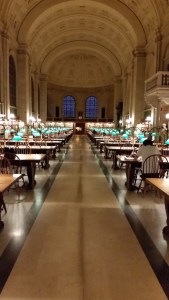
Bates Reading Room at the Boston Public Library. (Spot of many happy hours for me.)

If you want to get laid, go to college. If you want an education, go to the library.–Frank Zappa

Without libraries what have we? We have no past and no future.–Ray Bradbury

Libraries will get you through times of no money better than money will get you through times of no libraries.–Anne Herbert

Libraries always remind me that there are good things in this world.–Lauren Ward

Rule number one: Don’t fuck with librarians.–Neil Gaiman

Opera Tidbits: Don Carlo

Took in Washington National Opera’s Don Carlo this week.  The best Verdi singing at the company in a long time, particularly notable in this extremely challenging opera. It actually sounded like a real life opera company!  (It didn’t look like one, the clumsy production–particularly ill-fitting costumes and high school dramatic society level lighting on a borderline offensive set concept were something you just had to decide to overlook).

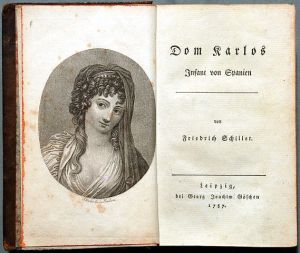
The Schiller play on which Verdi based the opera. By Egid Verhelst – Antiquariat Dr. Haack Leipzig → Privatsammlung Baden-Württemberg, CC BY 3.0, https://commons.wikimedia.org/w/index.php?curid=4115888

But the singing was glorious. This is something you expect from Eric Owens and Jamie Barton, both of whom are Met regulars and possessed of glorious instruments that they put use in conveying meaning and character. But Quinn Kelsey, who was just a name to me, was a knockout Posa, manly, vocally secure and incisive, and also touching in his ability to add vulnerability to a role that some bellow through. Leah Crocetto has been in DC before, and proved her mettle in a dazzling “Tu Che La Vanità”–a bit general in her character, but gorgeous full top to her voice, and the requisite dignity for the pure, troubled Elisabeth. Russell Thomas will not banish thoughts of great Don C’s of yore (it’s a tribute the rest of the gang that they did put previous casts out of my mind, and particularly made the second half of this long opera fly by).  But although occasionally a bit under powered in this company, he had a wonderful “Hamlet” kind of thing going on, where you heard and saw his divided loyalties, fraught passions and terrible dilemmas of filial loyalty, political passions, and ardent love. (This particular Verdi opera lays all of this most political composers signature concerns on in excess. He really couldn’t leave anything out, and the auto-da-fé scene, always hard to stage, was just awful in this conception, with what might have been meant to be an evocation of 20th century totalitarianism, instead of coming off as sort of clumsy regie-dinner-theater.)

But never mind, it was a glorious performance musically and If you don’t know Don Carlo, it is something that grows on you, or at least did me, from once seeming unrelentingly dark and long (and of murky plot, since it is almost always significantly cut.) But it is one of his greatest works, and his perhaps his most concentrated take on men’s dilemmas (and his none too charitable view of how they respond).

Three excerpts to win you over:

The extraordinary Shirley Verrett singing “Oh Don Fatale” from a BBC broadcast.

Monserrat Caballé, who for me at least, was above all, a great Verdian. Here she is in a concert performance of Elisabeth’s aria, “Tu Che La Vanità”

Next, Sherill Milnes and Placido Domingo (Rodrigo/Posa and Carlo) in the duet in which they pledge eternal loyalty and friendship in the best “shoulder to shoulder” Verdi style.

And for a bonus, the same duet with the great Verdi baritone of the ages, Piero Cappuccilli (and the tenor, Carlo Bergonzi also a marvel). Listen to their words. They mean every one.

Photo Thursday: Developing Your Eye

I am taking one of WordPress.com’s courses, Developing Your Eye I, which gives you a photography prompt and some advice each day for ten days.  (And, of course, I am already behind.)

The first day’s prompt was “home,”  and here is my somewhat random response (didn’t have to leave home to get these shots, they were vistas or items nearby, a free  interpretation of the prompt, granted).

Three Good Ledes

It’s been said that “80 percent of success is showing up” (or a closely related “genius is 90% perspiration and 10% inspiration”). In newspaper writing, getting the lede right is sometimes nearly 100% of the job.

Three ledes I’ve encountered recently and enjoyed:

1. Jacob Brogan in Slate on Paul Manafort’s technical maladroitness.

“There are two types of people in this world: those who know how to convert PDFs into Word documents and those who are indicted for money laundering. Former Trump campaign chairman Paul Manafort is the second kind of person.”

2. A fascinating Times obit by David Margolick of one Alan Gershwin, who might or might not have been the issue of George, a claim he pursued his whole life.

“As Alan Gershwin told the story — often — he was hidden away at his Uncle Ira and Aunt Leonore’s house on North Roxbury Drive in Beverly Hills in late 1945, right after his discharge from the Navy. Ignoring the orders of his hosts, he headed downstairs to join one of the parties the Gershwins regularly gave. When a guest spotted him on the landing, he dropped his glass of Scotch in shock. Or maybe two guests did.

By then, seven years had passed since the man Alan Gershwin called his father had died. But all anyone eyeing 19-year-old Alan that night saw was George Gershwin, reincarnated.

For 70 years or so, Alan Gershwin insisted he was George Gershwin’s long-lost son. And with his death on Feb. 27 at 91 in a Bronx hospital, the curtain came down on what was surely the Gershwins’ most bizarre show ever, revolving around whether this affable but monomaniacal man was one of the greatest victims in American musical history, or a grifter running a long-term con, or someone suffering decades of delusion.”

3. Finally, Vanity Fair‘s Darryn King catches up with Uwe Boll, a director who was not up for an Academy Award last weekend.

In a small, cold film studio in early 2016, the man known by the Internet as the “worst director in the world” was doing what he does, well, worst.

“O.K., one more time,” said Uwe Boll (his first name is pronounced “OO-vah”), feeding lines to one of the actors in the absence of a script. “Straight in the lens: ‘. . . has been killed. By the law . . . er . . . the law enforcement? Has been shot by law enforcement.’ Yes. O.K., do it. Ready, and . . . Action!”

“This is the worst-looking set,” assistant director Michael Pohorly admitted between takes. “The budget on this set was . . . nothing. Twenty dollars for a lick of paint? It’s a $20 set.”

The Sensor Society: Invisible Infrastructure

So much about the Internet age has turned out to be vexing–a far cry from my enthusiasm a generation ago, shared by many nerds, for a utopian future of connectivity and a library of one’s dreams.

“I would not open windows into men's souls.” — Attributed to Queen Elizabeth IHard to know where to start with the disappointments and fears, but one that particularly nags is the feeling that we are building (with our eyes closed and tacit consent) an infrastructure that monitors our every move, encasing every one of us in a personal surveillance state, in return for the convenience of carrying a connected device everywhere we go.

Australian Prof. Mark Burdon has termed this the “Sensor Society,” the notion that passively, without our knowledge or consent, and for unknown purposes, everything we do becomes raw data for commercial discovery (and possibly for government snooping). This follows inevitably from the “always on/always connected” world, but is it too high a price to pay?

The entire interview is worth reading, but herewith a few bracing bits:

Q: What are the implications if sensors completely permeate society?

A: Well, it’s not necessarily just about the complete permeation of sensors. Rather, the greater implications regard the emergence of pervasive and always on forms of data collection. The relationship between sensors, the data they produce, and ourselves is important to understand.

For example, sensors don’t watch and listen. Rather, they detect and record. So sensors do not rely on direct and conscious registration on the part of those being monitored. In fact, the opposite is the case. We need to be passive and unaware of the sensing capabilities of our devices for the sensors to be an effective measurer of our activity and our environments.

Our relationship with our devices as sensors is consequently a loaded one. We actively interact with our devices, but we need to be passively unaware of the sensors within our devices. The societal implications are significant—it could mean that everything we do is collected, recorded and analysed without us consciously being aware that such activities are taking place because collection is so embedded in daily life.

Q: How would you recommend someone learn more about the impact of living in a sensor society?

A: Look at your everyday devices in a different way. Behind the device and the sensor are vast and imperceptible, invisible infrastructures. Infrastructures of collection enable the explosion of collectible data and infrastructures of prediction enable understanding and thus give purpose to sensors. Otherwise, sensor-generated data without an analytical framework to understand it is just a mountain of unintelligible data.

The sensor society, therefore, redirects us towards the hidden technological processes that make data collection capture, storage, and processing possible. This, in turn, highlights the importance of understanding relations of ownership and control of sensors and the infrastructures in which sensors operate. So when you’re at home with your devices, realize that you are not alone and just think about those invisible infrastructures that are also present with you. Then question to ask then is: What data is being collected, by whom and for what purpose?

Our metadata, ourselves… how are we ever to be left alone? He’s got a good TedX talk as well.

“[The framers] sought to protect Americans in their beliefs, their thoughts, their emotions and their sensations. They conferred, as against the government, the right to be let alone-the most comprehensive of rights and the right most valued by civilized men.”  — Louis Brandeis

Roll Your Own Film Series

Washington’s Building Museum, one of the city’s often overlooked gems, recently had an Architecture & Design Film Festival that I unfortunately missed.

I have already seen Columbus, which I recommend design minded, about the meaning of a city and outlining low-key relationships that rang true. (It helps perhaps that I have been to some of those buildings in Columbus, IN, and they are remarkable.)

In the process of looking up the others, found that all of Workplace, Gary Hustwit’s film about the creation of new quarters for NYC’s R/GA (a big deal ad agencies/design firms) is available, if and you liked Huswit’s Helvetica (which I loved), you’ll enjoy it. It starts a bit like an RG/A infomercial, but clearly Hustwit got editorial control. The principals say their piece (including candid meeting footage with Norman Foster) and so do those people who can’t believe what is being foisted on them!  Crisply done and worth a watch if you are interested in architecture and design.

The Gluck Berlioz connection

Composers frequently find touchstones in earlier composers, but few seem to manifest as direct a lineage (or in some ways as surprising) as Hector Berlioz’ connection with the music Christoph Willibald Gluck, whom he venerated above all opera composers.

“There are two supreme gods in the art of music: Beethoven and Gluck. The former’s realm is that of infinite thought, the latter’s that of infinite passion; and though Beethoven is far above Gluck as a musician, there is so much of each in the other that these two Jupiters form a single god, and all we can do is to lose ourselves in admiration and respect for him.”

In his study and scholarship on the Gluck scores (already old-fashioned in Paris during Berlioz’s era),  a musical revolutionary composer found common cause with a master of classical equilibrium. Here is Gluck from Iphigenie en Tauride, Regine Crespin singing “Cette nuit … O toi qui prolongeas mes jours“) (Iphigenia always brought forth magic from him–he pretty much owns the doomed classical heroine fach.)

And then, from Berlioz’ The Trojans (as classical a theme as Gluck could have wished for), the duet for Dido and Aeneas that closes Act III. More doom, more beauty and radiance.) A performance with Susan Graham and Gregory Kunde.

“I assure you, dear sister, that the music in Les Troyens is something noble and elevated; it is also compelling and truthful, and if I am not much mistaken there are a number of novelties which will arrest the ears of musicians throughout Europe and perhaps make their hair stand on end. It seems to me that were Gluck to come back to life, he would say of me on hearing the work: “Here in truth is my son.” Hardly modest, you will say. But at least I am modest enough to admit to be lacking in modesty.”

Commonplace Book: Anne Enright

The Irish novelist Anne Enright, with a meditation on Genesis and the evolution of blame. Excerpt below.

She goes on to evoke everything from Milton to Twitter, with her usual lightly worn, but amazing wit and erudition. The whole thing is worth a read.


From the Metropolitan Museum

The story of the Fall is one of the most enduring stories we have, and it is never fair. You could use it as a template for a certain kind of novel: put a choice in there, tip the balance, make the consequences so disproportionate we doubt our sense of cause and effect, make them suffer, make them into better human beings. Visually, the narrative is brilliantly successful, for being so easy to hold within a single frame. There is nothing static about the way the viewer sees an image of the first couple considering apples. It is a moment of great tension, and they are wearing no clothes. So, to the rules for writing a successful fiction, we might add, pretend that it is not about sex, make the world symbolic, expand the small asymmetries. Here are two human beings who are slightly, but perhaps disastrously, anatomically different. She likes something long, he likes something round – what could possibly go wrong?

The story is a riddle about authority and predestination that has survived the theological palaver of generations because, simple to the point of transparency, it is also impenetrably self-enclosed. It is held in a brilliant web of balance and contradiction by a few hundred words; so it is worth looking at those words and what they actually mean.

Just to be clear: there was no seduction. There was no devil, nor any mention of Satan, who was, at this stage, an unimportant figure. Although he played a sporadic role in the torment of Job, or in the temptation of Christ in the desert, Satan was not a mythical force before the bestiary of Revelations, and the rebellious Lucifer was some other angel until Milton came along. The idea of a great battle between light and the forces of darkness did not get going until early Christian times, possibly because this small, persecuted sect needed to find a great spiritual enemy against which to pit themselves. The creature in Genesis was just a snake, and though he was crafty, he didn’t seduce, nor did he ‘tempt’ Eve – this last term means ‘to test’ and is used only once in Genesis, when God tests Abraham, requiring the sacrifice of his son Isaac. So Eve did not tempt Adam, either, nor was he seduced by her nakedness. There is, in fact, very little sex in the story. Our readings of it are all subtext, all interpretation, all error.

Fred, Ginger, and Frank

When it’s all too much–a mode I fall into more and more, & alas not without reason, I happen on something like this, which offers a glimmer of hope.

Somehow makes me think of a line by the poet Frank O’Hara,

“I can’t even enjoy a blade of grass unless I know there’s a subway handy, or a record store or some other sign that people do not totally regret life.”

You can’t imagine Fred and Ginger regretting life.