Reporter Danuta Kean provides this on a Theodore Dreiser sentence from An American Tragedy
“One of the best literary malapropisms in print appears in Theodore Dreiser’s 1925 classic An American Tragedy. In a passage of which Bad Sex award-winner Morrissey would be proud, two characters dance “harmoniously abandoning themselves to the rhythm of the music – like two small chips being tossed about on a rough but friendly sea”. Dreiser omits whether those chips were served with curry sauce.”
(Of Dreiser, an author many love to hate, I think H.L. Mencken had it right, ‘Dreiser possessed no talent, only genius.’ Their lifelong friendship and sparring would make a good play.)
Franzen, Joyce, and Henry Miller and Cormac McCarthy all get their due as well.
Cold and wet in Boston and DC (my two homes). So a topical bit of Edward Thomas (doomed WWI era poet, if only he had taken Robert Frost’s invitation to come to the U.S.)
Rain
By Edward Thomas
Rain, midnight rain, nothing but the wild rain
On this bleak hut, and solitude, and me
Remembering again that I shall die
And neither hear the rain nor give it thanks
For washing me cleaner than I have been
Since I was born into solitude.
Blessed are the dead that the rain rains upon:
But here I pray that none whom once I loved
Is dying tonight or lying still awake
Solitary, listening to the rain,
Either in pain or thus in sympathy
Helpless among the living and the dead,
Like a cold water among broken reeds,
Myriads of broken reeds all still and stiff,
Like me who have no love which this wild rain
Has not dissolved except the love of death,
If love it be towards what is perfect and
Cannot, the tempest tells me, disappoint.
Discovered the photography of San Francisco-based Todd Hido recently, through one of his “homes at night” series. Striking images, and perfect for a Shirley Jackson or Stephen Milhauser book jacket.
“This is the night of revelation. This is the night the dolls wake. This is the night of the dreamer in the attic. This is the night of the piper in the woods.–Steven Millhauser, Enchanted Night
“Any city, however small, is in fact divided into two, one the city of the poor, the other of the rich; these are at war with one another. “—Plato
“An imbalance between rich and poor is the oldest and most fatal aliment of all republics.” —Plutarch
“Jesus said unto him, If thou wilt be perfect, go and sell that thou hast, and give to the poor, and thou shalt have treasure in heaven: and come and follow me.
But when the young man heard that saying, he went away sorrowful: for he had great possessions.
Then said Jesus unto his disciples, Verily I say unto you, That a rich man shall hardly enter into the kingdom of heaven.
And again I say unto you, It is easier for a camel to go through the eye of a needle, than for a rich man to enter into the kingdom of God.” —Matthew 19: 21-24
“The disposition to admire, and almost to worship, the rich and the powerful, and to despise, or at least, to neglect persons of poor and mean condition is the great and most universal cause of the corruption of our moral sentiments.”—Adam Smith
“The causes which destroyed the ancient republics were numerous; but in Rome, one principal cause was the vast inequality of fortunes.” —Noah Webster
“The man of great wealth owes a peculiar obligation to the state because he derives special advantages from the mere existence of government.” —Theodore Roosevelt
“I am opposing a social order in which it is possible for one man who does absolutely nothing that is useful to amass a fortune of hundreds of millions of dollars, while millions of men and women who work all the days of their lives secure barely enough for a wretched existence.” —Eugene V. Debs
“We can either have democracy in this country or we can have great wealth concentrated in the hands of a few, but we cannot have both.” —Louis Brandeis
“American inequality didn’t just happen. It was created.” —Joseph Stiglitz
“The test of our progress is not whether we add more to the abundance of those who have much; it is whether we provide enough for those who have too little.”—Franklin D. Roosevelt
“Where justice is denied, where poverty is enforced, where ignorance prevails, and where any one class is made to feel that society is an organized conspiracy to oppress, rob and degrade them, neither persons nor property will be safe.” —Frederick Douglass
“There’s class warfare, all right, but it’s my class, the rich class, that’s making war, and we’re winning.” —Warren Buffett
“America is, and always has been, undecided about whether it will be the United States of Tom or the United States of Huck. The United States of Tom looks at misery and says: Hey, I didn’t do it. It looks at inequity and says: All my life I busted my butt to get where I am, so don’t come crying to me. Tom likes kings, codified nobility, unquestioned privilege. Huck likes people, fair play, spreading the truck around. Whereas Tom knows, Huck wonders. Whereas Huck hopes, Tom presumes. Whereas Huck cares, Tom denies. These two parts of the American Psyche have been at war since the beginning of the nation, and come to think of it, these two parts of the World Psyche have been at war since the beginning of the world, and the hope of the nation and of the world is to embrace the Huck part and send the Tom part back up the river, where it belongs.” —George Saunders
“When the rate of return on capital exceeds the rate of growth of output and income, as it did in the nineteenth century and seems quite likely to do again in the twenty-first, capitalism automatically generates arbitrary and unsustainable inequalities that radically undermine the meritocratic values on which democratic societies are based.” —Thomas Piketty
“All social inequalities which have ceased to be considered expedient, assume the character not of simple inexpediency, but of injustice, and appear so tyrannical, that people are apt to wonder how they ever could have been tolerated; forgetful that they themselves perhaps tolerate other inequalities under an equally mistaken notion of expediency, the correction of which would make that which they approve seem quite as monstrous as what they have at last learnt to condemn.” —John Stuart Mill
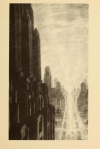
United Nations, New York, NY – Bird’s-eye perspective looking south. 1947
On a recent trip to the National Building Museum, I encountered a book of drawings by the architectural draftsman Hugh Ferriss, 1889-1962. The name was new to me, but the style was immediately recognizable: Muted, glowing cityscapes, rendered in charcoal, evoking the beauties of classical modernist architecture, as well as memories of a now-vanished future.
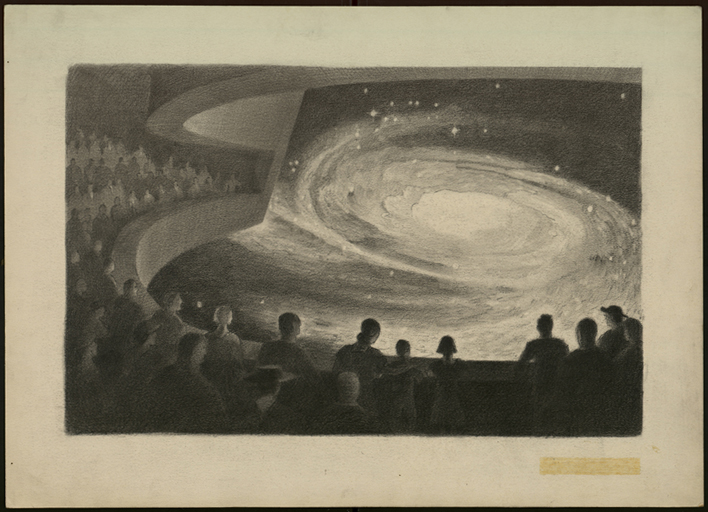
Some of his subjects are still around, of course. Ferriss, who was based in New York City, did architectural drawings for many familiar buildings, such as the United Nations and the Hayden Planetarium,
Hugh Ferriss, “Preliminary Report to the Hayden Planetarium Authority,” Nov 1941-Feb 1942.
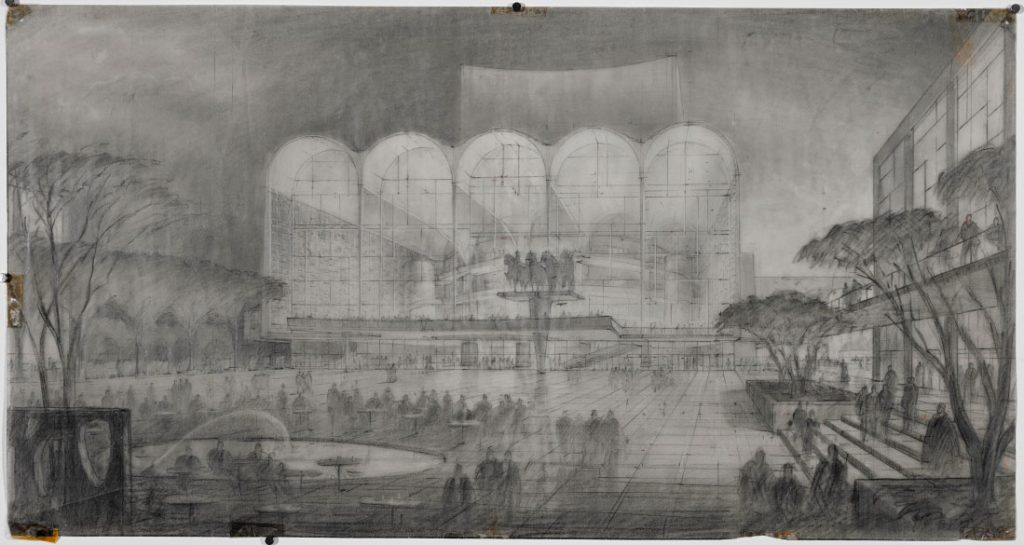
Lincoln Center for the Performing Arts. Center of the Center, 1958.
Another depicts a building that he didn’t live to see completed, the Metropolitan Opera House at Lincoln Center. (The trademark arches are clear, but otherwise the plaza doesn’t bear much resemblance to how it was built, much less how it is today. )
With a bit of digging, I found The Metropolis of Tomorrow, Ferriss’ poetic speculations, published in 1929 (in which 2018 must have seemed tomorrow and then some). In a charming introduction, he disclaims any particular prophetic ability, noting that he did these in his leisure moments, and that they reflect “wondering in drawings” about where then-current architectural trends might lead.
Fascinating to browse (even if some of his utopian visions are a bit totalitarian in character). A full imaginary city takes up the final section of the book, and has has zones for business, art, science, technology, etc., and a grand tower for philosophy, “where art and science meet.” You can browse the entire book at the link above.
Like most of the known universe, I am, however reluctantly, on LinkedIn. Today, following a contact request I was greeted with this.
For the innocents among you, Grindr is a gay social networking app. I have never heard it referred to as anything but a hookup app when described by gay men, but they perhaps find that a bit limiting. That they would want a former Congressional researcher, news librarian, and manager of an information service on opera is unlikely.
Still, I followed the link to their page and found this video.
I will refrain from additional comment about the combination of Grindr, hackathon, and security engineers who appear to be wearing unicorn pajamas.
P.S. Best use I have heard for Grindr: a guy in NYC who uses it to find bathrooms in the city when he needs a bathroom break, and no public facility is near by. Uber for when you need to pee!
Farewell, my lovely. A Xerox copier from the 1960s, now at the Museum of American History in Washington, DC.
Xerox, a giant of my generation (its name had become a verb) seems to be breathing its last, as it is acquired by Fujifilm (story in today’s NYTimes).
“How Xerox fell so far is a case study in what management experts call the “competency trap” — an organization becomes so good at one thing, it can’t learn to do anything new.”
Somewhat undercutting this thesis, the writer mentions that Xerox did try to do a bunch of different things as the environment changed, just not all that successfully. Still the later point, made by a comparison with Apple, is that experience can actually inhibit certain kinds of innovation.
To wit: Xerox famously did pioneering work on computer interfaces, the mouse, and other technology well before the personal computer revolution. A young Steve Jobs visited Xerox Park in Palo Alto, a story that is now one of the foundational bed-time stories for Silicon Valley, and saw some of this technology, which later made into his products.
The Times piece concludes,
Over the years, Apple has had its own ups and downs. But whenever Mr. Jobs became convinced that something new was afoot, he moved forcefully and refocused the company. He did not fall into the competency trap, and today Apple is the most valuable corporation in the world.
Jobs was all kinds of things no doubt, but just yesterday I read this bit from a memoir of working with him, tweeted by Bethany Bongiorno, formerly an engineering director at Apple.
At one point Steve wanted to turn UIKit elements orange. Not just any orange, he wanted a particular orange from the button on a certain old Sony remote. We got a bunch of remotes from Sony with orange buttons to try and find the right one. in the end, Steve hated it.
That’s sure not the competency trap, what it is exactly probably couldn’t be summed up in a management concept, but it does hint at the pure wildness and level of detail the late CEO of the world’s most valuable tech company engaged with.



 Many of my ‘composer crushes’ over the years have come and gone, as they do. However, my love for G.F. Handel never fades.







 A Few Reasonable Words