The Cicadas are Coming

Science writer Carl Zimmer has a piece on the emergence of the 17-year cicadas in Tuesday’s Timescicada, with a great lead:

From North Carolina to Connecticut, billions of creatures with eyes the color of blood and bodies the color of coal are crawling out of the earth.

He’ll be adding an interactive map of their infestations (somehow a little more unsettling than the travels of the monarch butterflies, tracked in  Learner.org’s Journey North).

I lived through a previous emergence of  “Brood II” (1979 I think) in Salisbury, MD, and it was like something out of a Sci Fi film. Our tree-lined front sidewalk was coated with insects, and the night sounds were theirs entirely. Now I’m right next to Rock Creek Park, and haven’t caught site of one yet, but am expecting (and actually looking forward to) an evening symphony of their “dry and exalted” sounds, (as James Agee put it).

Keep Calm, They're Only 17-Year Cicadas

Gameland: Nintendo’s Gay Marriage option is a bug, not a feature

NPR reports that the ability of men to marry men in Nintendo’s Tomodachi Collection: New Life was merely a software glitch, not some trail-blazing effort at marriage equality for cute imaginary Japanese characters.

http://www.npr.org/blogs/thetwo-way/2013/05/14/183902153/reports-bug-allows-gay-marriage-in-video-game-fix-likely

Screen Shot 2013-05-15 at 9.15.55 AM
Not on Nintendo’s watch.

I guess that means any nuptials between Mario and Luigi are off. (Ooops, they’re brothers anyway, right?) Hello Kitty is no doubt above it all.

Reasonable Words: Ed Kilgore

The always readable Ed Kilgore of Washington Monthly on whether our thirst for scandal can be ever be slaked.Screen Shot 2013-05-14 at 7.18.51 AM

http://www.washingtonmonthly.com/political-animal-a/2013_05/a_reminder044719.php

I don’t get the sense, though Lawrence quotes a few, that too many Republicans are thinking there’s a downside to going scandal-crazy. If anything, going into a “base-dominated” midterm election with a party that refuses to get anything done in Congress requiring compromise and that isn’t real flush with policy ideas, Republicans are going to be sorely tempted not to talk about anything but scandals (and perhaps Obamacare, which they are already treating as a “scandal” in itself) for the next year-and-a-half.


Photos: Recent Travels

Lots of time on the road for work, and here are a few snapshots from trips.

And Elizabeth Bishop on whether it’s worth getting out of the house in the first place:

Questions of Travel

There are too many waterfalls here; the crowded streams
hurry too rapidly down to the sea,
and the pressure of so many clouds on the mountaintops
makes them spill over the sides in soft slow-motion,
turning to waterfalls under our very eyes.
–For if those streaks, those mile-long, shiny, tearstains,
aren’t waterfalls yet,
in a quick age or so, as ages go here,
they probably will be.
But if the streams and clouds keep travelling, travelling,
the mountains look like the hulls of capsized ships,
slime-hung and barnacled.

Think of the long trip home.
Should we have stayed at home and thought of here?
Where should we be today?
Is it right to be watching strangers in a play
in this strangest of theatres?
What childishness is it that while there’s a breath of life
in our bodies, we are determined to rush
to see the sun the other way around?
The tiniest green hummingbird in the world?
To stare at some inexplicable old stonework,
inexplicable and impenetrable,
at any view,
instantly seen and always, always delightful?
Oh, must we dream our dreams
and have them, too?
And have we room
for one more folded sunset, still quite warm?

But surely it would have been a pity
not to have seen the trees along this road,
really exaggerated in their beauty,
not to have seen them gesturing
like noble pantomimists, robed in pink.
–Not to have had to stop for gas and heard
the sad, two-noted, wooden tune
of disparate wooden clogs
carelessly clacking over
a grease-stained filling-station floor.
(In another country the clogs would all be tested.
Each pair there would have identical pitch.)
–A pity not to have heard
the other, less primitive music of the fat brown bird
who sings above the broken gasoline pump
in a bamboo church of Jesuit baroque:
three towers, five silver crosses.
–Yes, a pity not to have pondered,
blurr’dly and inconclusively,
on what connection can exist for centuries
between the crudest wooden footwear
and, careful and finicky,
the whittled fantasies of wooden footwear
and, careful and finicky,
the whittled fantasies of wooden cages.
–Never to have studied history in
the weak calligraphy of songbirds’ cages.
–And never to have had to listen to rain
so much like politicians’ speeches:
two hours of unrelenting oratory
and then a sudden golden silence
in which the traveller takes a notebook, writes:

Is it lack of imagination that makes us come
to imagined places, not just stay at home?
Or could Pascal have been not entirely right
about just sitting quietly in one’s room?

Continent, city, country, society:
the choice is never wide and never free.
And here, or there . . . No. Should we have stayed at home,
wherever that may be?”

–Elizabeth Bishop

Beautiful Music: Alessio Bax

Screen Shot 2013-05-14 at 6.56.14 AMGreat young pianists will always be with us, but nosing around Naxos Music Library I came upon Alessio Bax and think he stands out from the crowd of ferociously talented players on the scene. The Italian-born pianist has just released a CD of Brahms, (much praised in Gramophone Magazine) and joins a bunch of great Italian pianists (Maurizio Pollini and Maria Tipo come to mind) who have a compelling way with German romantic repertoire, music that in other hands sometimes sounds sluggish and overwrought.

I couldn’t find footage of him playing Brahms, but here’s a nice Bach transcription courtesy of WQRX. (Bax has done a recording of them).  Following is a blistering account of the fugue from the Hammerklavier, played for a masterclass with Daniel Barenboim.

Barenboim’s comments are available as well, and together the clips provide an insightful tour of this monumental piece, which Bax already plays at a commanding level.

Reasonable Words: Sean Carroll on the Templeton Foundation

Caltech Physicist Sean Carroll has a level-headed response to the Templeton Foundation, and scientists who take money directly from it.

And that’s the real reason why I don’t want to be involved directly with Templeton. It’s not a matter of ethical compromise; it’s simply a matter of sending the wrong message. Any time respectable scientists take money from Templeton, they lend their respectability — even if only implicitly — to the idea that science and religion are just different paths to the same ultimate truth. That’s not something I want to do. If other people feel differently, that’s for them and their consciences, not something that is going to cause me to shun them.

It’s [shift in perspective from theism to atheism] the one piece of scientific/philosophical knowledge that could really change people’s lives. So in my view, we have a responsibility to get the word out — to not be wishy-washy on the question of religion as a way of knowing, but to be clear and direct and loud about how reality really works. And when we blur the lines between science and religion, or seem to contribute to their blurring or even just not minding very much when other people blur them, we do the world a grave disservice.

Interesting comments, including some from the evolutionary biologist, Jerry Coyne, author of “Why Evolution is True

http://whyevolutionistrue.wordpress.com/2013/05/12/templeton-sean-carroll-and-the-ethics-of-mixing-science-and-faith/

ple_130425_ladanyi_1600
Hungarian Spring Eclipse from Astronomy Photo of the Day

A small sideline to this issue, I’m on Carroll’s side (not as purist as Coyne), but another thing in the mix: even if you are a believer (and I’m not), “religion” is not one undifferentiated mass of work. Different religions believe profoundly different things about the nature of reality (means and ends). Just as Templeton, to me, is off-base to believe in the potential synthesis of scientific and religious ways of thinking, the “all religions are streams heading to the same sea,” idea, although romantically appealing, is also flawed.

Unreasonable words: Some Birthday Haiku

Screen Shot 2013-05-13 at 9.36.29 AM

 
Facebook told me that
     it is your birthday today.
and they wouldn’t lie.

Wow! It’s your birthday!
    That reminds me of a joke
about old people.

I would sing for you
    but the Birthday Song is still
under copyright.

From a cute site called Haiku Poetry, Experiencing the World in 5-7-5.

Beautiful Pictures: Harpers Ferry


Got an early birthday present–a trip to Harpers Ferry, WV. Beautiful place with a bloodied, storied history. Took lots of photos, and here are a few.

Paper vs. Screen: Can you do academic reading on an iPad?

Last year I interviewed a bunch of college teachers as part of a work project.  Although my focus was getting user feedback on a new online educational product, as an aside, I asked the group about their own and their students’ attitude towards e-texts. I was struck by how uniform they were in dissing e-textbooks, and how frustrated students were with them.

ipad-mini-mock-up-full-view
iPad vs. dog-eared treasured volume? Which does your brain really want?

For this group (a very small n), e-readers (whatever the brand) were personal objects, fine for “recreational reading” but not suitable for academic work. Surprisingly, this even was true for law and criminal justice students, who have to lug around such massive tomes. You’d think that the weight factor would trump other considerations, but it wasn’t so.

When I probed a bit for reasons, the most frequent answer was that page numbers were not uniform (which would seem to be an easy problem to solve technically, but is kind of a psychological barrier; “80 pages of econ to read by Friday” being a college trope ). Also mentioned were the difficultly of note-taking and highlighting (functions that are available, but a bit more complicated than on paper) and the generally bad (or at least different) layout and typography.

IScreen Shot 2013-05-12 at 5.23.47 PM have an iPad and have found it okay for reading fiction. I have read William Morris’ News from Nowhere (somewhat ironic that given his anti-technology philosophy) and Jude The Obscure, both free from Project Gutenberg, and I bought Bullfighting, a collection of short stories by Roddy Doyle, in an e-edition. The cognitive experience didn’t feel much different, and although I wasn’t trying to do anything that people complain about (reading assigned pages, jumping around, taking notes, copying sections etc.) They were all wonderful by the way. Also, I am an “Alice in Wonderland” style reader:

The White Rabbit put on his spectacles. ‘Where shall I begin, please your Majesty?’ he asked.

‘Begin at the beginning,’ the King said gravely, ‘and go on till you come to the end: then stop.’

Given that it’s always been hard for me to do anything but work through a book from page 1–or to stop reading a book, however lousy, once I’ve started–perhaps I’m not a fair test of e-reading versus print. That said, I haven’t read much non-fiction on an e-reader, except for O’Reilly books, including a book on how to use Apple’s iBook Author program, (which ironically, would have been much easier for me to deal with in printed form).

All this as (overlong) preliminary to an interesting piece in Scientific American on the brain in e-reading.

http://www.scientificamerican.com/article.cfm?id=reading-paper-screens

The Reading Brain in the Digital Age: The Science of Paper versus Screens

How exactly does the technology we use to read change the way we read? How reading on screens differs from reading on paper is relevant not just to the youngest among us, but to just about everyone who reads—to anyone who routinely switches between working long hours in front of a computer at the office and leisurely reading paper magazines and books at home; to people who have embraced e-readers for their convenience and portability, but admit that for some reason they still prefer reading on paper; and to those who have already vowed to forgo tree pulp entirely. As digital texts and technologies become more prevalent, we gain new and more mobile ways of reading—but are we still reading as attentively and thoroughly? How do our brains respond differently to onscreen text than to words on paper? Should we be worried about dividing our attention between pixels and ink or is the validity of such concerns paper-thin?

Read the full article.

I wonder if MOOCs come with print textbook requirements? Would seem as archaic as requiring a modern college student to bring a typewriter…

Career Words: What do you want to do when you grow up?

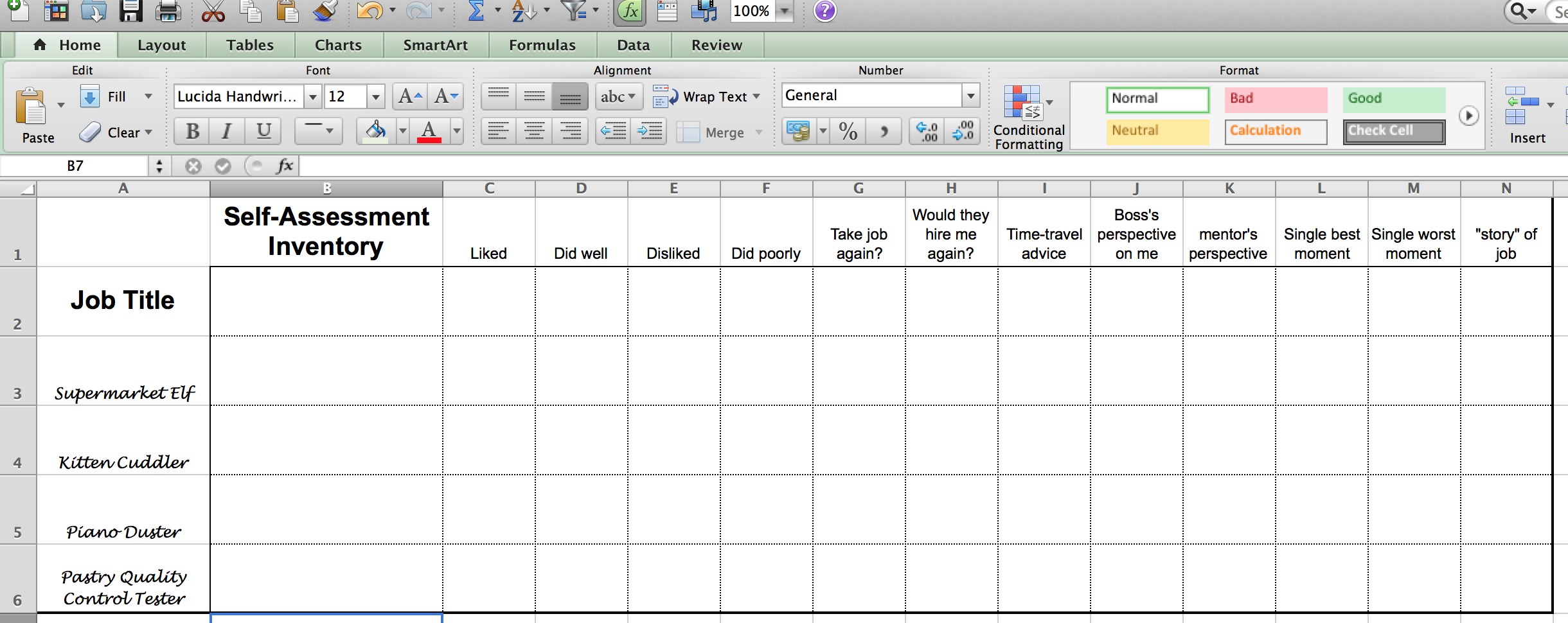
Last year, in the midst of my own (and a number of my friends’) mid-life “What am I doing?” moments, I came up with a career inventory spreadsheet (whatever the problem in life, I generally think a spreadsheet makes it better. Sit down, have a cup of tea, and make a spreadsheet, that’s my motto.) Below is a copy of the inventory.

Perhaps it will be of use to someone else trying to get a handle on what they really want to do for work–or what matters most about the work they are doing now.

Career Inventory (Can do in a spreadsheet or whatever tool suits you).

Format: list on a page your career history going back as far as is meaningful for you. (Don’t need to include summer, or school jobs if it was just for the bucks.)

List title and place of job (or educational activity) rough dates. For each, write as many responses to these prompts as you can. (Some it won’t be necessary/possible for.) Easy to do this as rows and columns in a table.
a. What, if anything, did I like about the job?
b. What did I do well in this job?
c. What, if anything, did I dislike about the job?
d. What did I do poorly in this job?
e. Would I take this job again? (Why/why not?)
f. If I were the (objective) boss would I hire me again? (why/why not?)
g. If I were traveling back in time to give advice to myself about this job, what would it be?
h. If I were going back to talk to the boss about my strengths and weaknesses? What would he or she say? [use the language they would have used.]
i. Did I have a mentor in this job? If so, what did he or she say? Did I follow that advice? [use the language they would have used.]
j. What was the single least rewarding aspect of this job? be as specific as possible and give concrete details).
k. What was the single most rewarding moment in that job?
l. What story do I tell to outsiders about that job? What story do I tell myself? How does this story make me feel?

You can adjust the questions as you need to, but you get the sense of it. It is important to try to consciously put yourself in the position of others around you for questions that refer to others. And for your own reflections about what you liked or disliked, it’s important not to lie to yourself about your answers; for instance, saying what you “should” have liked most. If you liked that you got paid a lot, or got to work out of doors, etc. that’s what you should put down.

Bullets are fine. Doesn’t have to be an essay.

After you have done this for any work that was meaningful, let it sit for a day or two and then come back to it and “code” it. Meaning, pull out lists of all the positive answers and all the negative answers, and look for themes. Continue to boil it down as much as seems useful.

After you have completed this, look at the positives, and ask yourself whether they are available and can be optimized where you currently are or whether it’s just a mismatch. If they can be optimized, make a plan to do that, if they can’t, make a plan to move on.

Here is the Career Inventory as a PDF.

Screen Shot 2013-05-10 at 7.31.21 AM
How the spreadsheet version might look, but you can do it any way you like, of course.

New York by Frank Gehry
A photo I took of Frank Gehry’s building at 8 Spruce Street in Lower Manhattan while visiting the city for work a few weeks back. Hard to see (sorry, it’s just an iPhone snapshot), but at the top is a team washing windows. As I walked to a business meeting, inside, no harness required, I reflected that I have a very easy job.