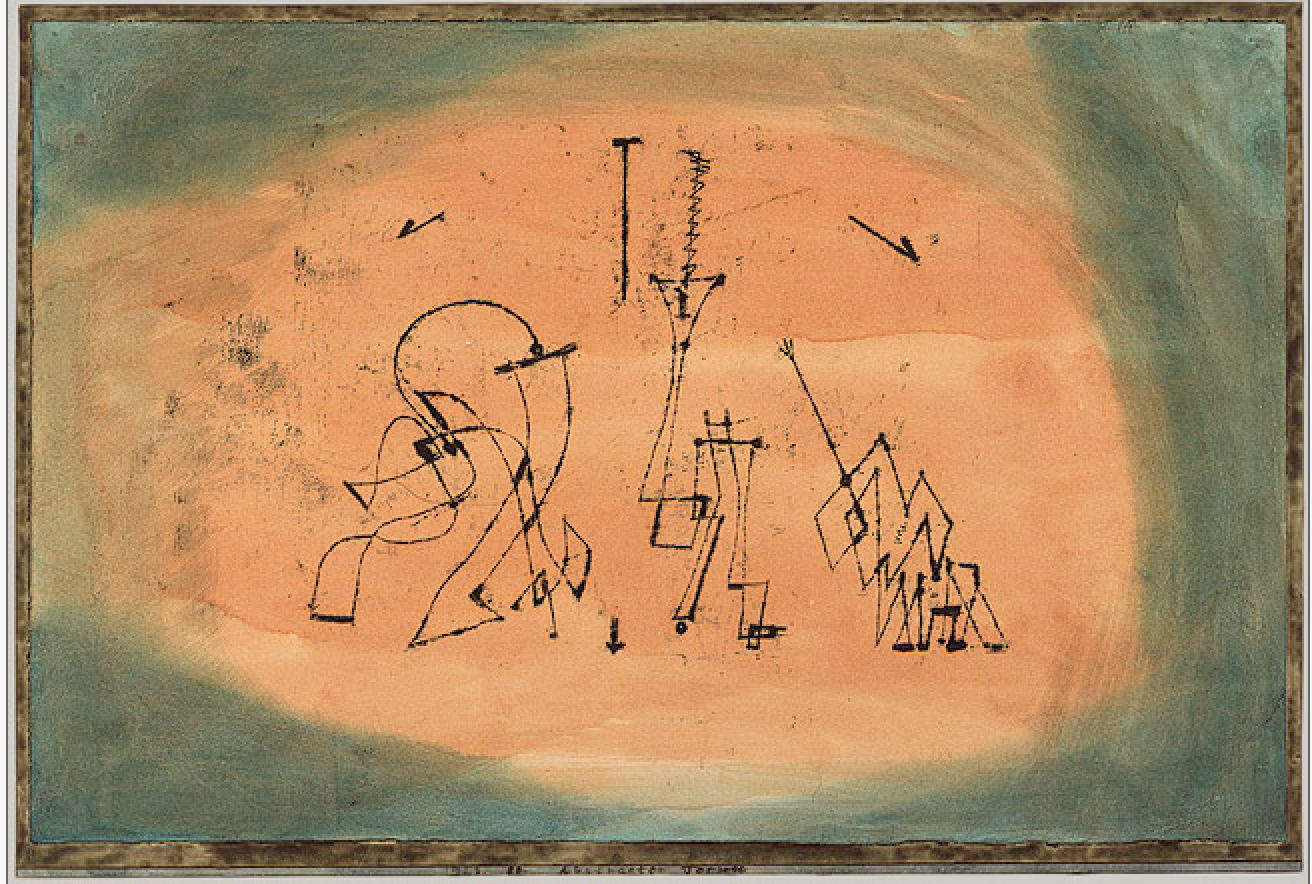
Once, in China, the writer and director Anthony Minghella came upon a street artist working randomly on a pavement picture. “What are you doing?” Minghella asked. “Taking a line for a walk,” the artist replied. He was quoting the Swiss painter Paul Klee.
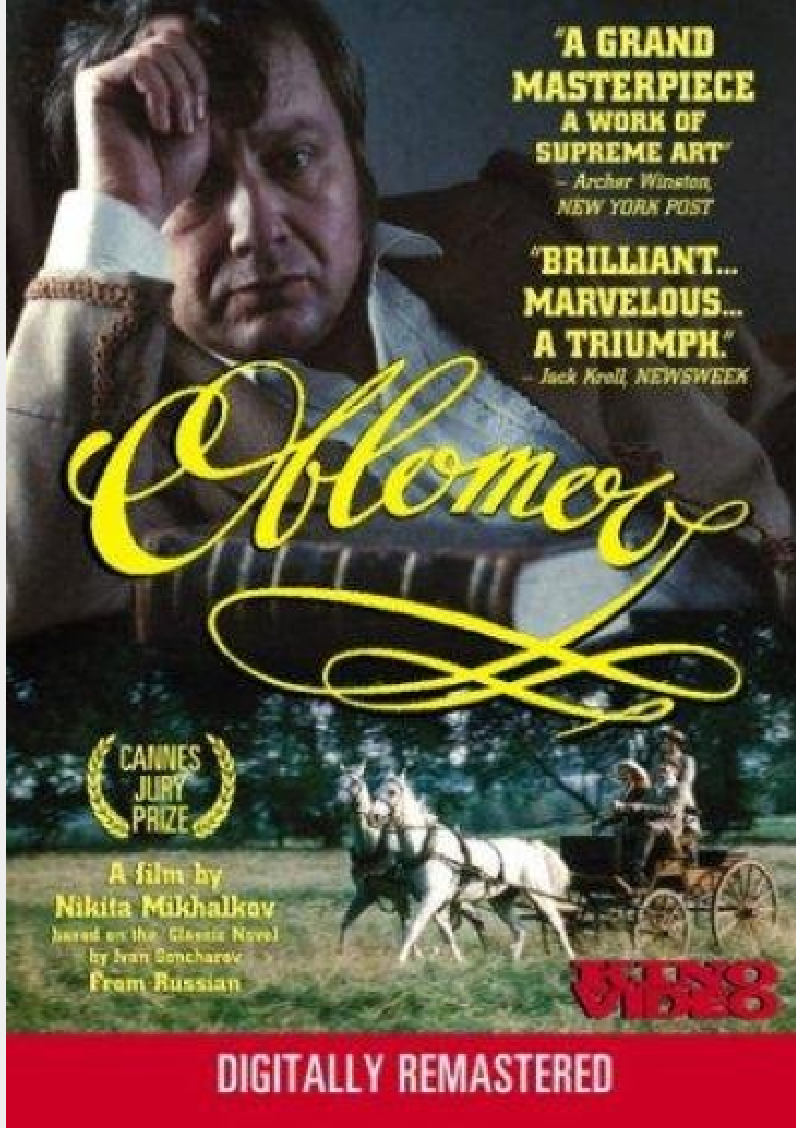
Laying about reading about a layabout: Finally got to Ivan Goncharov’s Oblomov a relaxed Russian novel about a character who abstains from just about everything. (There’s a beautiful film of the story I saw in college.)
Early in the book, the narrator gives us Oblomov, at the close of his school and civil service career (but still a relatively young man):
He returned to his seclusion without a store of knowledge which might have given a definite direction to his roving or idle and dreamy thoughts. What did he do, then? Well, he still went on drawing the pattern of his own life. He found in it, not without reason, so much wisdom and poetry that it provided an inexhaustible source of occupation apart from any books and learning. Having given up the service and society, he began to seek another meeting for his existence; he pondered what he could have been destined for, and at last discovered that he could find enough scope for activity in living his own life. He understood that his allotted portion was family happiness and the care of his estate.
I love Ob, not only for making laziness poetic, but because he makes those becalmed, endlessly ruminating Chekhov characters (whom I also hold dear) seem as energized as slides out of a Steven Covey Habits of Highly Effective People PowerPoint.
For Whom Is College Being Reinvented?
‘Disruptions’ have the buzz but may put higher education out of reach for those students likely to benefit the most.
A few choice bits:
A ‘Mass Psychosis’
Higher education does have real problems, and MOOC’s, badges—certificates of accomplishment—and other innovations have real potential to tackle some of them. They could enrich teaching, add rigor, encourage interdisciplinarity, reinforce education’s real-world applicability, and make learning more efficient—advances all sorely needed.
But the reinvention conversation has not produced the panacea that people seem to yearn for. “The whole MOOC thing is mass psychosis,” a case of people “just throwing spaghetti against the wall” to see what sticks, says Peter J. Stokes, executive director for postsecondary innovation at Northeastern’s College of Professional Studies. His job is to study the effectiveness of ideas that are emerging or already in practice.
He believes that many of the new ideas, including MOOC’s, could bring improvements to higher education. But “innovation is not about gadgets,” says Mr. Stokes. “It’s not about eureka moments. … It’s about continuous evaluation.”
Even more trenchantly from the president of Trinity College in DC who suggests a “follow the money” line of inquiry.
When does the MOOC bubble burst? Is there a Coursera Stats course I need to take to find out?
“The idea that they can have better education and more access at lower cost through massive online courses is just preposterous,” says Patricia A. McGuire, president of Trinity Washington University. Seventy percent of her students are eligible for Pell Grants, and 50 percent come from the broken District of Columbia school system. Her task has been trying to figure out how to serve those students at a college with the university’s meager $11-million endowment.
Getting them to and through college takes advisers, counselors, and learning-disability experts—a fact Ms. McGuire has tried to convey to foundations, policy makers, and the public. But the reinvention conversation has had a “tech guy” fixation on mere content delivery, she says. “It reveals a lack of understanding of what it takes to make the student actually learn the content and do something with it.”
Amid the talk of disruptive innovation, “the real disruption is the changing demographics of this country,” Trinity’s president says. Waves of minority students, especially Hispanics, are arriving on campus, many at those lower-tier colleges, having come from schools that didn’t prepare them for college work. “The real problem here is that higher education has to repeat a whole lot of lower education,” Ms. McGuire says. “That has been drag on everyone.”
Much of the hype around reinvention bypasses her day-to-day challenges as a president. “All of the talk about how higher education is broken is a superficial scrim over the question, What are the problems we are trying to solve?” she says. The reinvention crowd has motivations aside from solving higher education’s problems, she suspects: “Beware Chicken Little, because Chicken Little has a vested interest in this. There is an awful lot of hype about disruption and the need for reinvention that is being fomented by people who are going to make out like bandits on it.”
Overall, the Chronicle piece is a little muddled, befitting the topic. How do you describe a bubble from the inside anyway? It looks beautiful and shiny, and then it pops.
Of course, I’ve got MOOC musings of my own, but will save them for another day.
Info from a group out of the Berkeley Library School on a project they have been doing to archive audio, Pop Up Archive. Do you have audio content that could help them beta test?
Their letter, with an explanation of the tool:
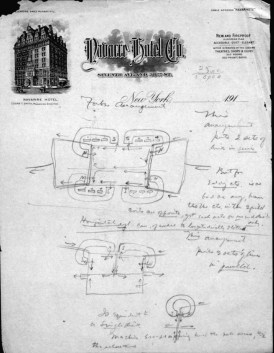
Lee De Forest’s schematic diagrams and scientific notes on hotel stationery, ca. 1915. (From The Library of Congress American Memory site.) De Forest was a technical pioneer of radio.
Dear Arthur,
It’s been a really exciting year. Things have been changing rapidly for Pop Up Archive since we won the Knight News Challenge in September. The Pop Up Archive site is nearly ready. It is a simple system for marking up and storing audio and related material, leveraging existing tools and developing standards to build a repository of oral history records and foster new methods for search and discovery. We’re planning to debut the site in March at SXSW:Interactive.
At this moment, we’re busy hammering out the platform itself with our friends at PRX, but technology is nothing without content. So we’re also reaching out to friends with amazing audio in the hope that we’ll be able to include their collections in Pop Up Archive. We’re working to secure records from larger organizations like WGBH and WNYC as well as media from independent producers and small archives. It would be awesome if you’d could pass the word along to anyone you think might be interested.
So what does Pop Up Archive do exactly? Put plainly, Pop Up Archive is a repository of oral history records that:
Preserves digital audio. Valuable cultural material is lost every time a harddrive dies or a folder gets erased to make more space on your laptop. Pop Up Archive enables anyone to add archival records and safeguard media privately on Pop Up Archive servers or publicly at the Internet Archive.
Makes it easy to add metadata. Pop Up Archive uses speech-to-text software to create useful subject tags about your audio automatically. You’ll also be able to add custom metadata using a simple form or by importing your existing CSV or XML records.
Enables anyone to search, filter, and access a substantive database of archival material from oral history archives, media stations, and individuals. However, we realize that not all audio is ready to be shared, so users will also be given the choice of storing their audio publicly or privately.
We’re trying to get a good base of beta testers so that we can start user testing. We’re eager to have users try out our batch upload and auto-tagging process so that we can improve the service and find out what other features people would be interested in. Also, if you’re planning to make it to SXSW this year, we’re hosting an archiving workshop and we’d love to see you there. Thank you for being a friend of Pop Up Archive!
Library school dropout though I am, I’ve always been fascinated by meta-data, and, in particular, have wondered why there is no WordPress-level practical solution for archiving web and other forms of digital production. From a web producer’s point of view, at least, adequately saving not only the finished web site but the resources, assets, and decisions that went into a digital project is nearly impossible. Pop-Up aims to do the job for audio it seems.
Looking at their report, I see that they used Omeka, an open-source platform for publishing content from museums and archives. After a quick glance, seems as if it lets discipline specific programs for various related tasks talk to each other, porting internal records to public facing web sites. (A little like American Memory?) When do catalogs become exhibits?
I’ll nose around more and report what I learn. In the meantime, ponder the wonderful names of the software programs for museum collection management mentioned by the Omeka team: Emu, PastPerfect, Pachyderm. (“Could I get the help desk please, my Pachyderm has crashed.”)
Got myself down to the Terrace Theater at the Kennedy Center last night to hear the Harlem String Quartet with pianist Misha Dichter. They were the subject of great two-part piece by Geoff Edgers in the Globe, and have recently been through a real (rather than made up) personnel crisis. I wanted a chance to hear them in person.
The newly constituted group–both the violist and cellist are recent additions–has great chemistry, and their program of Shostakovich, Chick Corea (with whom they perform), and Schumann came off well–and was a good musical meal. Their playing is sinewy, but also swings. Big moments are invariably thrilling, with a rich full sound (if a tad samey–there is more than one way to light a big canvas, and the Schumann Piano Quintet would have worked better if the range of forte moments had more variety of color.)
The fugue in the Shostakovich Quintet could have been written for them–the insinuating lines crept in like long shots in a great noir classic movie. It’s a “looking around the corner” piece, and first violinist Ilmar Gavilin’s twisty-turny style with a phrase is stunning (he missed a harmonic or two, but like the violist’s sketchy tuning in some of the Schumann, these were easily overlooked blemishes in performances that have so much verve.)
Dicter, admirable and clear though he was, didn’t do a lot for me personally. Big sound, lucid and accurate approach to the notes, but dull tone color and not much English on the ball. I realize that quibble is mostly taste on my part–I like pianists who make the piano sound like anything but a piano, even if they don’t play as well technically as Dichter (and god knows a lot don’t). But he was a good colleague, gamely pounding through “Take the A Train” as an encore with the Quartet, with the subtlety of a Mac truck.
In truth, the subtle light touch is the one thing I was missing in the evening as a whole. The Shostakovich has one of his wondrous, busy scherzos. (Check out Argerich and company in it.) What is the place where this scherzo unfolds? The crazy workshop of a whimsical watch maker? Is some kind of odd handmade contraption taking flight? Harlem St. Quartet played it hell-bent for leather (getting an ovation just for the movement) and it was thrilling, but in an industrial-sized way. The tiny, subtle jokes (a sly piano scale here, a ricochet bowing there) got brushed over. It also seemed rushed; fast music is somehow more (paradoxically) effective when even the most whiplash fast bits seem like they have all the time in the world around them. As the violin teacher Suzuki said in one of his many Zen-like pronouncements, “there is more to life than making it go faster.”
Still, the group has their own rich sound, their own boundless energy and unbridled joy in making music. They are on their way.
Storyteller and author Diane Wolkstein, associated with the American Museum of Natural History, among other venues, died last week at the age of 70. I learned about her through a TV series and Web site I worked on for Annenberg Media, Invitation to World Literature, which featured, among its 13 works, “Monkey King,” a book new to me at the time that has since become a touchstone. It’s a massive, shaggy story about the journey of four unlikely characters including a mischievous Monkey King with mad magic powers and no-self discipline, a priest with self-discipline to the point of wimpiness, and Pigsy and Sandy, whose attributes can be guessed by their names.
They set off together to retrieve Buddhist scriptures in India and bring them back to China (the story has some vague basis in fact: a priest did make such a journey) but they run into every kind of obstacle and impediment, bureaucratic, natural and supernatural. And as religious and “life’s journey” parables go, it’s unique in being both profound and laugh-out-loud-on-the-subway funny.
When we did a video of it for the Annenberg series, the production team found Diane who had been living with the text of Monkey and performing it for years. Her site has something she wrote about the experience for “Storytelling Magazine:”
I set out to comprehend this 2,200 page novel by telling parts of it in Chinatown to Chinese immigrants to increase their knowledge of English. Six months later in March 2008, I produced a three-day marathon with 26 storytellers telling the entire epic. I then selected 20 of the 100 episodes and told them in every venue imaginable: in libraries in the Bronx to Afro-American teenagers, in universities in Taiwan to Buddhist nuns and students, in theatres and museums in New York, Canada, and Australia; alone and with musicians. A bit like a chameleon, the story stretched to become raucous, philosophical, adventurous, and spiritual, depending on the venue.
By the end of two years, by adding one episode to another and discussing the episodes with the audiences, I began to grasp the character of Monkey King and could tell a 45-minute version, spanning Monkey King’s birth to his imprisonment in the mountain.
In 2010, my trip to Taiwan to study Mandarin and work with qigong masters, brought unexpected insights. In their temples and in their homes, I experienced the great love the Chinese people have for Gwan Yin, the guiding Spirit who “supervises” the journey. Meeting with Zen Master Cheng Yeng, the founder of Tzu Chi Foundation, which is dedicated to the relief of suffering worldwide, actualized my understanding of both Gwan Yin and Xuanzang’s dedication to others.
The joy of working on a big story is the wisdom we discover both outside and within. We set out with the story’s protagonists in one place and then travel to a deeper interior territory. We experience and understand new and different emotions and feelings. It takes a long time, because transformation is slow and repetitive. (“Fall down seven, get up eight.”) Inviting others to share this opportunity with us enriches the process and links us to the wisdom of those who have already made the journey. I am still en route.
Diane Wolkstein in the “Journey to the West/Monkey King” episode of Invitation to World Literature.
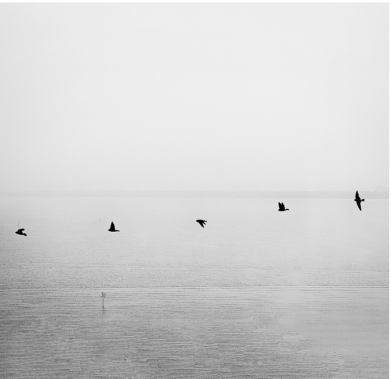
From today’s Poetry Daily, Not a new trope (birds + poems = love always), but I smiled at “riding on contingency,” which brought to mind birds I saw one day walking along the Hudson, wisecracking sea gulls in particular with their eye on the main chance.
Five White Birds
Having seared the sky, the sun—a brazier—
smolders through the crumbling clouds
upriver; to the east, rich mounds of smoky
vapors, signifying rain tomorrow, drift on.
Five white birds rise suddenly, fanned out,
flushing from a maze of roofs and gardens
well below my windows, topping mushroom-
rounded oak trees and the heady sycamores.
Riding on contingency, the birds with ease
glide upward, bodies turned to movement,
backlit from the final sun rays on the scrim
of sky and thought, as flashes of pure being—
foreseeing, passing, leaving all one ecstasy.
Drawing light against the indigo of evening,
they separate a moment, fingers spreading
from a palm, then close together to compact
their various motions into one white wedge,
which flies along the river now, accentuating
giant cranes, the beaks of freighters moored
among the Harmony Street wharves. I watch
the light reflected on sleek forms, which dip,
then disappear, a note, a point, a nothingness.
The swept effect remains, a smoothing-over
of asperities, a pentimento that refines the day,
its painted infelicities recolored in the silver
twilight. So one is, and is not, what has passed,
windy patterns on deep, loamy grasses, stilled
at dusk, a watermark of images upon the mind,
wings beating for a glassy moment in desire—
a gesture’s meaning as the shaken air resounds.



 Got myself down to the Terrace Theater at the Kennedy Center last night to hear the Harlem String Quartet with pianist Misha Dichter. They were the subject of great two-part piece by Geoff Edgers in the Globe, and have recently been through a real (rather than made up) personnel crisis. I wanted a chance to hear them in person.

 A Few Reasonable Words