Commonplace Book: Steven Millhauser

I seem allergic to the fiction in the New Yorker (not the pieces, but somehow its place at the kids’ table in the back of the magazine never works for me maybe.) But the name Steven Millhauser makes me drop everything and read whatever it is he’s written wherever I come across it. (He had me at Martin Dressler 15 years ago, and I haven’t looked back. “The New Automaton Theater,” too, part of that anthology of great short stories I curate in my head.)

From his story in the 12/10 NYker, which I started my morning with:

Screen Shot 2012-12-08 at 9.17.22 AM
Steven Millhauser

“His grave father bent over the Scrooge McDuck comic, praising the diving board in the money bin. Reading “Tootle” to him, telling him how good the first sentence is. “Far, far to the west of everywhere is the village of Lower Trainswitch.” Far, far to the west of everywhere. His father said, “There are three great opening sentences in all of literature. The first is ‘In the beginning God created the heaven and the earth.’ The second is ‘Call me Ishmael.’ The third is ‘Far, far to the west of everywhere is the village of Lower Trainswitch.'”

The story is called “A Voice in the Night.” God, childhood, insomnia and Judaism. Plus metafiction. What’s not to love?
Teaching Words: Broadway or Bust

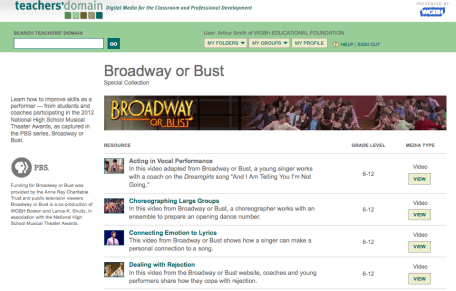
My latest gig was writing for Teachers’ Domain, WGBH’s digital library of resources for teaching and learning. I did the teaching tips for a small collection of clips from a recent PBS series called “Broadway or Bust.” Check it out at http://www.teachersdomain.org/special/bob12/

Screen Shot 2012-12-08 at 8.58.35 AM

The show itself aired back in the fall, but you can still watch it online. As Irving Berlin said, “There’s no people like show people…”

Words: Fightin’ about Writin’

From a (somewhat oversold) article in the Washington Post describing controversy about the new English language standards that are part of Common Core (an emphasis on non-fiction reading and writing that’s going to do in poetry and literature!).

One specific bone of contention, “the personal essay.”

Screen Shot 2012-12-08 at 8.38.52 AM

“Forgive me for saying this so bluntly, the only problem with . . . [that] writing is as you grow up in this world you realize people really don’t give a [expletive] about what you feel or what you think,” Coleman said, according to a recording. “What they instead care about is, can you make an argument with evidence, is there something verifiable behind what you’re saying or what you think or feel that you can demonstrate to me? It is rare in a working environment that someone says, ‘Johnson, I need a market analysis by Friday, but before that I need a compelling account of your childhood.’ ”

The ‘Coleman’ quoted above is now president of the college board and was a force behind the standards.

The debate is silly. The standards don’t really pit Malcolm Gladwell against Emily Dickinson, and even if they did, I have no trouble knowing who would win that round. “There’s a certain slant of light/On winter afternoons” is an example of the right words in the right order that the worthy Mr. Gladwell would not come up with.

And as for Coleman’s point. True dat, that analysts probably don’t have to do “A Child’s Christmas in Greenwich” for their bespoke-suited team leaders, but I think “Creative Non-Fiction” certainly has come in handy in the corporate world. Investopedia takes a game stab at explaining “Off-balance sheet entities.” Just getting good names for your made up companies on your financial statements, such a writing challenge! A reminder of some of the wonderful creative non-fiction that Enron provided their entities, thus adding to the canon: Raptor, Osprey, Zenith and Rawhide. Oops, they were fiction after all.

Beautiful Illustration

Screen Shot 2012-12-03 at 11.57.25 AM
One of Linzie Hunter’s “Spam One-Liners” illustrations

I learned about Thumbtack Press, a nifty Web distributor of illustrators’ work, because of a droll set of illustrations by Linzie Hunter inspired by spam email.

Now Thumbtack has something amazing up, illustrator Colin Johnson’s collage “Flotsam & Jetsam.” Remarkable piece, and remarkable process (which is explained step by step on the Thumbtack Press site).

flotsam&jetsam

Competition for DataViz on Aid

The Guardian has a data beat. Certainly, a good idea, if not always as compelling as it might be, even to a data-head like me. Among their latest offerings, a competition to help improve data visualization of where aid monies go. (Arnab, this is one for you, yes?)

From the site:

Help us visualise the flow of aid around the world. How transparent is aid data? Millions of dollars are spent around the world by governments in helping developing nations but what does it achieve and how much of it can we see?

The Guardian Datastore and Google have teamed up to see who can help visualise the data which can show how governments are shaping the Internet in relation to international development.

We will help start you off by suggesting the data, all you have to do is develop the most imaginative way to help our readers to explore it.

In particular, we are interested in questions like:

• Should governments take censorship into account when they distribute foreign aid?
• What does the current flow of information online/offline looks like vs. flow of foreign aid geographically?
• What impact do sanctions have on the flow of information? How does that map against foreign aid?
• How is international development affected by the free flow of information?

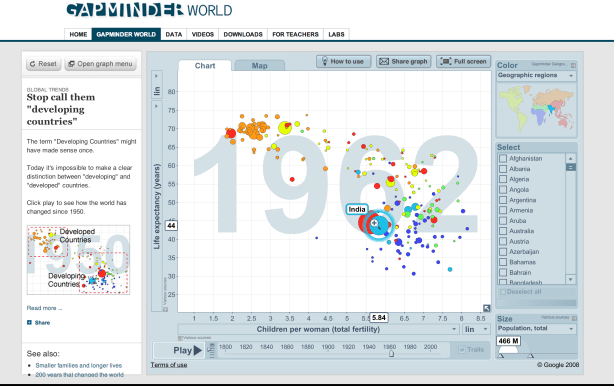
Fascinating list of links at the end. Not mentioned is the GapMinder World site, with its engrossing animations on topics like aid, but a resource which also prompts wonder about when we’ll get a “rhetoric of data” that is equal the answers we need and the media tools we have. At a minimum we need to have a better understand of what we ask of the x and y axes. What we ask of our X and Y axes matter.
Screen Shot 2012-12-01 at 11.05.51 PM
Animated Gap Minder World graph entitled “Stop Calling Them Developing Countries”

Poetry Advice from Robert Penn Warren

Screen Shot 2012-11-30 at 5.43.26 PM
Poets laying in writing supplies.

The poet and novelist Robert Penn Warren mentored a couple of generations of writers, including poet Tim Murphy, to whom he gave this advice:

“Boy, the first line of a poem has to grab you by the throat and say Poetry the same way this Jack Daniel’s grabs your throat and says Whiskey.”

A bit of Warren, from “Evening Hawk:”

Long now,
The last thrush is still, the last bat
Now cruises in his sharp hieroglyphics. His wisdom
Is ancient, too, and immense. The star
Is steady, like Plato, over the mountain.

If there were no wind we might, we think, hear
The earth grind on its axis, or history
Drip in darkness like a leaking pipe in the cellar.

Which in turn echoes a line of Wallace Steven’s long, but magical, “An Ordinary Evening in New Haven”

The last leaf that is going to fall has fallen.
The robins are là-bas, the squirrels, in tree — caves,
Huddle together in the knowledge of squirrels.