The Party After You Left

So, I lived in Somerville’s Union Square until 1999. After that, the hipness fairy descended on it and blessed it.

Here’s Wicked Local singing its praises,

It’s been well over a decade since Davis Square eclipsed Harvard Square’s hip factor. When the Museum of Bad Art was looking for a new home, it chose Somerville. And anybody who’s in the know these days will tell you that Union Square in Somerville in the new hip place to be with events like the Rock ‘n’ Roll Yard Sale, the Fluff Festival and The All-American Beard & Moustache Competition.

Now, I’ve just moved to Takoma Park in time to learn that as the Washington Post puts it,

It’s taken four decades, but Takoma Park may have finally started to leave the ’60s.

After years of flagging interest, the city recently killed its Free Burma Committee. Last month, it made a rare exception to its “nuclear-free zone” ordinance. The city’s corn silo still stands, and Takoma Park still refuses to buy bottled water, but the community tool library is gone, and many of the activists who once defined what has long been called the People’s Republic of Takoma Park are getting older.

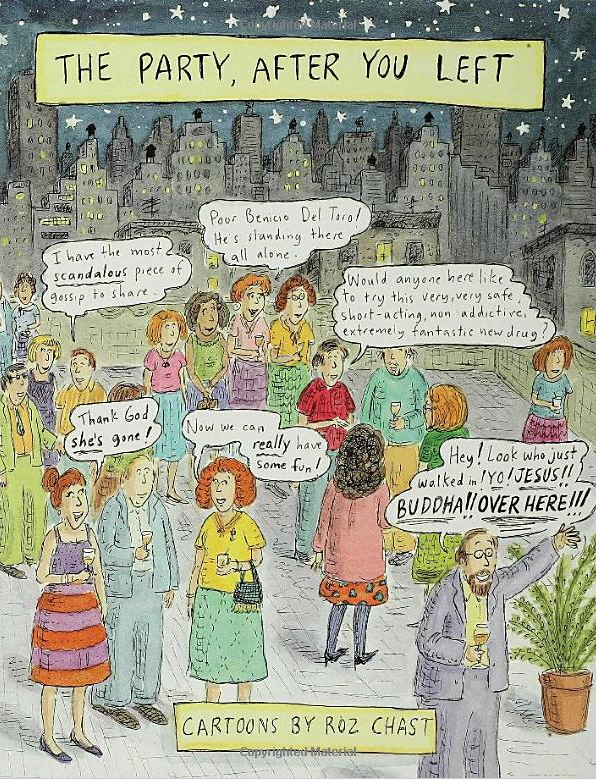
Roz Chast has my number (like all her books, wonderfully wry and well worth checking out):
So You Think You Can Paint

Courtesy of the SF Weekly’s Blog, “The Exhibitionist,” nice video of a club-like event where you can go and paint. Happens for free every Thursday.

More evidence for my possibly crack-pot theory that as so many of us spend work lives, and increasingly personal lives, interacting via screens, the desire to do something that is tangible, not mediated digitally, and happens with people IRL grows. At least this is true for me as a teleworker.

More practically: Why do things like this always seem to start in San Francisco? Is that Oscar Wilde quote to blame (now attributed to Jack London, I hear).

“It’s an odd thing, but anyone who disappears
is said to be seen in San Francisco.
It must be a delightful city and possess
all the attractions of the next world”
― Oscar Wilde/Jack London

The World At Night: Innsbruck

Bad Astronomy tipped me off to a mesmerizing time lapse video of Innsbruck, Austria, by Christoph Malin, who spent 8 months there and took 35,000 photos.

Hard to believe The Milky Way could be that clearly visible from just outside the city. It’s spectacular, and watch for meteors paraboling through. Part of a larger effort called, “The World At Night.” From their web site:

The World At Night (TWAN) is an international effort to present stunning nightscape photos and time-lapse videos of the world’s landmarks against celestial attractions. The eternally peaceful night sky looks the same above symbols of all nations and regions, attesting to the truly unified nature of Earth as a planet rather than an amalgam of human-designated territories.

Abandoned Walmart Reborn as Library

The Huffington Post has wonderful photos of the new McAllen, TX Public Library, a make over of a Walmart the city inherited. Of course, I would love the idea under any circumstances, but the photos make the execution look extraordinary. The color choices and lighting banish any trace of institutional big box.

Tumblr: Architecture

Better idea than the tumblr mentioned in The Independent, just use http://www.tumblr.com/tagged/architecture

It’s where I found this shot of the Kansas City Public Library parking garage.

Nice idea to have the city’s favorite books as the wall, although the sizes are are all the same: Romeo and Juliet looks particularly daunting at that scale!

Best Architecture Blogs

A list from The Independent, with my fave, Design Observer, coming in at #2. There’s a tumblr one listed, too much “World of Interiors” for me, beauty shots that defy you to understand the context of the building or the volumes. That said, a lot of cool rooms…I’m partial to this one.

Google Street View as Fine Art Photography

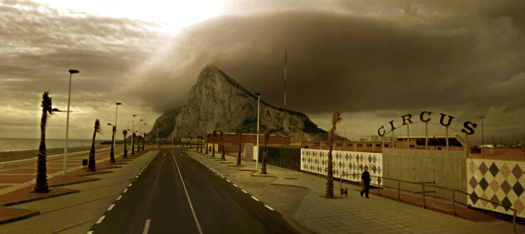
Found while rootling around in those Google Trekker links, striking photos from Google’s Street view, collected by Aaron Hobson. I can’t tell from his statement whether he does additional processing or not. Thought-provoking visually and philosophically.

La Linea de la Concepcion, Spain, Google Street View

His other work, self-described as dark, is striking and in part echoes MASS Art photographer Laura McPhee’s work for me.

Khan and Math Pedagogy

Before I departed WGBH, I organized a debate on the merits of Khan Academy and the claims made on its behalf. The debater and I flipped a coin to take Pro-Khan or Con-Khan positions, and I ended up with pro, despite quite a lot of personal skepticism, not about its value per se, but the claims made.

Robert Talbert, a blogger for The Chronicle of Higher Education, has a nice piece on what Kahn Academy is and isn’t (and a moment’s thought makes clear that people other than Khan himself or Bill Gates are better positioned to make that judgment). It also describes that Khan quite admirably responded to the “peer review” offered by parody videos of his videos, pulling them down, correcting errors, and improving the pedagogy.

There’s now a contest to do “critique” videos of Khan videos, as a means to improve content and pedagogy. Perhaps we’re at a 2.0 phase of videos for education, and Khan, positive and negative, is not the “ceiling” but the “floor” of this modality. Seems like a good thing. Below, another math teacher with richer videos that complement Khan’s procedurally-focused ones.

New Google Mapping Tools = New Frontiers

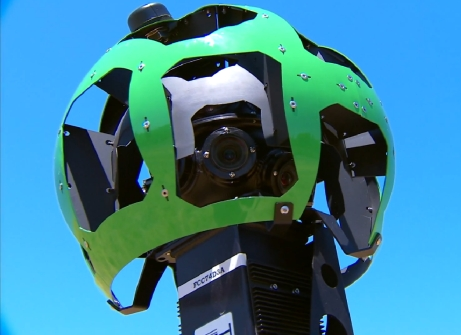
Rob Walker (once of the great “Consumed” column in the NYTimes Mag) has a fascinating post that kicks off with his lust for Trekker, the backpack-mountable Google street view camera that will take their ambitious mapping project off the grid.

He connects it to Venue, an intriguing project to explore, geographically and in story-telling ways, lesser known byways of the U.S., making a suggestion that I hope Google takes up, that the Trekker be a “guest” instrument with Venue team.

Among the many interesting points: these new tools answer the idea that America is “explored-out.” You build new tools with new resolutions and modalities, and you find new frontiers, as Walker notes, “all over the place.”

And like the old frontiers, they come amply supplied with dark sides for those on the other “side” of the frontier. Nowadays, perhaps all of us when Google is doing the exploring.

Why I am Not a Painter

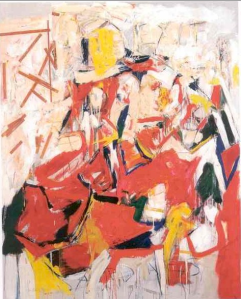
Wandering around the Smithsonian’s Museum of American Art with a friend yesterday (in an effort to escape DC’s 102 degree heat), we came upon Mike Goldberg’s “Sardines,” which took me back to discovering Frank O’Hara, a friend of Goldberg’s. O’Hara, now famous for his “I did this, I did that” poetry, with its informal snapshots of daily life in New York, was also a friend of many painters and modern art maven at MOMA.

His light touch gets me further into what modern art was about than pages and pages of Clement Greenberg (although I’m a Greenberg fan too.)

Why I Am Not a Painter

Frank O’Hara

I am not a painter, I am a poet.
Why? I think I would rather be
a painter, but I am not. Well,

for instance, Mike Goldberg
is starting a painting. I drop in.
“Sit down and have a drink” he
says. I drink; we drink. I look
up. “You have SARDINES in it.”
“Yes, it needed something there.”
“Oh.” I go and the days go by
and I drop in again. The painting
is going on, and I go, and the days
go by. I drop in. The painting is
finished. “Where’s SARDINES?”
All that’s left is just
letters, “It was too much,” Mike says.

But me? One day I am thinking of
a color: orange. I write a line
about orange. Pretty soon it is a
whole page of words, not lines.
Then another page. There should be
so much more, not of orange, of
words, of how terrible orange is
and life. Days go by. It is even in
prose, I am a real poet. My poem
is finished and I haven’t mentioned
orange yet. It’s twelve poems, I call
it ORANGES. And one day in a gallery
I see Mike’s painting, called SARDINES.