
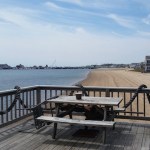
Spending a few days by the seashore, so for today one of the many classical pieces with an oceanic theme, a Sergei Rachmaninoff work.
Rachmaninoff’s Etude Tableaux are virtuoso piano works, written in his modern Russian style (before he decamped for the U.S. and his style schmaltzed up a bit). They are musical evocations of scenes (a frequent late 19th-20th century compositional move –see also Debussy’s Preludes, Images, most of Ravel, and any number of Liszt and Strauss works (Richard, not Johann).
The program key to the Rachmaninoff works is not certain. He didn’t publish names or descriptions, but did give a few hints. The point rather is how the music evokes a scene and an emotion, vivid but not fixed.
My favorite of the lot is #2 in A minor from the second set, Op. 39, which has gotten the informal subtitle, “The Sea and the Gulls.” Here it is in the capable hands of Sviatoslav Richter,
.
The conductor Serge Koussevitzky had the bright idea to ask the Italian composer Ottorino Respighi to arrange some of the Rachmaninoff pieces for orchestra, and here is a set (kicking off with The Sea and the Gulls) in a wonderful performance by the BBC Phil and Noseda (the National Symphony Orchestra’s lucky snag for next music director).
Dressed up for orchestra, it’s lovely, but the piano work with those 2 against 3 rhythms and lines (the sea birds?) swooping in and out of the wavy texture sparkles so much it seems like it’s giving off light, not just reflecting it.
 My mid-life of music listening has been enriched by coming back to or meeting for the first time composers I undervalued during my years as a SERIOUS MUSIC PERSON. I guess this re-calibration is natural, if you love Tchaikovsky’s B-flat minor Piano Concerto as a teen, comes a time when you will look back at it as gauche, and then when you’ll back at that backwards glance as silly in turn.
 A Few Reasonable Words