Nice piece over on the Gramophone magazine blog about Mozart’s knowledge of Handel. As musicologist Lindsay Kemp points out, knowledge of older musical eras and styles was not as typical of 18th century composers as it became later, but Mozart’s encounter with baroque music was profound. From the blog piece:
Above all, the realisation of the expressive potential of Baroque music found voice almost immediately in Mozart’s own music, at first in the grandiloquent choruses of the great Mass in C minor, but also in a four-part fugue, also in C minor, that he composed for two pianos in 1783, and which five years later he arranged for strings and prefaced with an Adagio much in the style of an overture by Handel (K546). This is no mere exercise in pastiche, but a piece of almost terrifying cumulative power, an acknowledgement of earlier genius that is deeply, almost disturbingly personal.
Here’s a performance of the Adagio and Fugue he mentions:
It may be too facile, but there does seem to be as much that looks ahead to the massive fugues of Beethoven as back to Bach and Handel. Four parts + minor key + 6 minutes + Mozart = more dramatic intensity than most operas or movies for that matter.
Listening to lots of oratorio recently, and of course that means Handel. Here is a morning helping from Theodora, which even by his high standards abounds in gorgeous music.
Blest pair of Sirens, pledges of Heav’ns joy,
Sphear-born harmonious Sisters, Voice, and Vers,
Wed your divine sounds, and mixt power employ
Dead things with inbreath’d sense able to pierce,
And to our high-rais’d phantasie present,
That undisturbed Song of pure concent,
Ay sung before the saphire-colour’d throne
To him that sits theron
With Saintly shout, and solemn Jubily,
Where the bright Seraphim in burning row
Their loud up-lifted Angel trumpets blow,
And the Cherubick host in thousand quires
Touch their immortal Harps of golden wires,
With those just Spirits that wear victorious Palms,
Hymns devout and holy Psalms
Singing everlastingly;
That we on Earth with undiscording voice
May rightly answer that melodious noise;
As once we did, till disproportion’d sin
Jarr’d against natures chime, and with harsh din
Broke the fair musick that all creatures made
To their great Lord, whose love their motion sway’d
In perfect Diapason, whilst they stood
In first obedience, and their state of good.
O may we soon again renew that Song,
And keep in tune with Heav’n, till God ere long
To his celestial consort us unite,
To live with him, and sing in endles morn of light.
Four lines of which were set by Handel in the glorious soprano aria, “Let the Bright Seraphim,” from the his opera Samson. Here is Joan Sutherland, “La Stupenda,” singing it.

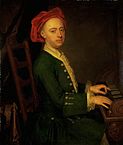 Many of my ‘composer crushes’ over the years have come and gone, as they do. However, my love for G.F. Handel never fades.
 A Few Reasonable Words