The Met has a new production of Mozart’s Così fan Tutte, a radiant if troubling work that revolves around two pairs of lovers engaged in a test of fidelity, in which the men, with increasing intensity (either comic or melodramatic depending on the direction) try to woo one anothers’ fiancées.
Director Phelim McDermott has set it in a 1950s Coney Island amusement park, complete with sideshow performers, and an appealing cast with ardent young lovers, and the established star baritone Christopher Maltman as Don Alfonso (sometimes played as an aging and cynical character part, but here a much more nuanced and better sung performance). Best of all was Broadway star Kelli O’Hara as the saucy maid, Despina, who with Don Alfonso, is the motor which makes the entire funny cruel game work. Her singing was exemplary and as others have pointed out, she inhabited the role physically and vocally. Not always something you see on an opera stage. She was compelling every minute.
I caught the rebroadcast of the Met in HD airing tonight and came away thinking that although Cosi remains a challenge–depending on your take on the joke it’s either bleakly misogynistic, or a deeply cynical about any kind of romantic love–this production resolved more of the problems in theme, philosophy and staging than others I’ve seen. (And since it’s one of my favorite operas musically I’ve seen it a lot.)
The best thing thing was a dazzling way of handling the scene changes with motel room doors that become interiors as they spun around. Really ingenious and in keeping with the ever changing sense of the principals’ relationships.
The carnival setting worked too-solving the last scene in which the the men come back as themselves via a magical chest (also playing a role in the opening gesture in the opera). And the vexing question of whether the opera ends in the original configuration of lovers or reflects the results of the game (generally thought to be unresolved in the score and libretto) was resolved in a manner both convincing and droll.
The sideshow performers were natural parts of it somehow–humanity in all its variety being one of both Mozart’s and McDermott’s preoccupation. And the subtle point that in this opera–as in so many–everybody is lying to everybody else at some point was underlined. Only the sideshow performers were honest–well and truly themselves with no artifice except their art itself. It was a point that it’s easy to see Mozart smiling at.
It will likely show up on PBS or in theaters in HD repeats this summer. If you are an opera fan, worth taking a look.
Reminded today of one of my favorite, and not very often heard, symphonies today. Borodin’s Second. A professional chemist and avocational composer who left us a small number of wonderful works. Check out particularly the elegiac slow movement that begins at 12:21.
Here in a performance from Amsterdam, a bit rough and ready perhaps, but still enjoyable.
Browsing around in John Ruskin’s autobiography, Praeterita, some bits from there and elsewhere in his formidable output.
In order that people may be happy in their work, these three things are needed: They must be fit for it. They must not do too much of it. And they must have a sense of success in it.
About the moment in the forenoon when the modern fashionable traveller, intent on Paris, Nice, and Monaco, and started by the morning mail from Charing Cross, has a little recovered himself from the qualms of his crossing, and the irritation of fighting for seats at Boulogne, and begins to look at his watch to see how near he is to the buffet of Amiens, he is apt to be baulked and worried by the train’s useless stop at one inconsiderable station, lettered ABBEVILLE. As the carriage gets in motion again, he may see, if he cares to lift his eyes for an instant from his newspaper, two square towers, with a curiously attached bit of traceried arch, dominant over the poplars and osiers of the marshy level he is traversing. Such glimpse is probably all he will ever wish to get of them; and I scarcely know how far I can make even the most sympathetic reader understand their power over my own life.
Waves of clear sea are, indeed, lovely to watch, but they are always coming or gone, never in any taken shape to be seen for a second. But here was one mighty wave that was always itself, and every fluted swirl of it, constant as the wreathing of a shell. No wasting away of the fallen foam, no pause for gathering of power, no helpless ebb of discouraged recoil; but alike through bright day and lulling night, the never-pausing plunge, and never-fading flash, and never-hushing whisper, and, while the sun was up, the ever-answering glow of unearthly aquamarine, ultramarine, violet-blue, gentian-blue, peacock-blue, river-of-paradise blue, glass of a painted window melted in the sun, and the witch of the Alps flinging the spun tresses of it for ever from her snow.
HAIL, VERNAL EQUINOX!
If all that I hear is true, a great deal has been written, first and last, about that season which we slangily call “Spring”; but I don’t remember ever having seen it done in really first-class form;—that is, in such a way that it left something with you to think over, something that you could put your finger on and say, “There, there is a Big, Vital Thought that I can carry away with me to my room.”
What Spring really needs is a regular press-agent sort of write-up, something with the Punch in it, an article that will make people sit up and say to themselves, “By George, there must be something in this Spring stuff, after all.”
What sort of popularity did Education have until correspondence schools and encyclopedias began to give publicity to it in their advertisements? Where would Music be to-day if it were not for the exhortations of the talking-machine and mechanical-piano companies telling, through their advertising-copy writers, of the spiritual exaltation that comes from a love of music? These things were all right in their way before the press-agent took hold of them, but they never could have hoped to reach their present position without him.
Of course, all this has just been leading up to the point I want to make,—that something more ought to be written about Spring. When you consider that every one, including myself, agrees that nothing more should be written about it, I think that I have done rather well to prove as much as I have so far. And, having got this deep into the thing, I can’t very well draw back now.
Well then, Spring is a great season. Nobody will gainsay me that. Without it, we should crash right from Winter into Summer with no chance to shift to light-weight underwear. I could write a whole piece about that phase of it alone, and, if I were pressed for things to say, I myself could enlarge on it now, making up imaginary conversation of people who have been caught in balbriggans by the first sweltering day of summer. But I have so many more things to say about Spring that I can’t stop to bother with deadwood like that. Such literary fillerbusting should be left to those who are not so full of their subject as I am.
In preparing for this article, I thought it best to look up a little on the technical side of Spring, about which so little is known, at least by me. And, would you believe it, the Encyclopedia Britannica, which claims in its advertisements not only to make its readers presidents of the Boards of Directors of any companies they may select, but also shows how easy it would be for Grandpa or Little Edna to carry the whole set about from room to room, if, by any possible chance they should ever want to, this same Encyclopedia Britannica makes no reference to Spring, except incidentally, along with Bed Springs and Bubbling Springs.
This slight of one of our most popular seasons is probably due to the fact that Spring is not exclusively a British product and was not invented by a Briton. Had Spring been fortunate enough to have had the Second Earl of Stropshire-Stropshire-Stropshire as one of its founders, the Britannica could probably have seen its way clear to give it a five-page article, signed by the Curator of the Jade Department in the British Museum, and illustrated with colored plates, showing the effect of Spring on the vertical and transverse sections of the stamen of the South African Euphorbiceæ.
I was what you might, but probably wouldn’t, call stunned at not finding anything about the Season of Love in the encyclopedia, for without that assistance what sort of a scientific article could I do on the subject? I am not good at improvising as I go along, especially in astronomical matters. But we Americans are not so easily thwarted. Quick as a wink I looked up “Equinox.”
There is a renewed agitation of late to abolish Latin from our curricula. Had I not known my Latin I never could have figured out what “equinox” meant, and this article would never have been written. Take that, Mr. Flexner!
While finding “equinox,” however, I came across the word “equilibrium,” which is the word before you come to “equinox,” and I became quite absorbed in what it had to say on the matter. There were a great many things stated there that I had never dreamed before, even in my wildest vagaries on the subject of equilibrium. For instance, did you know that if you cover the head of a bird, “as in hooding a falcon” (do you remember the good old days when you used to run away from school to hood falcons?) the bird is deprived of the power of voluntary movement? Just think of that, deprived of the power of voluntary movement simply because its head is covered!
And, as if this were not enough, it says that the same thing holds true of a fish! If you should ever, on account of a personal grudge, want to get the better of a fish, just sneak up to him on some pretext or other and suddenly cover its eyes with a cloth, and there you have it, helpless and unable to move. You may then insult it, and it can do nothing but tremble with rage.
It is little practical things like this that you pick up in reading a good reference book, things that you would never get in ten years at college.
For instance, take the word “equites,” which follows “equinox” in the encyclopedia. What do you know about equites, Mr. Businessman? Of course, you remember in a vague way that they were Roman horsemen or something, but, in the broader sense of the word, could you have told that the term “equites” came, in the time of Gaius Gracchus, to mean any one who had four hundred thousand sesterces? No, I thought not. And yet that is a point which is apt to come up any day at the office. A customer from St. Paul might come in and, of course, you would take him out to lunch, hoping to land a big order. Where would you be if his hobby should happen to be “equites “? And if he should come out in the middle of the conversation with “By the way, do you remember how many sesterces it was necessary to have during the administration of Gaius Gracchus in order to belong to the Equites?” if you could snap right back at him with “Four hundred thousand, I believe,” the order would be assured. And if, in addition, you could volunteer the information that an excellent account of the family life of the Equites could be found in Mommsen’s “Römisches Staatsrecht,” Vol. 3, your customer would probably not only sign up for a ten-year contract, but would insist on paying for the lunch.
But, of course, this has practically nothing to do with Spring, or, as the boys call it, the “vernal equinox.” The vernal equinox is a serious matter. In fact, I think I may say without violating any confidence, that it is the initial point from which the right ascensions and the longitudes of the heavenly bodies are measured. This statement will probably bring down a storm of ridicule on my head, but look at how Fulton was ridiculed.
In fact, I might go even further and say that the way to seek out Spring is not to trail along with the poets and essayists into the woods and fields and stand about in the mud until a half-clothed bird comes out and peeps. If you really want to be in on the official advent of Spring, you may sit in a nice warm observatory and, entirely free from head-colds, proceed with the following simple course:
Take first the conception of a fictitious point which we shall call, for fun, the Mean Equinox. This Mean Equinox moves at a nearly uniform rate, slowly varying from century to century.
Now here comes the trick of the thing. The Mean Equinox is merely a decoy, and, once you have determined it, you shift suddenly to the True Equinox which you can tell, according to Professor A.M. Clerk’s treatise on the subject, because it moves around the Mean Equinox in a period equal to that of the moon’s nodes. Now all you have to do is to find out what the moon’s nodes are (isn’t it funny that you can be as familiar with an object as you are with the moon and see it almost every night, and yet never know that it has even one node, not to mention nodes?) and then find out how fast they move. This done and you have discovered the Vernal Equinox, or Spring, and without spilling a dactyl.
How much simpler this is than the old, romantic way of determining when Spring had come! A poet has to depend on his intuition for information, and, on the subject of Spring’s arrival, intuition may be led astray by any number of things. You may be sitting over one of those radiators which are concealed under window-seats, for instance, and before you are aware of it feel what you take to be the first flush of Spring creeping over you. It would be obviously premature to go out and write a poem on Youth and Love and Young Onions on the strength of that.
I once heard of a young man who in November discovered that he had an intellectual attachment for a certain young woman and felt that married life with her would be without doubt a success. But he could never work himself up into sufficient emotional enthusiasm to present the proposition to her in phrases that he knew she had been accustomed to receive from other suitors. He knew that she wouldn’t respond to a proposal of marriage couched in terms of a real estate transaction. Yet such were the only ones that he felt himself capable of at the moment under the prevailing weather conditions. So, knowing something of biology, he packed his little bag and rented an alcove in a nearby green-house, where he basked in the intensified sun-warmth and odor of young tube roses, until with a cry, he smashed the glass which separated him from his heart’s desire and tore around the corner to her house, dashing in the back door and flinging himself at her feet as she was whipping some cream, and there poured forth such a torrent of ardent sentiments that there was really nothing that the poor girl could do but marry him that afternoon.
In fact, if you want to speak astronomically (some people do), you may define Spring even more definitely. Since we are all here together, and good friends, let us take the center of the earth as origin, and, once we have done this, the most natural fundamental axis is, obviously, the earth’s rotation. The fundamental plane perpendicular to it is the plane of the equator. That goes without saying.
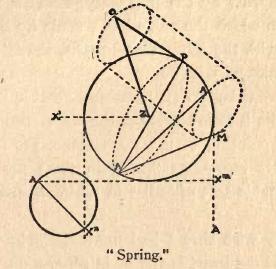
Now, here we go! Coördinates referred to in this system are termed equatorial, and I think that you will agree with me that nothing could be fairer than that. Very well, then. Since this is so, we may define Spring by the following geometric representation in which the angle ZOP, made by the radius vector with the fundamental plane, shows a springlike tendency.
This drawing we may truthfully entitle “Spring,” and while it hasn’t perhaps the color found in Botticelli’s painting of the same name, yet it just as truthfully represents Spring in these parts as do the unstable sort of ladies in the more famous picture.
I only wish that I had more space in which to tell what my heart is full of in connection with this subject. I really have only just begun.
Had the good fortune to see New York City Ballet this week. They did a Jerome Robbins mixed bill, including his Glass Pieces, which is a wonder. NCYB dancer, choreographer and interim co-director dances and explains a bit of it.
“‘Glass Pieces,” with music by Philip Glass and choreography by Jerome Robbins, is unlike any work the New York City Ballet has ever had in its repertory. At its world premiere Thursday night in the State Theater, Mr. Robbins succeeded in taking ballet into a brave new world.”
“Choreographer Mark Morris just finished creating a new dance in February. And, if it’s anything like the roughly 150 works that made him a darling of the performance world, it will be breathtaking. But this particular piece of modern dance won’t be presented next season. In fact, it won’t be performed for years—maybe 20, possibly 30. It’s intended to give the Mark Morris Dance Group fresh material long after its innovative director is gone.
The Metropolitan Opera as it was in its original home on Broadway. Big changes in artistic leadership, during fraught times, are happening.
Morris, 61, isn’t in ill health. But the idea to save some works for the future came up when Nancy Umanoff, the executive director of his 38-year-old company, was exploring ways to preserve the choreographer’s legacy. That includes not only his body of work, but also a popular school, numerous outreach programs, and the seven-studio Mark Morris Dance Center—which helped anchor Brooklyn’s downtown arts district. In 2017 the company had revenue of $5.5 million from performances.”
Although I long (and happily) out of the arts management game, I do remember how difficult transitions were in any arts organization. The creative impetus of the founder(s), even when it’s not the actual content, as with Morris’s works, is so often the beating heart of an organization that it’s hard to imagine it without it. Yet, if it is to survive, some “what happens after me?” is an essential question.
Ravel’s piano music is known for its colorful palette, and its staggering technically difficulty. One piece that is within the reach of mere mortals is the Mother Goose Suite, a set of five character pieces for piano four hands (and later orchestrated as was often the case with Ravel). Although it was originally written for children, it has found a lasting place in the concert hall as well in the hearts of amateurs. (I even performed it in college as part of a student-faculty recital.)
Here it is in a nice performance from Cleveland with pianists Orion Weiss and Roman Rabinovich (who was just in town playing superb Rachmaninoff and interesting if not totally convincing Chopin). Although it is not impossible to imagine a six and seven year old (the ages of the original dedicatees) getting their fingers through this pieces, it isn’t really a beginners’ piece. The subtle touch, and reticent style that these two bring to it, not to mention the impeccable control, are things it seems you’d need some life experience to conjure.







 A Few Reasonable Words