Commonplace Book: Wise Words, Lanchester on Bullshit vs. Nonsense

Screen Shot 2015-10-23 at 9.04.24 AMReading Lanchester’s How to Speak Money, a great read: droll, useful, and angry (in a flippant British way). Here’s his entry on the difference between “bullshit” and “nonsense” as a taster. The whole book well worth dipping into.

bullshit versus nonsense
In Kingsley Amis’s novel The Old Devils there is a brief but very thought-provoking speech by Peter Thomas, one of the book’s main characters. His friend has just given a talk about how the poet Brydan, based on
Dylan Thomas, didn’t speak a word of Welsh but how the presence of Welsh was nonetheless very important as a subliminal presence in his work. In the pub afterwards, Peter picks him up on what he’s said.

“I want to get this over to you while I remember and before I have too many drinks. When somebody tells you in Welsh that the cat sat on the mat you won’t be able to make out what he saying unless you know the Welsh for cat and sat and mat. Well, he can draw you a picture. Otherwise it’s just gibberish.”

The friend objects, but Peter presses on with his point:

“The point is it’s unnecessary. They’ll be just as pleased to hear how Brydan wrote English with the fire and passion and the spirit of this, that and the bloody other only possible to a true or real or whatever-you-please Welshman, which if it means anything is debatable to say the least, but whatever it is it’s only bullshit, not nonsense. Stick to bullshit and were all in the clear.

And that, for all the lightness of the context, is a very important distinction. Bullshit and nonsense are different. Bullshit is all around us; the term implies exaggeration, rhetoric, and a mild kind of untoxic falsity. It suggests something is false but not malign. Every time someone tries to sell somebody something, a degree of bullshit is usually involved. Some words are more or less guaranteed to be bullshit: “executive,” for instance, is, used as an adjective, pure bullshit– executive chef, executive apartments, executive decision. “Exclusive” is bullshit, not least because it is used mostly about places that are open to the public, like restaurants and hotels. But the damage done by bullshit is usually fairly mild, and it can even be, if not exactly benign, then so much part of the normal process of selling that it is all just part of the dance. There’s a Big Issue seller near where I live who holds out a copy with the line “last one”; when he sells it, he waits for the customer to walk away, then reaches into his bag and pulls out another “last one.” That is bullshit, and relatively harmless–I say “relatively” rather than “wholly” because once you fallen for the line, and then seen through it, it tends to diminish your trust in Big Issue sellers. The “hype cycle” around new inventions involves in a near-ritualized early period of puffing, boosterism, and bullshit: as John Perry Barlow, song writer for the Grateful Dead, once brilliantly put it, “bullshit is the grease for the skids on which we ride into the future.” (I like that line because it is both an example of bullshit and a great explanation of it.) There is an enormous amount of bullshit in the world of money.

Nonsense is different. It’s worse. It consists of things that are actively false, and at its worst of things that are not just not true but can’t possibly be true. It is rarer than bullshit but much more toxic, and it is the difference between someone exaggerating a bit because he’s trying to sell you something and someone who is consciously lying to you, or is so far out of touch with reality that he doesn’t know he’s lying. In the world of money, the most recent and glaring example of nonsense was in the run-up to the credit crunch, in which broad sectors of banks and investors convinced themselves that they had invented a new category of financial instrument that guaranteed high rates of return with no risk. Since it is a fundamental axiom of investment that risk is correlated with return–that you can’t make higher rates of return without taking on higher levels of risk–this is like claiming to have invented an antigravity device, or a perpetual motion machine. As the British investor John Templeton once said, “The four most expensive words in the English language are ‘this time it’s different.’” In everything to do with money, and in many other areas too, it’s important to keep an eye out for those moments that are not just (relatively) harmless bullshit but the much more actively dangerous nonsense.

Mobile everywhere: Local News Outfit Replaces Camera Crews with iPhones and Selfie Sticks

I knew this was on some news directors’ wish list, but I was surprised to see that it had already happened. PetaPixel has a report.

lens
Granted it’s not a news lens, but this little number, a Canon 60x field lens, will set you back a cool $90K. You can buy a lot of iPhones and selfie sticks with that kind of dough.

iPhones may not be very good at photographing lunar eclipses, but apparently they’re just fine for television news broadcasts. A local TV news station in Switzerland has ditched standard TV cameras to go 100% iPhone.

Swiss newspaper Le Temps reports that the TV station Léman Bleu made the major switch this past summer when it outfitted each reporter on the field with an iPhone 6 kit for shooting pre-recorded stories and for shooting live shots.

http://petapixel.com/2015/09/29/swiss-tv-station-replaces-cameras-with-iphones-and-selfie-sticks/

Provocative Words: Are We Living Our Own Story?

Aeon has a great essay by the philosopher Galen Strawson on the dangerous idea that life is a story. At least dangerous for the non-narrative types among us.

A few choice bits,

On conceiving of ourselves in some sense as a collection of stories…

fairy_tales
What if life is not a set a of stories?

“Perhaps. But many of us aren’t Narrative in this sense. We’re naturally – deeply – non-Narrative. We’re anti-Narrative by fundamental constitution. It’s not just that the deliverances of memory are, for us, hopelessly piecemeal and disordered, even when we’re trying to remember a temporally extended sequence of events. The point is more general. It concerns all parts of life, life’s ‘great shambles’, in the American novelist Henry James’s expression. This seems a much better characterisation of the large-scale structure of human existence as we find it. Life simply never assumes a story-like shape for us. And neither, from a moral point of view, should it.”

He pulls into service a couple of other views, most elegantly Virginia Woolf, who goes for a sort of bundle of phenomena argument, at least in this passage.

Examine for a moment an ordinary mind on an ordinary day. The mind receives a myriad impressions – trivial, fantastic, evanescent, or engraved with the sharpness of steel. From all sides they come, an incessant shower of innumerable atoms; as they fall, as they shape themselves into the life of Monday or Tuesday, the accent falls differently from of old; the moment of importance came not here but there; so that, if a writer were a free man and not a slave, if he could write what he chose, not what he must, if he could base his work upon his own feeling and not upon convention, there would be no plot, no comedy, no tragedy, no love interest or catastrophe in the accepted style, and perhaps not a single button sewn on as the Bond Street tailors would have it. Life is not a series of gig lamps symmetrically arranged; life is a luminous halo, a semi-transparent envelope surrounding us from the beginning of consciousness to the end.

And also Mary Midgley and Paul Klee on containing multitudes:

Midgley: [Doctor Jekyll] was partly right: we are each not only one but also many… Some of us have to hold a meeting every time we want to do something only slightly difficult, in order to find the self who is capable of undertaking it… We spend a lot of time and ingenuity on developing ways of organising the inner crowd, securing consent among it, and arranging for it to act as a whole. Literature shows that the condition is not rare.

and Klee: My self… is a dramatic ensemble. Here a prophetic ancestor makes his appearance. Here a brutal hero shouts. Here an alcoholic bon vivant argues with a learned professor. Here a lyric muse, chronically love-struck, raises her eyes to heaven. Here papa steps forward, uttering pedantic protests. Here the indulgent uncle intercedes. Here the aunt babbles gossip. Here the maid giggles lasciviously. And I look upon it all with amazement, the sharpened pen in my hand. A pregnant mother wants to join the fun. ‘Pshtt!’ I cry, ‘You don’t belong here. You are divisible.’ And she fades out.

Strawson’s piece is a good read, although I do wonder if the overheated “life is a story, life is a journey” trope, which raises my hackles too, amounts to much more than a tactic or habit, rather than something essential about our selves in a philosophical sense. Perhaps it’s just a convenience, like an algorithm that makes a complicated reality seem tractable.

End of an era: The passing of the catalog card

card_cat_drawerLibrary Link of the Day tipped me off to the news that OCLC, the technical provider of all things library catalog related, has printed their last card catalog card.

I remember these catalogs (whether just a few drawers in a school library or the mammoth city of catalogs at the Library of Congress when I worked there in the 80s).  I don’t miss them as an information tool, but they had a certain human beauty that somehow a computer search input box lacks.

Commonplace Book: October in Poetry

Some verse for a blustery start to October, as the mid-Atlantic hopes to be spared the wrath of Hurricane Joaquin.

October

by Don Thompson

I used to think the land
had something to say to us,
back when wildflowers
would come right up to your hand
as if they were tame.


Sooner or later, I thought,
the wind would begin to make sense
if I listened hard
and took notes religiously.
That was spring.


Now I’m not so sure:
the cloudless sky has a flat affect
and the fields plowed down after harvest
seem so expressionless,
keeping their own counsel.


This afternoon, nut tree leaves
blow across them
as if autumn had written us a long letter,
changed its mind,
and tore it into little scraps.

Tidbits from Around the Web: Memento Mori Edition

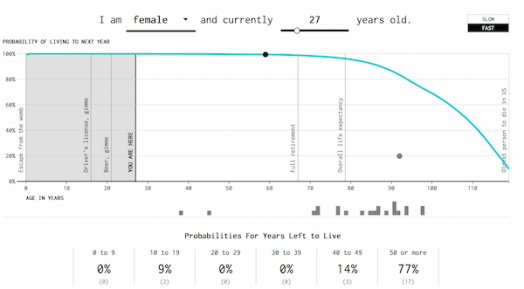
Happened on a fascinating data animation by Nathan Yau,
Years You Have Left to Live, Probably.

life_expectancy

In addition to being cool to play with, it’s a great example of mathematical representation, as the data it uses comes from this table.

actuarial

Same content, different form and experience. (A lot of projects I have worked on as an educational media producer have focused on helping teachers figure out how to get kids comfortable moving among mathematical representations, from a table, to a graph, say, or from a function, to words. Grasping the power inherent in the idea that one phenomenon can be represented in these varied ways. How neat would it be if kids today are adding animation to that list: a calculus text book with examples that show accelerations as animations that, um, accelerate!).

But back to planet morbid: After fooling with this for a while, I remembered The Death Clock, which terms itself “The Internet’s friendly reminder that time is slipping away.”

death_clock

I assume this uses more detailed actuarial data, and gives a specific day rather than a probability, and a helpful count of the number of seconds until you shuffle off either to Buffalo or “this moral coil” depending on your religion. My appointment with “dust to dust” is 2050.

Finally, a poem by W.S. Merwin on this theme. An angle that many have considered, I’d bet.

For the Anniversary of My Death

Every year without knowing it I have passed the day
When the last fires will wave to me
And the silence will set out
Tireless traveler
Like the beam of a lightless star

Then I will no longer
Find myself in life as in a strange garment
Surprised at the earth
And the love of one woman
And the shamelessness of men
As today writing after three days of rain
Hearing the wren sing and the falling cease
And bowing not knowing to what

QZ On the SEP

ResearchBuzz: Firehose picked up a nice story on one of my favorite resources online, SEP.

ResearchBuzz's avatarResearchBuzz: Firehose

QZ has a nice writeup on the Stanford Encyclopedia of Philosophy. “The internet is an information landfill. Somewhere in it—buried under piles of opinion, speculation, and misinformation—is virtually all of human knowledge. But sorting through the trash is difficult work. Even when you have something you think is valuable, it often turns out to be a cheap knock-off. The story of how the SEP is run, and how it came to be, shows that it is possible to create a less trashy internet—or at least a less trashy corner of it.”

View original post

Funny Words: Peter Godfrey-Smith

Boston Review has a perceptive, and droll, review of a new philosophy title, Retrieving Realism by Hubert Dreyfus and Charles Taylor. There are lots of interesting takes in it and John Dewey and Martin Heidegger figure prominently. (So of course I was interested, as Dewey is a fascinating figure to me.)

The full review will likely be of interest mainly to philosophy nerds like myself, but one passage was too good to pass up quoting. Just after untangling a number of moves and distinctions presented in the book, Godfrey-Smith writes,

I don’t want to suggest, through this assertion of Dewey’s place in the story, that he had all the answers. Far from it, and I will look in a moment at an area he handled quite badly. In explaining his larger neglect in this part of philosophy, I am also mindful of other deficiencies. Dewey’s writing has an exhausting earnestness, which contrasts with the dark edginess, the anything-can-happen feel of Heidegger’s. If someone sees you reading Heidegger on a train, they might think you would be an interesting person to have sex with. If they see you reading Dewey, there is a risk they will think you would be an excellent person to serve on a committee.

deweyPersonally, seeing somebody peruse Sein und Zeit on the Red Line wouldn’t exactly flick my switch, but I can vouch for the fact that Dewey evokes committee service: perhaps because it reads a bit like it was written by a committee, and ‘exhaustingly earnest’ is definitely apt as well.

Blogging 101 Day Five: Love Your Theme

So I’m not doing the Blogging 101 Lessons in order (I was like this in school, if Hamlet was assigned I read King Lear. Not particularly admirable, but at least I did read Lear).

This assignment is “love your theme” with the advice to try at least three different themes. “Even if you’re happy with the one you first chose. Try one you’re drawn to, and one you would never use.”

As I have blogged before, trying out themes is something that I do a lot–in fact it’s a problem.  (See https://afewreasonablewords.com/2015/06/14/words-of-advice-the-tragedy-of-theme-addiction/)

2015
My current theme, 2015, from WordPress.

What’s more I’m very happy with 2015 (one of the standard WordPress themes) when it comes to my personal blog. I don’t do anything particularly tricked out in terms of features, widgets, doodads, and the like, so haven’t encountered anything it can’t cope with  and it’s responsive and works well with my signature image (a blue sky over Monhegan, ME).

But in the spirit of trying of doing the homework as assigned for once, I checked out two different ones; here they are and what I learned:

cyanotype
Cyanotype theme

Here’s Cyanotype, love the color and type, and how the photos pop. Not sure if the antique photography inspiration works visually or editorially with my content. Seems a little too spare. (This is the one I chose because it appealed to me).


And then there’s Patch, which I chose because it was one I would never use. It’s all “cards” (how is that still an Internet design thing, aren’t we on to the next idea?)  But I will grant that 1) this kind of approach dissolves the distinction between content for mobile and content for desktop sizes (by making it mobile first, not a bad idea). 2) It pointed out to me that featured images and tagging are  as important as what you post.

patch
Patch WordPress theme. You can smell the hipster mustache wax. Can see it being great for a news-oriented blog.


A useful exercise, but I’ll stick with my current rig.


Reasoning Words: Should Public Libraries be TOR Exit Relays?

The Electronic Freedom Foundation reports that a a pilot project at the Lebanon, New Hampshire, Library to serve as a TOR exit relay has been temporarily halted, and potentially totally scotched, by the U.S. Department of Homeland Security. ProPublica has a rundown as well.

To shed some light on the the question of whether this is an outrage or reasonable, here’s a quick TOR 101 lesson.  TOR (name comes from The Onion Router, but no relation to the satirical web site) is a means of using the Internet anonymously. Individual computers (of volunteers) provide entry into and exit from anonymous, encrypted network paths–sort of a series of safe houses that let computer traffic pass from one to the next without recording from whence it came or whither it goest. (Disclosure: I’ve not used it, got as far as downloading the software, installing it, and chickening out. So somebody who has it running live can no doubt improve and correct that description.) Also: lots of good explanations around the web, including one from EFF’s “in plain English” series. The key thing is that the set-up provides a theoretically untraceable way to navigate the Internet, and can be installed on any computer.

The library proposes to offer an exit for TOR, meaning people could use its computer network to download materials anonymously. A bunch of questions ensue: what do people do in TOR, and does this activity matter as a point of library policy? The dark speculations come easily: Deal drugs? Send a bomb threat? Plot insurrection or worse? Just steal software? But in the other column, there are better possibilities: evading censorship for for political art? Blowing the whistle on unconstitutional surveillance? Negotiating a job offer across international borders or protecting a trade secret? Organizing for rights in a closed regime? Negotiating safe passage for a political prisoner?

Since it’s software, TOR is simply a platform for human purposes, be they benign or malignant. It is no more culpable than the library card catalog of a previous era: those listed  how to find books on the shelves, providing neutral access to anything, be it The Anarchist Cookbook or Charlotte’s Web. What patrons did with the books was their concern, and librarians at least aspired to stay out of that question.

Were I still a librarian, I would be vexed by this one. It’s a first-amendment loving profession, and access is central (both characteristics resonate with me). At the same, criminal activity such as Silk Road, or ransomware bots, may live in TOR, organizing capacity for hate groups, and human trafficking networks could lurk as well. Yet, TOR’s stated goals are to support free expression, privacy, and human rights, and libraries, in their nerdy, sometimes quaint way aim to live that mission every day. If some teenage Ai Wei Wei-type in is trying to get her message out, and my library is her exit relay, should I say no? Access is entwined with the right to privacy: being able to checking out the oft-banned Ulysses, for instance, means being able to check this out more or less anonymously. If I use a library terminal to tap the Internet, what content is fair game, and what level of privacy is appropriate?

I think on the whole (particularly if I were a New Hampshire librarian–a state that has “Live Free Or Die” on its license plants), I’d brave the battle and provide the relay. Libraries are networks, and although its easy to stay out of the fray, and let others fight this battle, who is really doing it from the public interest side? Our Google overlords have already got a huge advantage, and are so unfazed by their ability to track our every move online that their position–something which I think the STASI would have been fine with — is “don’t do anything that you shouldn’t, and everything will be fine.” Privacy in our lawful actions is not something we should compelled to give up, nor do our intentions and our explanations of what we might do become property of the state, even if some of our fellow inhabitants of the planet have dark ones, and use tools to foment them. TOR is tool to keep things private, at least some of which should be, even at a public library, perhaps even particularly there, where there is a means to discuss the public good and answer to it.