James Fallows on Jimmy Carter

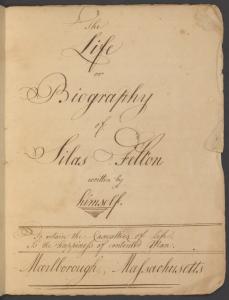
Tipped by a NYTimes piece on the latest Trump book, I read James Fallow’s think piece on Jimmy Carter, written in 1979, after Fallows had serve a stint as a presidential speech writer.

Interesting to read through the lens of current events, and history’s perhaps somewhat less harsh judgment of Carter.  One bit stuck out…the “gatekeeper” role of media, and Carter’s lack of insight into it.

Nor did [Carter] distinguish among the audiences he had to address. For some—but only a few—of his televised appeals, it was important that a speech be understood by every hearer. In most other cases, that was a false goal. In a television interview in 1960, Walter Lippmann said that an effective President “must be articulate. He must be able to talk in language which is not the lowest common denominator, but the best. What you must lead in the country are the best of the country and they will carry it on down. There’s no use of the President trying to talk down to a fellow who can just about read and write. Let somebody else do that. He must talk to the people who teach the man to read and write.” I came to believe very deeply in a hierarchy of information and attitudes. Once an idea took hold in the serious magazines and the editorial pages, it would make its way down through the news columns, the reports in Time and Newsweek, and eventually to the television commentators, who shape most people’s view of public affairs. In many cases, the real audience for a speech should be not the 5000 people who are present for the occasion but the editors, academics, politicians, and columnists who will read the text and adjust their view of the President accordingly. Such speeches are the best, sometimes the only, way a President can show that he understands the complications in his policies, the problems ahead, the hard questions that have been raised about his course. Except for one or two speeches on foreign policy—where he was more willing in general to buy the conventional wisdom than he was in domestic affairs—Carter never consented to such speeches.

Nearly 40 years on, I wonder what has happened to this hierarchy, and  Fallows’ “deep belief” in it. The ones that I grew up with and worked in have surely toppled, or simply melted away in favor of platforms that in theory let everybody talk to everybody with explosively unpredictable results.

The decline in newspaper readership from a Pew study.

Interesting read overall. Fallows’ take on Carter is not mine, but he was there and I was a kid.  And the readership, and related hierarchy, of that 5000 is mostly gone I would think.


Winter music

Some music for a gray winter day in DC.

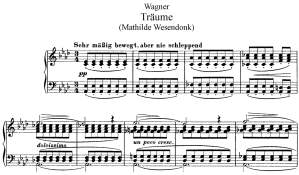
Richard Wagner, in one his many  infatuations, had more than a passing, affair with Mathilde Wesendonck (and following his usual m.o., cadged a lot of money and housing from her, and Otto, her husband).

the first measures…

One result of this is a set of songs, The Wesendonck Lieder, to poems she wrote and which he set while he had Tristan in mind among other things. The final song, “Träume,” is a 5-minute Wagner gem (most of his portions come in 5 hours so that’s saying something):  a nice distillation of what is so distinctive about him–the endless line, the sense of yearning, the odd text setting (he’s sort of the humpty-dumpty of prosody, “words will have stresses where I mean them to!”)–and the radiant glow, distinctly his in an era of ardent romantic music.

He liked Träume so much he set it for solo violin and chamber orchestra as well. And here are a few versions to accompany the snow.

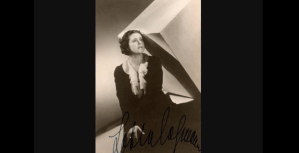
Lotte Lehmann from 1941…


https://youtu.be/EPG-aFDBRKQ

Interpretive freedom that seems fresh, but is, in fact, so old fashioned by today’s puritanical textual standards.

The German tenor Jonas Kaufmann (currently best-known in the U.S. for not being at the Met in Tosca), with his ability to summon a burnished baritonal sound as needed and such vocal tenderness (particularly for a helden tenor).

Finally, in case sung German is just not your thing, here is the violin arrangement, also gorgeous.

Word Watch: Hunker Down

The East Coast is getting clobbered by a “bomb cyclone” and weather stories (rather than actual weather) are a guilty pleasure of mine. Probably one of the few things I could have managed as a straight news reporter. If clichés  were traded on a linguistic S&P 500, now would be a great time to go long on weather ones, in particularly go out and buy some “hunker down” futures!

A nice instance comes from the end of the Times story on the storm,

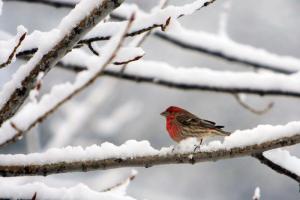
Carpodacus mexicanus (House Finch) location: Sierra Nevada, taken by Steve Ryan. I’m sure this guy is saying, “I’ve got the hunker down thing down.”

“The birds that are wintering down there are going to have to hunker down and deal with the conditions,” he said. [He being Geoff LeBaron, the director of Audubon’s Christmas Bird Count.]

This piqued my curiosity about “hunker down” and to learn more I dropped in at the OED to see what background  they offered:


Etymology: Origin obscure: it has the form of an iterative from a stem hunk-. Compare Middle Dutch hucken, huken (Verwijs and Verdam), Middle Low German hûken, Dutch huiken (Franck), Old Norse húka, modern German hocken (Kluge) to sit on the hams or heels, to squat. These words point to an original ablaut series heuk-, hûk, huk- (hok-); from this hunk-er, might perhaps be a nasalized derivative. Old Norse hok-ra to crouch may be a parallel form; Dutch hunkeren to hanker, is not connected.

a. To squat, with the haunches, knees, and ankles acutely bent, so as to bring the hams near the heels, and throw the whole weight upon the fore part of the feet.”

b.transf. To cower or squat in a lowly manner.

c. [draft] fig. With down. To concentrate one’s resources, esp. in unfavourable circumstances; to dig in, buckle down; spec. (frequently in Mil. contexts) to shelter or take cover, lie low. orig. and chiefly U.S.

This leads to the interesting image of a bird, “squat, with the haunches, knees, and ankles acutely bent”

I’m sure this guy is saying, “I’ve got the hunker down thing down.” Carpodacus mexicanus (House Finch) location: Sierra Nevada, taken by Steve Ryan.

Of course it’s the figurative use that OED sniffs at with “draft” that everybody uses (I can’t recall a literal hunker in my reading or conversation). How did a squat cower turn in to settling in and riding out the storm?


In any case, hoping wherever you are you are warm, dry, and hunkered down safely.

Your Very Own Search Engine

The adage, “Any sufficiently advanced technology is indistinguishable from magic,” attributed to Arthur C. Clarke, seems more applicable than ever.

There is corollary I would like to offer, “Any sufficiently advanced cloud application trailer is indistinguishable from a cheerfully ominous sci-fi novel opening scene.” To wit, I offer,

https://www.unforgettable.me/

This is a service, once hooked into your devices, in particular, your smart phone, and social media feeds, etc. tracks everything and compiles it into your very own search repository. They are in beta and have an explanatory video:

Diaries as they once were.

Brilliant? Creepy? Both? A solution in search of a problem? Or an early sign of how we will someday outsource our memories to our cloud storage lockers?

Aside from the rich ground for fictional (or humorous) speculation. (How do you call tech support to upgrade/correct your own memories? is there a “fish story” plugin?)  it does immediately raise questions about privacy, identity, and invasion/malleability thereof. What happens to this mass of data after somebody dies, is it uploaded into a new person’s avatar. The Sci-Fi possibilities really are endless.

Yet at the same time, before I get my hackles up, all this data is already being collected by the Big Brotherhood, and quite possibly the NSA. Unforgettable.Me is at least offering your data as a service to you, instead of offering you up as raw material for ad revenue and the like.

Another managed quote: “O brave new world that has such data in it.”

Commonplace Book: Wacky Weddings

Trying–yet again–to get the blog re-energized. For now just going to use it as a commonplace book, and this Sunday’s NYTimes was full of great stuff. Perhaps none better than this wedding story, which has the best lede I’ve read in a while:

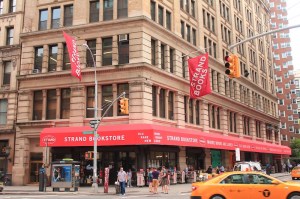
Not your average wedding venue…

“A man born to an Orthodox Jewish family in Toronto and schooled at a Yeshiva and a Japanese-American man raised on the island of Oahu, Hawaii, were married in the rare books section of the Strand Bookstore in Greenwich Village before a crowd of 200 people, against a backdrop of an arch of gold balloons that were connected to each other like intertwined units of a necklace chain or the link emoji, in a ceremony led by a Buddhist that included an operatic performance by one friend, the reading of an original poem based on the tweets of Yoko Ono by another, and a lip-synced rendition of Whitney Houston’s “I Will Always Love You” by a drag queen dressed in a white fringe jumper and a long veil.

The grooms met on the internet. But this isn’t a story about people who swiped right.”

The copyeditor did right by the headline too:
Of All the Blogs in the World, He Walks Into Mine


Over NYC

NY Mag has a sweet end of year feature called “Reasons to Love New York,” fun to browse and among their bites. And my fave: striking drone photos from above the city.

http://nymag.com/daily/intelligencer/2017/12/drone-photos-of-new-york-city.html

“Season of mists and mellow fruitfulness…

Close bosom-friend of the maturing sun”

After an excess of “dang muggy” days, as a friend puts it, autumn has begun to insinuate herself, the leaves beginning their fading blaze, cool mornings, and if not Keats’ poetic mist, a certain amount of companionable rain after a long summer.

Some seasonal lines and images.


NIGHT-TIME IN MID-FALL
It is a storm-strid night, winds footing swift
Through the blind profound;
I know the happenings from their sound;
Leaves totter down still green, and spin and drift;
The tree-trunks rock to their roots, which wrench and lift
The loam where they run onward underground.

The streams are muddy and swollen; eels migrate
To a new abode;
Even cross, ’tis said, the turnpike-road;
(Men’s feet have felt their crawl, home-coming late):
The westward fronts of towers are saturate,
Church-timbers crack, and witches ride abroad.

—Thomas Hardy, c 1925


It was early in October when the sky was terribly uncertain that I decided to set out on a journey. I could not help feeling vague misgivings about the future of my journey, as I watched the fallen leaves of autumn being carried away by the wind.

From this day forth
I shall be called a wanderer,
Leaving on a journey
Thus among the early showers.

You will again sleep night after night
Nestled among the flowers of sasanqua.

Basho, from “The Records of a Travel-worn Satchel”


The last leaf that is going to fall has fallen.
The robins are là-bas, the squirrels, in tree-caves,
Huddle together in the knowledge of squirrels.

–Wallace Stevens, from “An Ordinary Evening in New Haven”


Commonplace Book: NYTimes Book Review Tidbits

Actually had time & inclination to read most of the NYTimes Sunday Book Review today. (Editing standards have gotten a tad rickety there of late, but this issue was enjoyable.)

Three quotes to share:
From a review of a new bio of socialite and Bunny Mellon by Meryl Gordon comes this tidbit,

“I don’t really come here to pray,” Mellon once told the rector of an Episcopal church in the Norman medieval style that she financed and help designed. “I come in to talk with God because he’s a dear, dear friend of mine.”

Second, a Q&A wherein it is revealed that the real Roz Chast is just like the characters she draws. Q: “What kinds of books bring you the most reading pleasure these days?  A: …Right now I’m listening to “The Old Curiosity Shop.” Listening to a book while working on a craft project, like hooking a rug or embroidering, is my idea of a really good time.”

That it sounds good to me too (minus the crafty part) is perhaps TMI.

Finally from John Williams’ column, pegged to podcasts and a book by Marc Maron of WTF fame:

“Talking about his own tumultuous relationship with his dad, Bruce Springsteen told Maron: ‘People don’t end up in my circumstance who generally had these very placid, loving, very happy fulfilled lives. It’s not how you become a rock-and-roll star.”

Vinyl Rarities

Trying to do some research on liquidating a large collection of classical LPs (“good luck with that” is what I keep hearing), I happened on this fascinating list of valuable vinyl. No idea how up-to-date or authoritative it is, but fun to browse.

http://rateyourmusic.com/list/yerblues/vinyl_fetish__a_list_of_some_of_the_most_valuable_vinyl_records/

Not surprisingly, unusual pressings of The Beatles figure prominently, but there is something even rarer, a single pressing of a 1927 blues recording that will set you back a cool 60K, if you can find it. But like the famous “Inverted Jenny” or  Edgar Allan Poe’s “Tamerlane and Other Poems,” likely to be rare on the ground..

Screen Shot 2017-10-05 at 1.15.42 PMInverted_Jenny.tamerlane


Nerd Words: Fallacies of Data Science

Good piece  by Shane Brennan on Medium about the realities of data science in day-to-day working life (in contrast with how it’s taught).

His ten fallacies:

1. The data exists.
2. The data is accessible.
3. The data is consistent.
4. The data is relevant.
5. The data is intuitively understandable.
6. The data can be processed.
7. Analyses can be easily re-executed.
8. Where we’re going we don’t need encryption.
9. Analytics outputs are easily shared and understood.
10. The answer you’re looking for is there in the first place.

I have always considered Excel primarily a medium for creative expression!

He is writing about a business context–for instance where Google Analytics, and its attendant woes, are likely to play a big role in answering a client’s marketing strategy question. But what struck me about his fallacies is their aptness in worlds I hang in–journalism and education. Data journalism is, of course, the flavor of the week, month, and year, and no doubt it is of value–but it is sometimes seen like a magic toolbox that can be used without an hypothesis, without a real data set, and, most importantly, no clear idea of what would actually constitute a newsworthy answer to the query.

I know there are data journalism efforts that don’t fall pray to Brennan’s list,  but I wonder how many. In particular, overcoming that last point in the affirmative is a high bar. Is the information really there for the finding? Reminds me of a quote from Confucius.

“The hardest thing of all is to find a black cat in a dark room, especially if there is no cat.”–Confucius

(As for education, I’ll save my gripes about use and misuse of data for another day.)