Still working my way through David Ferry’s Virgil, wonder, astonishment and beauty; here’s a grim excerpt that shows the vividness and control of both author and translator.
http://www.metmuseum.org/art/collection/search/251473 Roman, Marble relief fragment with scenes from the Trojan War, 1st half of 1st century A.D., Marble, Palombino, 7 1/8 x 6 15/16 in., 1.1kg (18.1 x 17.6 cm). The Metropolitan Museum of Art, New York. Fletcher Fund, 1924 (24.97.11)
“Aurora rose, spreading her pitying light,
And with it bringing back to sight the labors
Of sad mortality, what men have done,
And what has been done to them; and what they must do
To mourn. King Tarchon and Father Aeneas, together
Upon the curving shore, caused there to be
Wooden funeral pyres constructed, and to which
The bodies of their dead were brought and placed there,
In accordance with the customs of their countries.
The black pitch smoke of the burning of the bodies
Arose up high and darkened the sky above.
Three times in shining armor the grieving warriors
Circled the burning pyres, three times on horseback,
Ululating, weeping, as they rode.
You could see how teardrops glistened on their armor.
The clamor of their sorrowing voices and
The dolorous clang of trumpets rose together
As they threw into the melancholy fires
Spoils that had been stripped from the Latins, helmets,
And decorated swords, bridles of horses,
And glowing chariot wheels, and with them, also,
Shields and weapons of their own familiar
Comrades, which had failed to keep them alive.
Bodies of beasts were thrown into the fire,
Cattle, and bristle- backed swine, brought from surrounding
Fields to be sacrificed to the god of death.
And all along the shore the soldiers watched
The burning of the bodies of their friends,
And could not be turned away until the dewy
Night changed all the sky and the stars came out.
Over there, where the Latins were, things were
As miserable as this. Innumerable
Scattered funeral pyres; many bodies
Hastily buried in hastily dug-up earth,
And many others, picked up from where they fell
When they were slain, and carried back to the fields
Which they had plowed and tilled before the fighting,
Or back into the city where they came from;
Others were indiscriminately burned,
Unnamed, and so without ceremony or honor.
The light of the burning fires was everywhere.
On the third day when the light of day came back
To show the hapless scene, they leveled out
What was left of the pyres and separated what
Was left of the bones, now cold and among cold ashes,
And covered over the ashes and the bones.
Determined to keep this daily blogging up, I have run into the inevitable [at least for me] writer’s block, and have turned to the WordPress.com people who have a, “365 Days of Writing Prompts” ebook. Ever the helpful pusher, those people.
These are mostly too personal, potentially pointless, or Pooter-esque for me, but I did like this prompt, so here goes:
Bedtime stories
What was your favorite book as a child? Did it influence the
person you are now?
Like many, E.B. White’s children’s books–Stuart Little, Charlotte’s Web, and the Trumpet of the Swan--were the guiding stars of my childhood reading. My parents read Stuart Little to me at bedtime in first grade, but I was able to read Charlotte’s Web by myself in second grade, crying the night I finished it, and going down stairs to see my parents. There my father, in a moment that has stayed with me, explained that the wonderful thing about books was that I could return to the start, read again, and Charlotte and the farmyard gang would all be there, and alive as ever. That both my parents comforted me on crying over a book offered a validation (sometimes missing in other aspects of my childhood) made me realize that reading would be front and center in my life, as indeed it was in theirs.
Whether Charlotte, Wilbur, Templeton and Fern influenced me is harder to discern, but certainly White’s lean, polished, gently humorous prose did calibrate something in me. It may be hard to imagine the extent to which he was the gold standard for writing in the mid-century. His essays were given as models for my school writing exercises, and his way of being a writer, complete with his reluctant status as a sage; even leaving New York for a small town in Maine seemed the vision of cranky Yankee ‘lit’ry’ idealism for me. (That said, I was not exactly hankering to be the next Hunter Thompson or Norman Mailer though. )
He has held up for me, most of all the rhythm of his prose and a style, notable in descriptive passages, where you seldom catch him “writing.” That said, it is odd that he was such a paragon for writing students. What is beautiful about his writing is as distinct to him as a fingerprint: that prose rhythm, and a sense, really a New Yorker sensibility of humor. (Almost completely gone from the magazine today.) The things I loved about him were the things that were most elusive to a beginning writer. The visible bits, structure and rhetoric, which in theory you could take apart and assess, were often mystifying to me. Even The Elements of Style, which is still a charmer, is a little thin literally and figuratively when it comes to practical writing advice. And what is there, I have practically made a career of avoiding.
Still, the feelings, aspirations, and fantasies of childhood and adolescent reading must stay with any writer, and I’m sure that I’m shaped even by those essays I couldn’t parse. One thing I suspect: he wouldn’t have abided rambling, self-indulgent blog entries, so best to finish it up, with the the hope that I have inspired you to read the man himself.
“The crickets felt it was their duty to warn everybody that summertime cannot last for ever. Even on the most beautiful days in the whole year – the days when summer is changing into autumn – the crickets spread the rumor of sadness and change.”
“Charles Dickens started work on Bleak House in 1851. If you’re like me and don’t spend all of your free time romping through the fields of etymology, you too may startle at suddenly stumbling on “ganglion” in those 900-plus pages. Like, what?—did he make a quick trip in his time chaise, and return with a shiny copy of this month’s Scientific American, set on appropriating its language? “Refrigerator” is here too: not in the sense of a kitchen appliance, but still…a frisson volts across my spine. (For a thousand more reasons than this, it’s a glorious book. Bill Matthews says, in “Le Quarte Saisons, Montreal, 1979,” “I read Bleak House / a third time, slowly, fondly.”)
Dickens, Meville, Mary Shelley…something in the nineteenth century seems to set a tiny crystal ball in the heads of certain writers. When Wordsworth stares out dolefully at London’s silhouette and frets at its burgeoning changes—the rise of the factory system and market economy; the end of cyclical time; the degradation of child labor; the first industrial pollution; and the rest—it’s almost as if his gaze is so intense, he can see it all unfold like gritted, sooty origami into the centuries ahead, until it is 2006 for him. No wonder he’s so despondent.
I like to teach his daffodils poem, “I Wandered Lonely as a Cloud.” For one thing, it’s a terrific simple example of connotation at work: we only understand the poem if we understand the difference between the negative “lonel[iness]” (line 1) and the positive “solitude” (line 22). The intervening daffodils, of course, are what alchemize one state into the other. Or rather, his recollection of the daffodils. And so it’s a terrific poem, too, for teaching the distinction between a subject (here, the joyous encounter with nature) and a theme (the healing use we can make of a memory)”
I share Goldbarth’s, and the late William Matthews’love of Bleak House too.
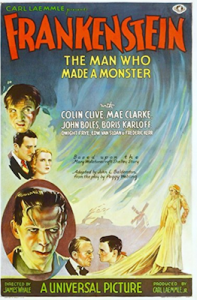
A recent TLS has a knockout review by Frances Wilson of three new books about Frankenstein, a text now at its 200th birthday. Whole thing behind a paywall, but here’s the lead
The world’s most rewarding metaphor is now 200 years old. Since his dull yellow eye first opened on January 1, 1818 Victor Frankenstein’s creature has been compared to the Irish mob, the lumpen proletariat, the wandering Jew, and the UK Independence Party. Today he is spokesman for minority rights – including gay and lesbian and those born with disabilities and disfigurements – while his creator is patron saint of Artificial Intelligence, nanotechnology, robotics, bio-hackers, body-shaming and bad parenting. In English departments, where Mary Shelley has a dual identity as the celebrated author of a canonical novel and a woman writer excluded from the canon, Frankenstein is one of the five most commonly assigned texts. Linguistically, we talk about (genetically modified) Frankenfoods, Frankenstorms (stitched together from different weather systems), Frankenbikes (built from different parts) and Frankenbabies (born of three-parent IVF). The books under review here – in which the various Frankensteins are discussed in terms of cultural and textual history, political philosophy, and the life of the author – form a motley crew we might call Frankentexts.
Our celebration of the birth of Frankenstein follows the baby shower held in June 2016 to commemorate the wet weekend two centuries earlier when Mary Shelley first conceived of her story. Another flurry of publications will doubtless appear five years hence, to cash in on the creature’s first stage appearance at the Lyceum Theatre on July 28, 1823, in a dramatization by Richard Brinsley Peake called Presumption; Or, The Fate of Frankenstein which ran for thirty-seven nights and inspired, over the next three years, fourteen further English or French plagiarisms (with names like Frank-in-steam; Or, The Modern Promise To Pay, and Humpgumption; Or, Dr Frankenstein and the Hobgoblin of Hoxton). The tone was set for Bride of Frankenstein, Son of Frankenstein, House of Frankenstein, The Rocky Horror Picture Show, Robocop, Blade Runner and The Fly. Frankenstein’s capacity to reproduce is seemingly endless; like aphids, he was born pregnant.
Three more shots from the Outliers show at the National Gallery of Art, one of the most thought-provoking exhibits there in years. More captions to come when I do my repeat visit (and with my real camera, sorry for the lousy resolution).
Runaway Goat Cart, c. 1939–42. Bill Traylor, American, c. 1853–1949.
Enjoying Samuel Butler’s The Way of All Flesh, no doubt he would approve of not giving it a try before age 50, as it is full of hard-won personal wisdom. Three bits among many I like…
“My boy,” returned my father, “you must not judge by the work, but by the work in connection with the surroundings. Could Giotto or Filippo Lippi, think you, have got a picture into the Exhibition? Would a single one of those frescoes we went to see when we were at Padua have the remotest chance of being hung, if it were sent in for exhibition now? Why, the Academy people would be so outraged that they would not even write to poor Giotto to tell him to come and take his fresco away. Phew!” continued he, waxing warm, “if old Pontifex had had Cromwell’s chances he would have done all that Cromwell did, and have done it better; if he had had Giotto’s chances he would have done all that Giotto did, and done it no worse; as it was, he was a village carpenter, and I will undertake to say he never scamped a job in the whole course of his life.”
“But,” said I, “we cannot judge people with so many ‘ifs.’ If old Pontifex had lived in Giotto’s time he might have been another Giotto, but he did not live in Giotto’s time.”
“I tell you, Edward,” said my father with some severity, “we must judge men not so much by what they do, as by what they make us feel that they have it in them to do. If a man has done enough either in painting, music or the affairs of life, to make me feel that I might trust him in an emergency he has done enough. It is not by what a man has actually put upon his canvas, nor yet by the acts which he has set down, so to speak, upon the canvas of his life that I will judge him, but by what he makes me feel that he felt and aimed at. If he has made me feel that he felt those things to be loveable which I hold loveable myself I ask no more; his grammar may have been imperfect, but still I have understood him; he and I are en rapport; and I say again, Edward, that old Pontifex was not only an able man, but one of the very ablest men I ever knew.”
“Yet when a man is very fond of his money it is not easy for him at all times to be very fond of his children also. The two are like God and Mammon. Lord Macaulay has a passage in which he contrasts the pleasures which a man may derive from books with the inconveniences to which he may be put by his acquaintances. “Plato,” he says, “is never sullen. Cervantes is never petulant. Demosthenes never comes unseasonably. Dante never stays too long. No difference of political opinion can alienate Cicero. No heresy can excite the horror of Bossuet.” I dare say I might differ from Lord Macaulay in my estimate of some of the writers he has named, but there can be no disputing his main proposition, namely, that we need have no more trouble from any of them than we have a mind to, whereas our friends are not always so easily disposed of. George Pontifex felt this as regards his children and his money. His money was never naughty; his money never made noise or litter, and did not spill things on the tablecloth at meal times, or leave the door open when it went out. His dividends did not quarrel among themselves, nor was he under any uneasiness lest his mortgages should become extravagant on reaching manhood and run him up debts which sooner or later he should have to pay.”
To me it seems that youth is like spring, an overpraised season—delightful if it happen to be a favoured one, but in practice very rarely favoured and more remarkable, as a general rule, for biting east winds than genial breezes. Autumn is the mellower season, and what we lose in flowers we more than gain in fruits. Fontenelle at the age of ninety, being asked what was the happiest time of his life, said he did not know that he had ever been much happier than he then was, but that perhaps his best years had been those when he was between fifty-five and seventy-five, and Dr Johnson placed the pleasures of old age far higher than those of youth. True, in old age we live under the shadow of Death, which, like a sword of Damocles, may descend at any moment, but we have so long found life to be an affair of being rather frightened than hurt that we have become like the people who live under Vesuvius, and chance it without much misgiving.
Next, Ramiro Gomez’s response a few decades on, “Woman Cleaning Shower in Beverly Hills”
Yes, an obvious point, but still, something overlooked. Put me in mind of the Brecht poem, “A worker reads history,”
A Worker Reads History
Who built the seven gates of Thebes?
The books are filled with names of kings.
Was it the kings who hauled the craggy blocks of stone?
And Babylon, so many times destroyed.
Who built the city up each time? In which of Lima’s houses,
That city glittering with gold, lived those who built it?
In the evening when the Chinese wall was finished
Where did the masons go? Imperial Rome
Is full of arcs of triumph. Who reared them up? Over whom
Did the Caesars triumph? Byzantium lives in song.
Were all her dwellings palaces? And even in Atlantis of the legend
The night the seas rushed in,
The drowning men still bellowed for their slaves.
Young Alexander conquered India.
He alone?
Caesar beat the Gauls.
Was there not even a cook in his army?
Phillip of Spain wept as his fleet
was sunk and destroyed. Were there no other tears?
Frederick the Greek triumphed in the Seven Years War.
Who triumphed with him?
Each page a victory
At whose expense the victory ball?
Every ten years a great man,
Who paid the piper?
So many particulars.
So many questions.
And the original, accessible if you have a little German
FRAGEN EINES LESENDEN ARBEITERS
Wer baute das siebentorige Theben?
In den Büchern stehen die Namen von Königen.
Haben die Könige die Felsbrocken herbeigeschleppt?
Und das mehrmals zerstörte Babylon,
Wer baute es so viele Male auf ? In welchen Häusern
Des goldstrahlenden Lima wohnten die Bauleute?
Wohin gingen an dem Abend, wo die chinesische Mauer fertig war,
Die Maurer? Das große Rom
Ist voll von Triumphbögen. Über wen
Triumphierten die Cäsaren? Hatte das vielbesungene Byzanz
Nur Paläste für seine Bewohner? Selbst in dem sagenhaften Atlantis
Brüllten doch in der Nacht, wo das Meer es verschlang,
Die Ersaufenden nach ihren Sklaven.
Der junge Alexander eroberte Indien.
Er allein?
Cäsar schlug die Gallier.
Hatte er nicht wenigstens einen Koch bei sich?
Philipp von Spanien weinte, als seine Flotte
Untergegangen war. Weinte sonst niemand?
Friedrich der Zweite siegte im Siebenjährigen Krieg. Wer
Siegte außer ihm?
Jede Seite ein Sieg.
Wer kochte den Siegesschmaus?
Alle zehn Jahre ein großer Mann.
Wer bezahlte die Spesen?
As a long-time choral singer, I appreciated these tidbits that came across my reading last week:
1) Philosopher J.D. Trout on one way he managed to stay out of trouble during a tough adolescence.
The Tanglewood Festival Chorus, the all-volunteer group that supports the Boston Symphony Orchestra
I was able to steer clear of trouble in part because I was involved in activities that crowded out a lot of the unpleasantness that kids face. Choral singing is incredibly wholesome, and doing it well imposes a discipline that frustrates the temptations of idleness in a permissive world. I know that sounds Victorian, and it is, in a way. But it is also a contingent fact about humans that they form (mal)adaptive preferences, learning to like the often objectively bad practices in their orbit. Staying busy with work and singing, and having thoughtful, captivating, and funny friends, left little time or desire for idle, pointless wondering about whether my life could be better if I learned to steal money, enjoy cocaine, or sleep till noon. None of that ever sounded very fun to me, nor was I much in the orbit of its pull.
2. Daniel Pink, who has praise for choral singing in his new book on timing, When.
Q: Share with us a striking insight from your research on timing.
Pink: Let me offer two:
People are twice as likely to run their first marathon at age 29 as they are at age 28 or age 30. Forty-nine-year-olds are three times more likely to run a first marathon than 50-year-olds. Endings—simply being aware of an end—dramatically shape our behavior.
Choral singing is the new exercise. Research shows that the benefits of singing in a choir (not singing alone, but singing together) are massive: higher pain thresholds and reduced need for pain medication, increased production of infection-fighting immunoglobulin, reduced symptoms of depression, increased sensitivity toward others, improved mood, and much more. There’s something about synchronizing in time with others that is profoundly human.
First, the autumnal glow of the Romance for Violin and Orchestra, in the capable hands of Kyung-Wha Chung and Riccardo Muti’s Philadelphians. (Sorry about the bad break in the file…when it goes to 2 of 2.)
Next, the folk-inflected slow movement of his Sonatina for Violin, played by violinist Josef Suk, Dvorak’s great-grandson, and Rudolf Firkušný, not a household name, but revered by pianists.
And the third movement from his Symphony No. 8, Allegro Grazioso, a tender dance, gentle shimmering nostalgia, Manfred Honeck and Frankfurt Radio Symphony Orchestra.
Gramophone (a classical music monthly from England) devotes its cover story to Debussy this month, and mentions in passing a wonderful performance of one of his most familiar pieces, Prélude à l’après-midi d’un faune, reminding me of Doriot Anthony Dwyer, the principal flute of the Boston Symphony, one of the first female principals in any orchestra and a magical player.


 The world’s most rewarding metaphor is now 200 years old. Since his dull yellow eye first opened on January 1, 1818 Victor Frankenstein’s creature has been compared to the Irish mob, the lumpen proletariat, the wandering Jew, and the UK Independence Party. Today he is spokesman for minority rights – including gay and lesbian and those born with disabilities and disfigurements – while his creator is patron saint of Artificial Intelligence, nanotechnology, robotics, bio-hackers, body-shaming and bad parenting. In English departments, where Mary Shelley has a dual identity as the celebrated author of a canonical novel and a woman writer excluded from the canon, Frankenstein is one of the five most commonly assigned texts. Linguistically, we talk about (genetically modified) Frankenfoods, Frankenstorms (stitched together from different weather systems), Frankenbikes (built from different parts) and Frankenbabies (born of three-parent IVF). The books under review here – in which the various Frankensteins are discussed in terms of cultural and textual history, political philosophy, and the life of the author – form a motley crew we might call Frankentexts.





 A Few Reasonable Words