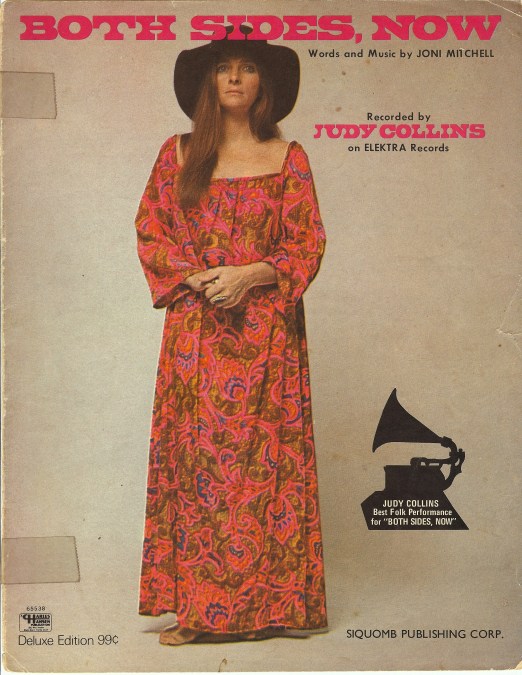
Another song that was a mega-hit, and seems more or less forgotten. Although that dress, once seen, does stay with you. And Judy Collins is still going strong–touring at age 74.

A commonplace book
Another song that was a mega-hit, and seems more or less forgotten. Although that dress, once seen, does stay with you. And Judy Collins is still going strong–touring at age 74.
Hard to believe what a mega-hit this was back in the day.

When I heard my father sing it (with his operetta-size baritone), I was mostly puzzled about why the protagonist of the song was going from Phoenix to Oklahoma, and how he made such good time. It made no sense to a 7 year old.
Wikipedia explains the that Jim Webb the composer knew the geography was borked. It also has the remarkable fact (if true) that this was the third most popular song from 1940-1990 according to BMI.
Here is the man who made it famous:
Back to Richard Rodgers and Oscar Hammerstein for today’s selection. The great solo from Carousel, Soliloquy, a scene and aria by any other name. Love the illustration…

Fast Company gets all hot and bothered about MOOCs and Sebastian Thrun’s (the movement’s Tim Berners-Lee) qualms and new directions. They hardly seem like news flashes:
As Thrun was being praised by Friedman, and pretty much everyone else, for having attracted a stunning number of students–1.6 million to date–he was obsessing over a data point that was rarely mentioned in the breathless accounts about the power of new forms of free online education: the shockingly low number of students who actually finish the classes, which is fewer than 10%. Not all of those people received a passing grade, either, meaning that for every 100 pupils who enrolled in a free course, something like five actually learned the topic. If this was an education revolution, it was a disturbingly uneven one.
“We were on the front pages of newspapers and magazines, and at the same time, I was realizing, we don’t educate people as others wished, or as I wished. We have a lousy product,” Thrun tells me. “It was a painful moment.” Turns out he doesn’t even like the term MOOC.
The crux of the piece (full of rather yucky lifestyle writing, proving that the Fast Company editors are every bit as indulgent to their wards as The New Yorker ones) seems to be the less than shocking news that Udacity is focusing on workforce training and the business customer. (Is there MOOC provider out there that isn’t thinking seriously about this market?) Still it’s worth a browse.


Why or how this came into our house, I’m not sure. Although it was a big hit for Frank Sinatra, so that might be the reason: both my parents were certainly fans. Wikipedia has a somewhat suspect entry on the origin of the piece and its American incarnation. And for a taste of what it sounds like, how about Michael Bublé, who seems to be time traveling back to the heyday of “101 Strings”:
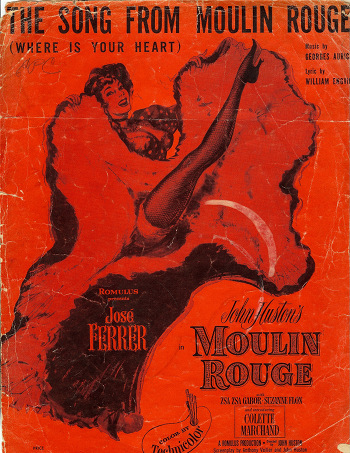
“Where is Your Heart?” from John Huston’s 1952 film “Moulin Rouge,” has yet another great melody. Apparently Zsa Zsa Gabor’s character sings it in the film (dubbed by someone else). The music is by George Auric, of Les Six, a group of French composers who tried to find a new path in the shadow of Debussy and Ravel.
Nice montage inspired by the film:
And Chet Atkins’s surprising take:
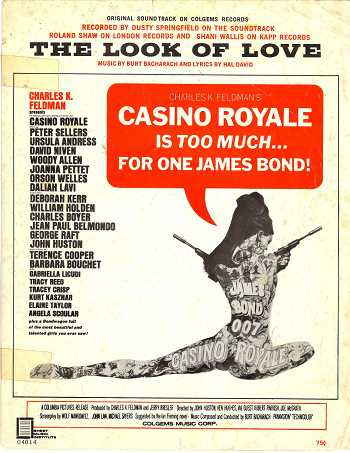
And the over the top sheet music cover:
The one sheet is pretty tasteless, the 1967 movie was forgettable (at least to me), but the Bacharach and David tune, at least in the relaxed style of Dionne Warwick, is quite winning. (And that cast makes for great six degrees of separation fun: Orson Wells and Woody Allen?)
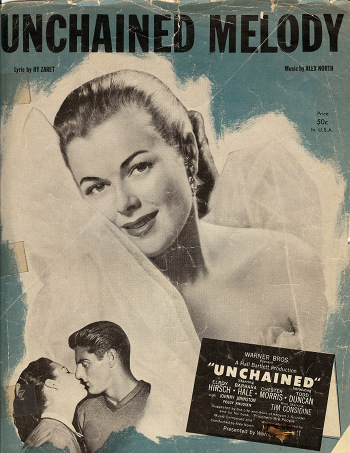
This unforgettable tune has a mostly forgotten history. It originated in a prison film based on a book called Prisoners Are People.
In the film it is sung by Todd Duncan, the operatic baritone, a performance that is surprising with so many later versions in one’s ear.
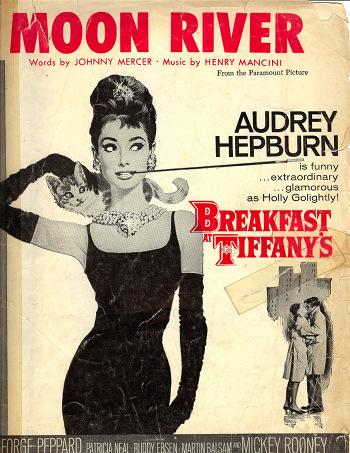
Today’s selection is Moon River, the 1962 song from the movie of the same name. It was a big hit (and Academy Award winner) for Henry Mancini and Johnny Mercer. A perennial favorite at our house–I can plunk through it relatively successfully.
Here’s a nearly operatic version by Shirley Bassey.
Another hit song from a mostly forgotten film. (Martin Scorsese + musicals, perhaps not a marriage made in heaven.) But the tune certainly has done well for itself.
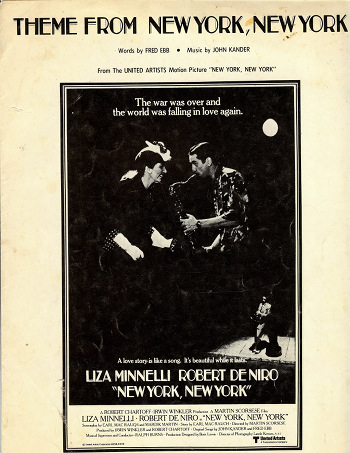
Here’s a bit of the film, courtesy of Turner Classic Movies.
And Liza doing her thing:
 A Few Reasonable Words