For today: one of the great classics of American popular song, written by the German exile Kurt Weill (who bridged the concert hall and Broadway), reportedly in a couple of hours for Walter Huston. (Like “Send in the Clowns,” it was adapted to the original singer’s limitations.)
A great song is more than a tune, of course, it’s also lyrics, and playwright Maxwell Anderson (one of Weill’s many brilliant lyricists) catches that bittersweet, backward looking feel of time passing by.
For the most part, today’s choice evokes high school chorus and a god-awful TV movie with William Katt and Ben Vereen.
More recently, it was a big Tony winner in a revival from American Repertory Theater, which brought us “The Gershwins’ Porgy and Bess” of which more anon.
In fairness to ART, they probably did better than this:
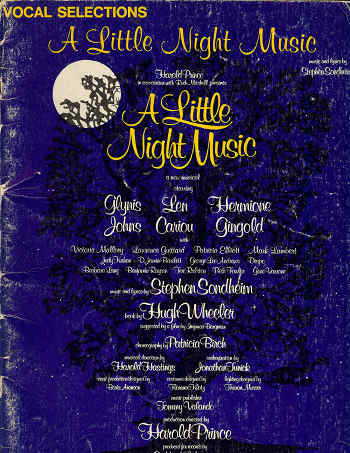
Stephen Sondheim’s 1973 take on Ingmar Bergman’s “Smiles of a Summer Night” was unconventional, bittersweet and grown up. And also boasted perhaps his only breakout song, “Send in the Clowns.” The sheet music, like the poster one-sheet, was a little risqué for the times. At some point I saw sheet music versions where the “tree of love” background was removed.
Babs doing it, with a text adjustment sanctioned by Sondheim.
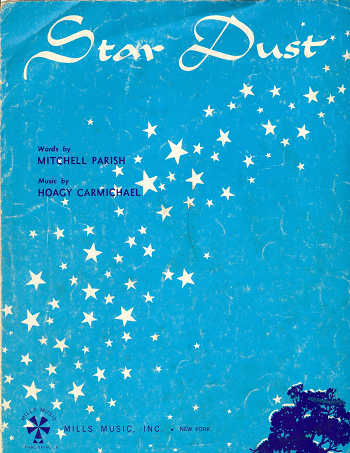
Selected this one yesterday, but didn’t post, sorry. It’s the Hoagy Carmichael standard, “Stardust.” It, according to Wikipedia at least, started life as the 28-year-old pianist and bandleader strolled around the IU campus (where he got a BA and law degree). He said of tunes, something he knew his way around, “You don’t write melodies, you find them…If you find the beginning of a good song, and if your fingers do not stray, the melody should come out of hiding in a short time.”
Here Carmichael is playing it.
The history implies that it was uptempo originally, before it got words and relaxed into a ballad. That’s how I know it (and how my grandparents knew it and loved it as their favorite song).
I’m willing to bet the version that got them teary-eyed was Nat King Cole’s.
Perhaps the best Broadway Music score ever (and I say that knowing the Sondheim scores well). The musical itself is showing its age, at least judging by a flabby revival at DC’s Arena stage last year. Odd that the original source, George Bernard Shaw’s Pygmalion is as tart as ever.
I think the Learner and Loewe score will be treasured as long as people remember musicals.
Here’s Rex Harrison and his famous Sprechstimme doing the whole scene:
More ’70s nostalgia. I don’t think I ever managed to make it to the film, the third(?) remake of “A Star is Born.”
In the clip below, Babs seems less-self indulgent than I remember at the time. And a hirsute Kris K was even sort of fetching. Still it all seems kind of trapped in the aspic of the Carter administration.
Check out this wonderful short from ESPN on the Cape Code couple who sat at the kitchen table in their Cape Code home and created the Major League Baseball scheduled for decades.
Henry and Holly Stephenson, the husband and wife team who created the MLB schedule for 25 years.
It’s now done by another company that presumably relies more on algorithms. Although it seems like the mathematics (and the psychology) of scheduling makes it an unsolvable problem, in the sense that no one solution optimizes all the conditions. From a web site on a math course on scheduling at the University of Alabama:
“Although the Critical-Path Algorithm is generally better than the Decreasing-Time Algorithm, neither is guaranteed to produce an optimal schedule. In fact, no efficient scheduling algorithm is presently known that always gives an optimal schedule. However, the Critical-Path Algorithm is the best general-purpose scheduling algorithm currently known.”
If you look for algorithms on the web, you come to this wikipedia page, where the focus is approaches for scheduling tasks in computer processors. That perhaps sounds dry, but one of the algorithms is called “Credit-based fair queuing” and another is “Brain Fuck Scheduler” I don’t understand either of them, but I now suspect the latter has been in use by my computer for years; I just didn’t know the term. Its emblem is that spinning beach ball. Somehow I prefer the idea of people like the Stephensons handling the big jobs in the universe and then taking the dog for a walk.
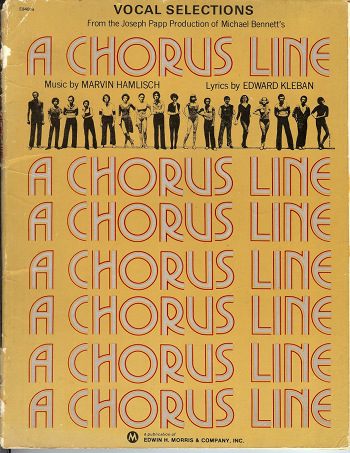
Not strictly speaking sheet music, but a closely related phenomena the “vocal selections” — a set of hits from a show, generally with simplified arrangements. Got a lot of mileage out of this one, a show as omnipresent in its era as Wicked is today.







 A Few Reasonable Words
