The Reading & Writing Life: Periodicity

Like many, I found term papers in college a grim business. Despite any amount of planning, they were always a rush at the end, and despite my characteristic glibness, and being a fast writer, they were usually a mess and busted as such by faculty.

I assumed the deficits were all on my side, and mostly moral failings at buckling down to do the work, so it was odd to discover a few years later when I was writing for a daily newspaper as a stringer that I never missed a deadline, and mostly enjoyed the experience of getting a piece written and filed. I also thrived in the culture of a daily newsroom, finding a natural place within the shared rhythm that grows out of the collective imperative of getting the paper out on time. (The wonderful term “putting the paper to bed” like muskox, a nice bit of journalistic jargon now lost, gives a sense of how it feels when the paper has finally gone to press.)

In talking with my mother about this phenomena, she reflected on her journalism career in newspapers and magazines, saying, “well, it always seemed that working on a daily was easier than working on a weekly, much less a monthly or quarterly. The deadline shaped the work and you got it done.” A daily deadline means a workflow, helps you make sense of what you have to do that day, creates a system if only by default.

By that measure, annuals, and “occasionals” would be hard, and one-time productions, like a Ph.D. dissertation or magnum opus, would be most difficult of all. In those contexts, external factors likely don’t help, except perhaps to create neurotic and corrosive pressure, “when are you going to finish?” or worse, “when are you really going to start?”

Thus it surprised me then, and still does today, that we expect college students, and to some extent, high school students, to figure out how to cope with these long timelines, pulling together materials for a coherent term paper on their own without the guidance a workflow might give. It certainly was never any fun for me–nor, as nearly as I can tell, particularly edifying. I finally wrote a satisfactory term paper in grad school (no doubt in part because I had the confidence of having written for a newspaper under my belt). Perhaps all the botched attempts earlier did add up to some kind of embedded wisdom, at least of the “here’s what not to do” variety. But it really did seem a waste of writing and reading time all around.

Now of course I write every day, and it makes me pause to wonder if I had committed to writing every day on a term paper whether that would have been the ticket. (I doubt it.) People do sort of write a newspaper every day in their collective FB, Twitter, txt, email and other constant streams of content. This seems to bring up the inverse of the problem with the long lead time for a term paper, the constant deadline of “now,” that is, of no deadline, means that while the means to writing has never been easier–simple as pressing “post”– the rhythm is just a constant beating chaos of “update me” no putting it to bed, not much shared pulling together to get something done, just sort of a “feed me” 24/7 editorial maw. I wonder how newspapers–which I am long out of–even begin to cope.

Old words: Save the Musk-Ox

A short note about an odd coinage from the newspaper business that I think has mostly faded away: the “musk ox” story. This was a “filler” evergreen story that could run at any time, and was a term that my parents, both Chicago newspaper reporters, in the mid-century, used.

A musk ox might be a slice of life feature about a perfect family afternoon at Brookfield Zoo or an explanation of the history of park league softball in Chicago, one of the few places in the world that uses a 16-inch softball. In other words, benign stories, no particular news peg and perfect for a slow news day.

Reporters did well to have a few musk oxen in their desk, stories you could pull out, spruce up quickly and file. This is a reflection of the paradoxical situation that space would seem to be at a premium in a paper, with editors and writers having to go to the mat for their stories, there is, at the end of the day, often a copy hole to fill.  This was true then, and has been true on every publication I’ve ever worked on–including, web ones.  Sometimes you just need “10 Gardening Tips From Our Canadian Neighbors” to do the job.

Having such fillers in your back pocket are a particular boon to columnists and editorial writers, who have the unenviable task of trying to get a base hit day after day. Weather, how things used to be, funny spouses, kids, pets, or even traffic abound as topics. Columnists often seem to fall back on non-news about birds, which perhaps deserves its own Pulitzer category. A friend termed these “The frost is on the pumpkin” pieces, and I will give you even money that there is at least one such column waiting in a computer file at a newspaper right now. (Not to mention, “August in Washington: Hot Sidewalks, Hot Eggs” and “X Isn’t What it Used to be” where X is…’draft beer’ , ‘Dupont Circle’, ‘DC sex scandals’, or “How I Learned to Live With My Pet Chickens!”)

Chicago_Tribune_Front_Page
No musk-oxen here…the Trib on a day that was anything but slow, 7/29/1914

The musk ox had a much-derided companion in mid-century journalism, which prided itself on reporting that took actual work. This was the  “fanny piece,” a “news” story that required no actual work, and that you could just sit at your desk and write. (This is sort of a fanny blog).  These non-news fillers were bit players in daily journalism once upon a time, and the difference between them and actual news was mostly discernable. Has the musk ox perished from journalism, or are we awash in it?

Tech & Humanities Watch: Hackers and Hacks

For a further dispatch on the already noted incursion of big data/AI into journalism, see Tim Adams’ good piece in the Guardian about the cheerful software guys who are building a “Terminator” for the workaday reporter. It’s called Quill, and it is a software program that can take raw data feeds and craft news stories without the intervention of people. It’s part of the next generation of “data journalism,” and although I’m not sure quite how widespread it is, I’m confident that it will be soon, as it partakes of the inexorable “if it can be automated it will be automated” trend.

I suppose considered as a technical problem, a newspaper is just another “front end” to fill up with content, (just as the web itself originated as kind of a “front end” for the underlying Internet). We are living in a time where computing power can dip into previously unimagined sources and craft front ends for all kinds of things instantaneously (and not just presentation or content, software can make other software. One example is “The Grid” an AI-based system that custom designs and builds your blog for you.) Perhaps the most amazing thing about Quill is it’s probably not even that hard a content challenge for a computer to turn out the average local news story, earnings report, sports extra, or even a profile of Phyllis George. Not only can a computer replace half the newsroom, it can do it without breaking a sweat. The larger question: what other content is out there waiting to be harvested and automated? Textbooks? Annual reports? TV news broadcasts? Online courses already are to some extent. Surely somebody in a dorm at Cal Tech has written a bot to craft the perfect OK Cupid profile after scraping your FB feed. It’s the work of a weekend for a sufficiently gifted and lonely programmer.

What’s more, readers don’t really know the difference between computer authors and real ones: From the story,

“Perhaps the most interesting result in the study is that there are [almost] no… significant differences in how the two texts are perceived,” Clerwall concluded. “An optimistic view would be that automated content will… allow reporters to focus on more qualified assignments, leaving the descriptive ‘recaps’ to the software.”

And it’s just begun…The computer can also craft endless localized or more detailed versions of the story, with the pieces that are relevant to a very specific reader (think Amazon suggestions, but tuned to your news interests.) The era of the reporter–or the reader–having to manually crunch the numbers or anything for that matter, may be passing by.

“Hammond fully intends to live to see the day when people look at spreadsheets and data sets as being as antiquated as computer punch cards.

What is the most sophisticated thing the machine can do in this respect now? “We can do an eight-page exegesis of one number,” Hammond says, “for example on how likely it is a company is going to default on its debt. The eight pages will be written in plain English, supported where appropriate by graphs and tables. It will show you how it got to its conclusion. It is fine to read. The most important bits of analysis are shoved to the top.”

As a person with a lot of loyalty to the somewhat battered profession of journalism, I’m a little freaked out by this, but as a techy who thinks were still at minute 1 or 2 of what we can do with data, I’m super excited. Not about these ordinary stories that will now be automated, but that lurking behind this innovation is some new and potentially much better way of getting news to people. When rich media meets big data that should set off some sparks, or when the same algorithms that write the overnight sports stories are turned on say economic news or science topics, maybe we can change the whole nature of the usually inadequate coverage in these areas. I also think a tool like Quill when thought of through an educational lens (explanatory/educational journalism rather than breaking news reporting) offers a lot.

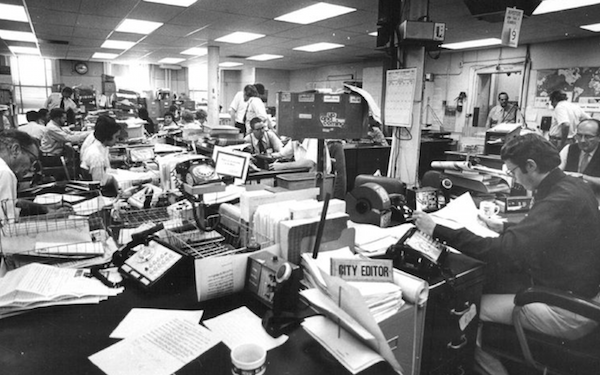
Yet, and for another day, what’s lost when doing it the old way finally fades: what an improbable and glorious human endeavor the newsroom was…

Human-based Content Creation & Management, once upon a time. The Denver Post newsroom in the 1970s.

Reasonable Words: WaPo editor Marty Baron, the future is now

nytimes_color
Color printing comes to the front page of the New York Times: 1997. A little more than a century after the three-color printing process was developed in 1893.

Washington Post Executive Editor Martin Baron’s speech on the changes in print journalism is timely and provocative (to use a journalistic cliché) if not exactly a news flash.

A few bits:

“It’s wrong to say we’re becoming a digital society. We ALREADY ARE a digital society. And even that statement is behind the times. We’re a mobile society. Eighty percent of adults on earth are expected to have a smartphone by 2020.”

“But distance between the newsroom and the business side fostered ignorance. Newsroom staff never really understood how we made money – and, in all honesty, didn’t really care. That’s because we made so much. And the business side, I should add, didn’t really understand the newsroom. Because of our dominant position among readers and advertisers, it didn’t seem to matter.”

Today, it matters. We need to know how the bills get paid – more pointedly, how the coverage is funded.”

“We have fostered a tight working relationship with our Engineering department, with 47 engineers working with our journalists. Four years ago, we had only four engineers in newsroom. When we move into a new office within a year, all 47 engineers will be embedded in our newsroom, working side by side with our journalists.”

His points aren’t surprising to me (I’ve been working on the web for 20 years, and tried to make the point about different forms of storytelling a decade back) I’ve also worked at a legacy electronic media company which has had its own struggles with loss of relevance, prestige, and a busted funding model.

But one thing I don’t see candor so often is that it was so damn easy to make $$$ in the newspaper business, at least for the big boys, for so long. Even during my few years as a Post/staffer and stringer, the amount of money the place made was bountiful beyond belief. And as Baron says, for reasons good and bad, the idea of the paper as a business seldom really impinged on the ethos of the 5th floor where the newsroom was. Editorial types came to journalism with a mix of motives, but there are (or at least were) a fair number of public-service minded or wonky types, who had no interest in, or real facility with things like “innovative business models” and didn’t even like to talk money per se.  They wanted to change the world, bring down a corrupt president, “tell the people” or be a foreign correspondent, maybe someday turn out a thumb-sucky book that influenced policy, and then be put out to pasture running a small liberal arts college somewhere. Turns out the publishers may not have been any great shakes at the whole biz model thing either: their task was to steer big elegant ships through monopolistic mass media waters with no actual competitive threats, certainly not in DC at least. Looked at it from that end of the telescope–not a completely fair perspective, granted, what’s amazing is not that the newspaper biz is crumbling cookie-wise as Jack Lemmon would say, it’s amazing that it stayed intact this long.

Another personal observation: as somebody who speaks newspaperman (having been raised by two) but who is also nerdy enough to at least have “advanced beginner” tech-speak skills, I do know these two languages offer abundant opportunities to epically misunderstand other.  It starts with a a software developer (not a ‘technologist,’ Marty!) referring to “content” which which a writer will feel dissed by, and a writer in turn going , “why can’t it just work that way when I press a button?” about some tech feature. It goes down hill from there, and ends with mutual “they just don’t get it.”

The image of “embedding engineers” in a newsroom is a a particular laugh. About the only thing that could be successfully embedded in any of the newsrooms I’ve ever worked in or seen is a bar. Maybe the best innovation is a touch screen app for reporters that brings Diet Coke, cigarettes, booze and coffee directly to their desk, and uses the voice of Hildy Johnson.

The whole Baron thing is worth reading.

When I got a thank you gift from Amazon in 1998, it was a coffee mug with this quote on it.

“I can’t understand why people are frightened of new ideas. I’m frightened of the old ones.” –John Cage. The enclosed message from Jeff Bezos (now owner of the Post), pointed out that Cage’s quote was one of his favorites.


Media Futures and Pasts

Tipped by the American Press Institute‘s lively newsletter, I came across a fascinating portfolio site done by a class at NYU that is researching futures for the NYTimes. Engaging to nose around in (and fronted by an excellent video). Some things that will shock j-school old-timers (“division between advertising and editorial? why still a thing?”), but overall it’s clearly a labor of love, and a well-done one at that.

Future New York Times