Today a bit of music theory. The most notorious interval in music is the tritone, the so called “devil in music.” This is the interval of an augmented 4th (that is, for instance, from C to F-sharp). It has all kinds of odd properties both theoretical (unlike other intervals it inverts to itself) and auditory (it seems to shimmer with instability).
Once forbidden in traditional western harmonies, as it tends to undo a solid sense of key, it gained favor as a sort of special effect in the 19th century music, and then became something more serious in 20th century works. (The somber opening of Britten’s War Requiem relies on it.)
It is all over “West Side Story,” which is full of clever musical tricks and references (the serial technique in “Cool” for instance). Perhaps the most subtle of the many tritones in the music (perhaps when all the dust has settled Bernstein’s greatest achievement), is how it weaves in and out of the tune and accompaniment to “Something’s Coming.” Far from being some technical error, it’s evocative, hopeful, and at the same time prophetic. Like a line of poetry that doesn’t quite turn. (It’s also key to how LB sets the word “Maria.”)
A break from classical music blather to provide a choice tidbit from Roddy Doyle’s The Commitments. Band manager Jimmy Rabbitte checks the paper to see if they got a review.
“There was no review in Hot Press. That was a disappointment. But they were in the Rhythm Guide.
–Your Regular Beat . . .
What’s Happening in Residencies. Wednesdays
Carlow, Octopussys: The Plumbers.
Cork, Sir Henrys: Asthmatic Hobbit Goes Boing.
Dublin, Baggot: The Four Samurai.
Dublin, Ivy Rooms: Autumn’s Drizzle.
Dublin, Miami Vice: The Commitments.
These are commonly assumed to be dark times for classical radio, although whether there have ever been truly bright times for this genre I’m not completely sure. Although I almost seldom turn on my local radio station over the air, I am a very content user of many online stations. So for me, at least, it’s just a shift, not a loss.
Three streaming stations–chosen from many–that I particular enjoy:
WQXR from New York is high on my list. They still play opera every Saturday, and have recently launched a show called “The Sopranos” with Debbie Voight. Quite a good web site as well, and they have an app.
BBC Radio 3 is superb all around–not just for the Proms which they do every summer. Lots of interesting talk amidst the music, which has a good complement of live offerings, including Wigmore Hall. Shows are archived often for a week, and some for longer. If you are a choral singer or fan of that repertoire, their program “The Choir” is fascinating. Their web site is part of the overall BBC one, and they have an app, although last I checked it doesn’t work in the U.S.
My German is rudimentary, but that has not stopped me from listening a lot to BR-Klassik, out of Munich, which has the benefit of coming from a country that is well-provisioned with classical ensembles, be they orchestras, choral groups or operas. Lots of live music, and a refreshing range of what counts as classical. Their hourly nachrichten is a good test for anybody’s long ago German I. The only thing I can reliably get is the weather.
For today: British mezzo Sarah Connolly singing “Scherza Infida” from Handel’s “Ariodante.” This was one of those recordings that seeks you out. Connolly had sung for “The Sixteen,” Harry Christopher’s elite chorus, and then started a solo career, which has become pretty starry. This early solo recording of hers–about 12 years old now–garnered great favor in Gramophone. I heard this cut from it excerpted on the demo CD they used to send. And I found myself playing it over and over…something I haven’t done for years, then got the full CD, which I have played over and over since then.
Something about her ardor and restraint is so very British, and so very moving…
So, trying to find any light to shed about the flap over Dejan Lazic’s request to have a critical review removed, and not really sure if there is any larger lesson. Neither the web nor music criticism works in such a way, much as we might wish they might–performers and critics both were prefer their efforts weren’t in the permanent record, but now that is how it works.
One positive outcome of this is that it has gotten me to go listen to Lazic for myself. Interesting pianist, unusual combo of old-school rhetorical flourish and super-modern pin-point clarity. He manages to engage me in a work I have come to loathe (after a teenage infatuation with it), Brahms alternately pompous and cloying B-minor Rhapsody. Lazic doesn’t quite scrub all the triteness out of it for me, but it definitely is a fresh take. Suggests his playing would be well-suited for Liszt.
Although I’m sort of a “neuro-skeptic” about all these “findings” from fMRI. Sticking somebody in a brain scanner while they play pinocle or whatever and discovering great truths seems to me a dubious methodology (although granted it’s been going on a decade).
But this is so charming, and such a boon to musical duffers such as myself that I thought I’d share.
Flute lessons as recorded on the walls of the pyramids.
Grove Online is the big daddy of classical music resources (at least in English). Its origins rest with one of the crazy 19th century encyclopedists, George Grove, who was asked to write a musical dictionary for amateurs.
Over the years it grew to a hefty twenty plus volumes, and is now the authoritative source, available online for a fairly sizeable subscription (although many academic and some public libraries offer access for card holders.) It combines “life and works” info, including musicological and interpretive music history context where relevant, and there are multimedia examples you can play or pull into programs like Sibelius. They are trying to deal with the question of how you update a professionally written and edited (rather than crowd-sourced) encyclopedia. Not completely up-to-date: Did just check and they still have Peter Maxwell Davies as the Master of the Queen’s Music (it’s Judith Weir now). So best to combine with other resources, but still the place to go for things like a comprehensive summary of the history of the mass in Western Classical music.
And on a lighter note, here’s Dame Kiri in a favorite encore of hers, “Art is Calling For Me,” which I heard the next rising star, Pretty Yende sing in a wonderful recital recently.
Best line “I want to be want to be a screechy peachy cantatrice.” Neither Pretty, nor Kiri have the least bit screechy about them! Only truly great singers can bring this one off..
Gerald Hugh Tyrwhitt-Wilson, better known as Lord Berners, 1883-1950, was an eccentric British composer, painter and writer–Grove Dictionary pegs him well as part of a “slender British avant garde which emerged after World War I.” –A sort of English Satie if you can imagine it, best known for some ballet music and a truly wonderful autobiography. The initial volume of which, “First Childhood,” begins thus:
I can remember very vividly the first time I became aware of my existence; how for the first time I realised that I was a sentient human being in a perceptible world. I seem to have acquired this state of self-consciousness very much in the way in which one masters the technique of riding a bicycle or of performing some trick of juggling, when, at a given moment and without any apparent reason, it is suddenly found that the thing can be done.
This awakening of my perception was not brought about by any very remarkable incident. There was no salamander in the fire, no tolling of bells to announce some famous victory or the accession of a monarch. Much as it would enhance the interest of my story and lend it a touch of the picturesque, a strict regard for truth forbids me to connect the circumstance with any occurrence of national or even of local importance. The conditions in which this epoch-making event in my mental career took place could not possibly have been more trivial. I was merely standing beside a table in the library at Arley, when, all at once, what had hitherto been a blurred background became distinct, just as when someone who is shortsighted puts on spectacles. Objects and individuals assumed definite shapes, grouping themselves into an ordered whole, and from that moment I understood that I formed part of it—without, of course, a full premonition of all that this exactly entailed. The commonplace features of this first landmark in my experience remain clearly recorded in my mind’s eye; the massive mahogany table with its cloth of crimson velvet, the fat photograph album with gilt clasps that could be locked up as though it were a receptacle for obscene pictures, whereas in reality it contained nothing worse than family portraits; the china bowl full of Christmas roses, slightly frost-bitten as those flowers usually are, a pastel portrait of my grandmother as a girl; in the middle distance my grandmother herself, my mother and a few aunts and, in the doorway, my nurse waiting to take me out for a walk. An ensemble which, you will agree, was entirely devoid of any kind of poignancy, although it may have had a certain charm as a Victorian conversation piece.
* * * * *
People I have questioned on the subject of the first awakening of their consciousness, have proved strangely uninformative. They could in most cases remember some particular incident that had occurred at an early stage in their lives, but none of them were able to recall the exact moment in which they had realised for the first time that they were human beings. Some even confessed that, as far as they knew, it had never happened to them at all. And I daresay they have managed to get through life just as happily.
The phenomenon I have described took place when I was three and a half years old. Up to that point my life had not been wholly uneventful…
How much of the classical repertoire do we actually perform or listen to? This question is prompted by a remark baritone Luca Pisaroni made after a recital he gave in DC last (for which I wrote the program note). For those of you who are not song-recital aficionados, they are a chance for the singer–rather than librettist–to shape the arc of the program and select the emotions, themes, personas etc. that will be presented. Crude analogy perhaps, but it’s sort of stand-up comedy for classical music, just as hard (maybe harder as you have to sing not speak, also in 3 or four languages, and hard to save yourself with an ad lib, although Luca did get in a line about his adorable dogs, one of whom worked on getting himself arrested at The White House).
Shaping a recital program, there’s a natural tendency to go with the tried and true, and Luca departed from this in a fascinating way, filling it full of unusual works, including a set of songs by Johann Friedrich Reichardt to poems by Petrarch, which I had never heard, and barely even heard of–even given 20 years of program note writing, and 35 years since my first music review. The remainder was Beethoven (but Italian songs), Brahms, and a Liszt set that managed to avoid most of the chestnuts. I asked him about his unusual programming and he responded if we only perform or listen to the “hits” that limits us to about “1%” of the music, and there is “so much else out there worth hearing.”
This was thought provoking, and in part reflective of the fact that he’s a searching artist and a smart guy, one who doesn’t want to be bored or bore his audience. And I’ve encountered or read the same sentiment from others. One of the many new astonishing violinists on the scene (there seems to be an infinite supply) told an interviewer in Gramophone (I think) that there had to be life beyond performing the seven big concertos (even at the ultra elite level) and maybe 3 or 4 recital programs for an entire career. My guess is that this was Ray Chen, but I can’t remember the quote.)
Ned Rorem, also chimes in, confessing in one of his diaries or essays that his disinterest in attending to New York Concert life in part stems from not wanting to hear yet another pianist traverse a Beethoven sonata for the umpteenth time (so that he can compare it, or pretend to compare it Brendel, Schnabel, Kempff, or God knows who).
A music prof of mine also inveighed against the tendency to unearth, perform, and record every last note by the established masters, including their worst efforts, rather than championing the best of lesser known composers who were their contemporaries and might help set the context. There are inane pieces of Beethoven–yes, I’m talking about you “Rage over a Lost Penny” – and a sonata by Clementi might shed some light on the age, while offering pleasures of its own—this was his take. (Now we have complete Clementi Sonatas, courtesy of Howard Shelly, and any number of complete Beethovens).
So all of these voices say, get off the beaten track, surely good advice, and I’d chime in, program new works to perform or to listen to on your play list, and stretch a bit. Still, this is more challenging than may immediately appear. From the artists’ side, for better or worse, there is implicit pressure to establish yourself with the well-known calling cards. I think this is particularly an issue for instrumentalists (Yuja Wang did not become a sensation championing Theodore Kullak’s Piano Concerto. Although another jaw-droppingly talented pianist named Wang, Xialin Wang, did record Richard Danielpour’s as one of her first offerings.) A violinist may not want to make a career recycling the big concertos, but unless he has a couple under her belt it might be hard to get the attention of agents and administrators who are booking. There are people who will want you to sing or play your signature piece—I’m one, a Leontyne Price recital without “Pace, pace mio dio” was a bit of disappointment for me, as that B-flat was one of the most reliable thrills in music.
And coming to the audience side, there is the issue that one person’s hackneyed old chestnut is somebody else’s brand new discovery. (Everybody’s got one–I remember being 13 and discovering the Allegretto of Beethoven’s Seventh and blabbering incontinently to everybody about it, only slowly realizing that this wasn’t my unique discovery–my parents had heard it many times, my middle school friends thought me a little nuts, not an assessment that has altered to any great degree). And it was hardly a unique secret–in fact the haunting feel of this music has been commented on by oodles of people (Richard Wagner’s odd “apotheosis of the dance” comment applied to this, and I see from IMDB that the score to the weirdly awful 1974 movie “Zardoz” features it.) That’s one way newness can be conjured even in the heart of the repertoire, there are others.
So maybe programming (or curating your own listening) does call for a magic balance, setting your own percentage mix of new, old, off the beaten track and reliable life-enhancers. For my part, I will keep this balance by pulling a random piece from Naxos Music Library every month–and with their 100,000 CDs am likely to find a complete surprise, one I hope that I love.
And that cues an apposite Sir Thomas Beecham story. He was rehearsing with an orchestra, and the rehearsal period ran out before they got to the second half of the program, Brahms 4th Symphony. He said something bluff and encouraging, along the lines of “Well, gentleman, I’ll see you at the concert, I’m sure it will all go smashingly well!” A concerned French horn player piped up (the 4th being a French horn intensive piece) and said,
“But, Sir Thomas, I’ve never played the Brahms 4th.”
“You haven’t!” thundered Sir Thomas, “well, you’ll love it, my boy!”
100,000 CDs, 1.5 million tracks, a landscape that goes far beyond the greatest hits.
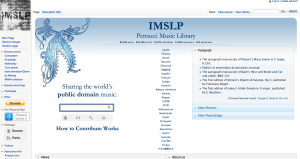
Today a resource for musicians: IMSLP, a repository of public domain scores that offers untold riches..
From their FAQ:
IMSLP stands for International Music Score Library Project and started on February 16, 2006. It is a project for the creation of a virtual library of public domain music scores based on the wiki principle; it is also more than that. Users can exchange musical ideas through the site, submit their own compositions, or listen to other people’s composition; this makes IMSLP an ever-growing musical community of music lovers for music lovers.
It takes a bit of trial and error to get the hang of searching it (and the instrumentation search can be quirky), but in addition to many, many scores, there are recordings, talk forums, and historical notes. Combined with “ForScore,” a sheet music app for the iPad, IMSLP has become a a regular browsing destination for me–fueling, among other things, an arguably unhealthy fascination with 19th century salon music. God was there a lot of it!
One such treat, the once wildly popular “Berceuse” from Benjamin Godard’s opera Jocelyn.”

 Today a bit of music theory. The most notorious interval in music is the tritone, the so called “devil in music.” This is the interval of an augmented 4th (that is, for instance, from C to F-sharp). It has all kinds of odd properties both theoretical (unlike other intervals it inverts to itself) and auditory (it seems to shimmer with instability).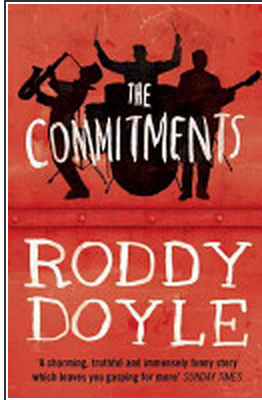






 A Few Reasonable Words