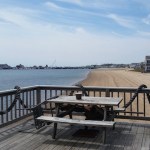
My digs for the next few days…sea, and even though they didn’t show for the picture, gulls.
Spending a few days by the seashore, so for today one of the many classical pieces with an oceanic theme, a Sergei Rachmaninoff work.
Rachmaninoff’s Etude Tableaux are virtuoso piano works, written in his modern Russian style (before he decamped for the U.S. and his style schmaltzed up a bit). They are musical evocations of scenes (a frequent late 19th-20th century compositional move –see also Debussy’s Preludes, Images, most of Ravel, and any number of Liszt and Strauss works (Richard, not Johann).
The program key to the Rachmaninoff works is not certain. He didn’t publish names or descriptions, but did give a few hints. The point rather is how the music evokes a scene and an emotion, vivid but not fixed.
My favorite of the lot is #2 in A minor from the second set, Op. 39, which has gotten the informal subtitle, “The Sea and the Gulls.” Here it is in the capable hands of Sviatoslav Richter,
.
The conductor Serge Koussevitzky had the bright idea to ask the Italian composer Ottorino Respighi to arrange some of the Rachmaninoff pieces for orchestra, and here is a set (kicking off with The Sea and the Gulls) in a wonderful performance by the BBC Phil and Noseda (the National Symphony Orchestra’s lucky snag for next music director).
Dressed up for orchestra, it’s lovely, but the piano work with those 2 against 3 rhythms and lines (the sea birds?) swooping in and out of the wavy texture sparkles so much it seems like it’s giving off light, not just reflecting it.
And for a musical birthday message: since Mozart didn’t write variations on “Happy Birthday to You!” here are his variations on Twinkle, Twinkle Little Star instead. This is one scenery chewing performance by Fazil Sey and his Bechstein.
Have been playing chamber music with a bunch of amateur musicians recently, and although it’s mostly strings and piano (a classic combo), a friend who is a good bassoonist is part of the mix.
This tenory-y double reed is the underappreciated star of the woodwinds, and I have no less an authority than the Grove Dictionary of Music to back me up:
In [18th century] Germany the bassoon was considered indispensable in the orchestra (even if not always given an independent part) as a means of consolidating and clarifying the bass line. Writing in 1784–5, C.F.D. Schubart asserted that the bassoon was able to ‘assume every role: accompany martial music with masculine dignity, be heard majestically in church, support the opera, discourse wisely in the concert hall, lend lilt to the dance, and be everything that it wants to be.’
True, it generally gets typecast as the woozy uncle, or offers a few sarcastic farts to take down the strings’ insufferable ardor now and then. Yet many orchestral wizards brought out the lover, the scamp, and even the ballerina in it. In particular, Prokoviev and Shostakovich deployed it with skill, disclosing a variety of color and character.
As you probably haven’t had your daily hit of bassoon music, here’s a beautiful sonata by Telemann:
and if you worried about typecasting the Bassoon, bet you didn’t know there were accomplished jazz bassoonists around. Here is one: Paul Hanson (also an accomplished sax player).
So if learning about a double reed was on your Monday morning list, “check” that’s done.
My mid-life of music listening has been enriched by coming back to or meeting for the first time composers I undervalued during my years as a SERIOUS MUSIC PERSON. I guess this re-calibration is natural, if you love Tchaikovsky’s B-flat minor Piano Concerto as a teen, comes a time when you will look back at it as gauche, and then when you’ll back at that backwards glance as silly in turn.
There are some things that there is no going back to. Turandot was my favorite opera as a teenager, and like people who are still listening to Carmina Burana at fifty, I think if I still were a Turandot fancier, it would be hard to refute the conclusion that something had gone wrong with my life in the music department.
One passion that has emerged for me is Rachmaninoff. This will probably seem surprising to many, who know the big tunes and the lush orchestral works: what’s not to love? I’m a creature of my time, however. For context, Rachmaninoff was not even taught as “20th century music” when I was a music student, although he died in 1943, just 2 years shy of Bartók, the pinnacle of 20th century musical modernism. Rachmaninoff’s tunefulness, a turn towards the broad gesture particularly in the work he wrote in the U.S., did him no favors with the composers and critics looking for a new path. A piano teacher friend of mine dismissed tunes in his Paganini Rhapsody as “schmaltz enlivened by music for the title credits to Bonanza” (Bonanza was a terrible western-themed evening soap opera of my youth.)
There is some truth to the charge–it is pretty corny, but there are responses as well. If the American Rachmaninoff could be a throwback, the Russian one was at least sometimes a modernist, if of gentle mien. Now we (or at least I) can see works like the Third Symphony (given a knock-out performance by the National Symphony Orchestra and their music director designate, Gianandrea Noseda, last fall, as an integrated part of the history of the symphony and a superb one, not a guilty pleasure.
As a taste of this, here is a song by Rachmaninoff, Daisies, both in a piano arrangement, played by the incomparable Emil Gilels
and sung by, Julia Lezhevna, a young Russian soprano with a crystalline voice.
All creation presupposes at its origin a sort of appetite that is brought on by the foretaste of discovery. This foretaste of the creative act accompanies the intuitive grasp of an unknown entity already possessed but not yet intelligible, an entity that will not take definite shape except by the action of a constantly vigilant technique.
This appetite that is aroused in me at the mere thought of putting in order musical elements that have attracted my attention is not at all a fortuitous thing like inspiration, but as habitual and periodic, if not as constant, as a natural need.
The premonition of an obligation, this foretaste of a pleasure, this conditioned reflex, as a modern physiologist would say, shows clearly that the idea of discovery and hard work is what attracts me.
The very act of putting my work on paper, of, as we say kneading the dough, is for me inseparable from the pleasure of creation. So far as I am concerned, I cannot separate the spiritual effort from the psychological and physical effort; they confront me on the same level and do not present a hierarchy. The word artist which, as it is most generally understood today, bestows on its bearer the highest intellectual prestige, the privilege of being accepted as a pure mind–this pretentious term is in my view entirely incompatible with the role of homo faber.
….
We have a duty toward music, namely to invent it. I recall once during the war when I was crossing the French border, a gendarme asked me what my profession was. I told him quite naturally that I was an inventor of music. The gendarme, then verifying my passport, asked me why I was listed as a composer. I told him that the expression “inventor of music” seems to fit my profession more exactly than the term applied to me in the documents authorizing me to cross borders.
Invention presupposes imagination but should not be confused with it. For the act of invention implies the necessity of a lucky find and of achieving full realization of this find. What we imagine does not necessarily take on a concrete form and may remain in the state of virtuality, whereas invention is not conceivable apart from actual working out…
Taking a break from the “Blogging 101” stuff to share an Abbey Simon track I encountered (or probably re-encountered) last night.
This is his performance of an arrangement from Gluck’s opera Orfeo ed Euridice. (The arrangement is more than a tad old-fashioned, but the piano sound–and the way he gets from phrase–gentle, golden, and singing).
And another lovely take on it–maybe even more haunting–gets a little of the operatic darkness too. Plus the bonus of being able to see the video of performer, Yuja Wang who, like many a great pianist, somehow barely seems to be moving her fingers from the top of the key to the bottom. (What did we do before ‘keyboard cam?’)
Wang’s power at the keyboard is astonishing–I’ve heard her live twice, and out comes this tiny person who thunders and sings through big pieces, for instance the Tchaikovsky Piano Concerto #1 with the high beams on, and the curves taken thrillingly fast, but with calm confidence. She’s incredibly strong, but what impresses is the delicacy. Going back to Simon, he was once asked “whether strength matters in piano technique?” and here are his reasonable words, applicable to other instruments and genres.
Abbey Simon: I don’t think [muscle strength] comes into it. You have to realize you don’t play a musical instrument with your fingers. A musical instrument is played by the ears. My own theory is that what sets apart the great artist from the competent one is that he hears differently. When people say, “The sound of Rubinstein,” Rubenstein played the same old piano that everybody else played. It was that he had a different conception of sound. The miracle of Horowitz is not the octaves. Conservatories are churning out people who can play octaves even faster than Horowitz can play them. The miracle of Horowitz is the color, the ability to change color. It’s all of those things, and those are things that are governed by the hearing. The wonderful sound that Heifitz had is because Heifitz heard differently. In addition to that brilliant ability, he heard things differently. All of these great artists hear things. They have an extra talent, an extra technique, and it’s the hearing technique because in the most elementary way our ears tell us we played a wrong note. We have to practice so that we don’t play a wrong note. From then on, it’s a constant refinement. The ears demand refinement — play faster, play louder, play softer, do this or that; you didn’t phrase that nicely. Some people’s ears become more sensitive and more demanding, and they’re the ones who are the great artists.
Discovered a web-documentary about the Joyce Hatto piano hoax from a few years back. For those who don’t remember, or missed it, in the early 2000’s, a pianist named Joyce Hatto emerged and became a critical darling. She was evoked as a neglected master from the old school, and the recordings poured out and got raves from the likes of Gramophone, to the point of cultish adoration among the piano fanciers.
It was a good story, 70-year-old unknown becomes a rediscovered keyboard genius (somehow that she was a dowdy Englishwoman helped). And as good stories will, it went, as not a word or a note of it held up. Her husband was plagiarizing others’ recordings, passing them off as hers.
I was then–as I am now–a Gramophone subscriber, and I watched it unfold in real time, including the sad denouement, after she had died of cancer and couldn’t comment one way another on motive or on what she did or didn’t know.
Rarely, it’s true, but still from time to time I get asked by parents how to get their kids interested in classical music. Given that I am of the “let kids be kids” school, and since I don’t really recall any concerted effort on my parents’ part to influence me with respect to music or much else, I’m reluctant to provide a “program.” Certainly nobody gets coerced into a life long love of anything–or at least I hope not. But how does it unfold that some people end up loving classical music?
In my case there are a few conditions & milestones that I can pick out in retrospect. 1) My parents enjoyed classical music, without being maniacs about it, and 2) there was amateur music-making in my house throughout my childhood, as there is in mine. My mother’s German-Irish heritage came with an implicit respect for music, be it the seriousness of the European classical tradition, or the nostalgic emotion of the Irish folk one. My father’s love of Barbra Streisand is one of those strange things best passed over without comment. But music was abundant. This included playing piano and singing.
So of course there were LPs around (and anybody who came of age with LPs of any genre probably harbors emotional memories and responses to them that I wonder if downloads or streams will ever match. You could handle a record, inspect its cover, protect it from scratches, jealously hoard it or generously loan it–it was a thing in your life, again a message of value). One particular LP of my parents’ was called “Opera’s Greatest Hits,” a two-record compilation of orchestral highlights–overtures, intermezzi, and the like–from the Boston Pops with Arthur Fiedler conducting. Not one note of singing, which for some reason did not strike me as odd. It did not occur to my 4th-grade self to wonder how opera’s greatest hits could skimp on providing a single aria? Instead I reveled in these 70mm technicolor performances of big emotional pieces. Mostly it was a generous helping of once great hits of the classical “Top 40,” for instance, the William Tell Overture, in 1971 still indelibly the Lone Ranger’s tune, the Intermezzo from “Cavalleria Rusticana,” soon to enjoy renewed fame from a star turn in “The Godfather,” and this ridiculous piece: “Dance of the Camorristi,” from a mostly forgotten opera entitled “The Jewels of the Madonna” by Ermanno Wolf-Ferrari.
Listening to this now, what comes to mind first is Noel Coward’s quip “Extraordinary how potent cheap music is.” Second though, is the memory of how much fun I had connecting to it–and all these pieces–when I was a nerdy fourth grader: air conducting, imagining and then making up the story (I still haven’t a clue what Wolf-Ferrari’s opera is really about), and getting access to the sweep of something that felt big. Forty odd years later, naturally enough, different musical pieces feel “big” to me, but I know that music can do that. That’s a space that was made long ago. It gets filled up with different things, a natural progression.
Reflecting on this, my advice for a parent is pretty slight and obvious, I suppose: be out of the closet about your own love of music, have music around and available, and show some intention about it. Often, music is merely wallpaper in our lives now, and it doesn’t make a lot of sense for a child to hear “listen to this, it’s good for you,” as a prompt to make one pattern in that wallpaper leap out. Instead, a kid who catches a parent listening intently, or playing an instrument, might pick up the message that this is meaningful and worth attention. And finally, I wouldn’t worry about taste. I don’t know what my parents thought of that Pops record (although we did watch the Pops broadcast with pleasure many times). I’d bet that my playing it over and over in the family room was not one of my more popular moves. But never did I get a “you should be listening to …” (insert name of composer, work, band, singer, etc. meant to be improving, cool, or at least tolerable). It was my thing, and like so many things, my parents’ staying out of the way was the ticket.
For those interested: here is the track list for that LP. Looking over it, do you see any gateway pieces from your youth?
A1 Aida: Grand March
A2 Cavalleria Rusticana: Intermezzo
A3 Tsar Sultan: The Flight Of The Bumblebee
A4 Faust: Waltz Scene
A5 Hansel And Gretel: Dream Pantomime
B1 Samson And Delilah: Bacchanale
B2 Love For Three Oranges: March
B3 Eugene Onegin: Polonaise
B4 The Tales Of Hoffmann: Barcarolle
B5 The Jewels Of The Madonna: Dance Of The Camorristi
B6 Mlada: Procession Of The Nobles
C1 Lohengrin: Prelude
C2 Le Cid: Aragonaise
C3 Sadko: Song Of India
C4 Die Fledermaus: Du Und Du Waltzes
C5 Prince Igor: Polovetsian Dances
D1 William Tell: Overture
D2 Goyescas: Intermezzo
D3 Carmen: March Of The Toreadors
D4 Die Walküre: Ride Of The Valkyries
A cigarette card helpfully explains how a gramphone works.
I’m not one for musical nostalgia. (Or any nostalgia for that matter: using the past to spank the present is a default trope in many areas, but one that throws off more heat than light, particularly corrosive in education.)
But musical pasts are fascinating in their own right and today three examples of “old style” (although not all from old musicians).
Jorge Bolet was a virtuoso in the old mold (which includes sometimes less than total adherence to the letter of the score), championing the romantics and playing with what piano expert Blake Morrison calls “epic virtuosity….fleet and lavish.” At the same time, he was dour in his stage manner, something that perhaps worked against his achieving the kind of fame that more demonstrative communicators like Horowitz and Rubinstein achieved.
Here he is in a Chopin Nocturne, with hands and a technique that fascinate. (What’s the deal with that left thumb?!) But so much to marvel at: the range of dynamics, control and poetry…how he puts forth the drama of the piece: moving from shadow/light, small scale/large scale, simplicity/elaboration. It’s hard not to imagine you are listening to a time capsule of a great pianist of the late 19th century.
Next a more complicated throw back: the Baroque cellist Anner Bylsma playing Duport études. Bylsma, like many musicians over the last 30 years, aims to recover the performance approaches and styles that prevailed when the piece was first composed. (Bach as Bach would have played and heard it, etc. A sort of musical ‘originalism’ that fomented much resistance and debate in the 80s, but has now settled down.)
Whatever your view of merits of this approach, it is eye, ear, and repertoire expanding. To me this Bylsma here evokes an almost folk music feel, which is an association that the 18th century classical tradition doesn’t usually prompt.
Finally, a musical argument for re-incarnation. How on earth does Javier Camarena sing like this…golden age style, glowing tone, manner, and timbre? Complete with a messa di voce that would make Donizetti smile.


 Have been playing chamber music with a bunch of amateur musicians recently, and although it’s mostly strings and piano (a classic combo), a friend who is a good bassoonist is part of the mix.
 My mid-life of music listening has been enriched by coming back to or meeting for the first time composers I undervalued during my years as a SERIOUS MUSIC PERSON. I guess this re-calibration is natural, if you love Tchaikovsky’s B-flat minor Piano Concerto as a teen, comes a time when you will look back at it as gauche, and then when you’ll back at that backwards glance as silly in turn.


 A Few Reasonable Words