A while ago, a concert series I volunteer for presented baritone John Brancy and pianist Peter Dugan. They gave a memorable concert focused on music of the World War I ear (which they have subsequently released as a recording).
One of the most compelling moments was their arrangement of Danny Boy.
And that tune! Just two more versions because I’m like that, first Bill Evans:
And the beloved, and much missed Oscar Shumsky (who gave maybe the best violin recital I ever attended).
His latest recording, mature thoughts on one of the great monuments of piano repertoire.
The world is full of magnificent pianists–every generation provides its gems–but for me, the Polish pianist Krystian Zimerman has always set the standard. I first heard him in the 80s in DC in a luminous performance of the complete Chopin Preludes at the Kennedy Center’s Terrace Theater. Later he came (with his own piano I think) to Jordan Hall in Boston for a solo recital, and then all three Brahms Violin Sonatas with Gidon Kremer (a musical odd couple, given Kremer’s impulsiveness versus Zimerman’s poise).
He is, like many a great musician, apparently a squirrely character. He has disowned some of his earliest recordings, despite their glories, and has gone into the studio only sparingly in recent years. He also is fanatical about the exact sound of the piano, and its technical maintenance, traveling with his own instrument when possible, and more recently, with a keyboard he created himself!
Here he is as a young man, the picture of musical elegance, the gesture of his hands alone enough to see how attuned his whole being is to the musical purpose.
Richard Wagner, in one his many infatuations, had more than a passing, affair with Mathilde Wesendonck (and following his usual m.o., cadged a lot of money and housing from her, and Otto, her husband).
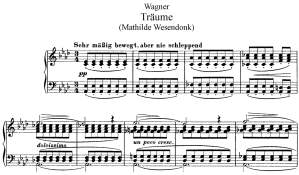
the first measures…
One result of this is a set of songs, The Wesendonck Lieder, to poems she wrote and which he set while he had Tristan in mind among other things. The final song, “Träume,” is a 5-minute Wagner gem (most of his portions come in 5 hours so that’s saying something): a nice distillation of what is so distinctive about him–the endless line, the sense of yearning, the odd text setting (he’s sort of the humpty-dumpty of prosody, “words will have stresses where I mean them to!”)–and the radiant glow, distinctly his in an era of ardent romantic music.
He liked Träume so much he set it for solo violin and chamber orchestra as well. And here are a few versions to accompany the snow.
Interpretive freedom that seems fresh, but is, in fact, so old fashioned by today’s puritanical textual standards.
The German tenor Jonas Kaufmann (currently best-known in the U.S. for not being at the Met in Tosca), with his ability to summon a burnished baritonal sound as needed and such vocal tenderness (particularly for a helden tenor).
Finally, in case sung German is just not your thing, here is the violin arrangement, also gorgeous.
Are we in a list moment? They seem to be all around us, even gaining their own silly term, listicle. But humans and lists go way back (one of the earliest cuneiform relics is of course a list of kings). List making is perhaps definitional of humans (my list of potential blog entries, most never written, could be my own exhibit A).
This all occurred to me perusing the plethora of lists on Gramophone’s web site. (Gramophone is a classical music magazine published in the UK, and mostly concerned with reviews of recordings. It’s been around a long time and this, plus its focus on classics, is basis for dismissing it out of hand, or treasuring it. I alternate positions.)
Like most digital publications, Gramophone has gotten in line with lists in a big way. Playlists on many topics (Hall of Fame Sopranos, Great Violinists, Inspirational Castratos (that is modern performances of work original written for castratos, not modern inspirational castratos, I hasten to say). This push you to a streaming service after you have read a pithy paragraph or two. I was pleased that the violin list reminded me of how wonderful the fiddling of Arthur Grumiaux was.
They also have numerous compilation lists, “50 Greatest Chopin Recordings” “50 Greatest Schubert Recordings” and so forth. Since they are aiming at record collectors, and we are nerds by definition, they also have “The 50 Greatest Classical Recordings You’ve (Probably) Never Heard.” (If you want a count, I own or have owned three of the 50 (am a streamer now), heard some others, but more than a few are tantalizing unknowns to me: to wit, soprano Gertrud Grob-Prandl, & composer, Johann Heinrich Schmelzer; I also didn’t know Stokowski did one of his technicolor arrangements of Wagner’s “Magic Fire Music” with the Houston Symphony–(a whole LP of magic fire for reals?)
Although music is ideal fodder for listomania, it’s hardly limited to that. Every bookstore I go in seems to have at least some entries in book series titled “1000 [insert noun here] before you die” with varied nouns:
Places to see
Books to Read
Songs to Listen To
etc.
The spoof writes itself, just slot in a different noun:
1000 Episodes of Law and Order to See Before You Die
1000 Starbucks Latte Varieties to Drink Before You Die
1000 Arguments to Have With Your Spouse, Children, Roommate, Dog About Where They Leave Their Stuff
Granted mine don’t have the ‘bucket list’ frisson of visiting Corfu or reading Ulysses, but they do have the virtue of being easily achieved.
Oddly, there is, at least as far as I know, no parallel “1000” series about things to avoid (call it the anti-bucket list). The 1000 Books Not To Read Before You Die (so many choices!) would be a hit I bet. I can contribute a few entries.
In addition to being easy, lists do emit at least a weak signal as a bit of rhetoric. Little doubt that most composition teachers and editors would discourage lists in prose. Writing-wise their challenges (parallel or not? what order? list within lists?) aren’t very taxing (certainly not the furniture moving-level effort required in the typical essay).
Yet they are writing, and sometimes can shine. That list of guests at Gatsby’s party is a miracle. And lists spin through Stephen Millhauser’s magical novels. Just now, I’m deep into Robert Macfarlane’s The Old Ways, inspired by the life of naturalist and poet Edward Thomas, whose guides to rambling through the British Isles are quiet classics, and whose bleak-beautiful poetry is newly appealing to me. Macfarlane has this delectable bit for the list-o-mane.
pilgrim paths
green roads
drove roads
corpse roads
trods
leys
dykes
drongs
sarns
snickets
he goes on “—say the names of paths out loud and at speed and they become a poem or rite–holloways, bostles, shutes, driftways, lichways, ridings, halterpaths, cartways, carneys, causeways, herepaths.”
Macfarlane’s book is beautifully written, and carries its literary and geographic learning with a light touch.
There is, of course, course another famous list, Ko-Ko’s from The Mikado of potential victims for the Lord High Executioner. Frequently updated, but at its most swell, perhaps, in Martyn Green’s classic recording.
First, pianist Igor Levit’s encore from the first night of the BBC Proms a few days ago:
This is the Ode to Joy, aka the Official Anthem of the European Union, in an arrangement by Franz Liszt. A Russian-German pianist, playing an iconic piece of music by greatest composer in the classical canon, as arranged by perhaps the most cosmopolitan pan-European of composers. Not only a beautiful performance (capping a dazzling take on Beethoven’s Piano Concerto in C minor) but in London, in July 2017, for a worldwide audience: making an eloquent vote for unity rather than division during fractious times.
On a different note, the Times also has a poignant take on the layoff (and restructuring) of copy editing at “The Grey Lady.” (This may be behind a paywall–sorry.)
If you don’t work in the scribbling trade or hang with people who do, you may not be aware of copyediting, its storied past, and uncertain future. As the Times piece points out, it is the immune system of any serious publication. Copy readers correct spelling, grammar, and usage errors, and vastly improve writing, often one tiny fix at a time: changes that tighten, clarify, and smooth out prose. They also impose ‘house style’ on a publication, which though derided and often annoying to writers (the diaereses in “reëlect” and “coöperate” that The New Yorker insists on must vex to all concerned), still matters. Style guides save time, e.g,, no ad hoc decision on the serial comma necessary. And they regularize content, be it in print or online and this helps readers, humans or algorithms, parse sentences.
Copyediting is an odd skill (and I certainly can’t do it). You have to read both for content understanding, which provides the context for the piece of writing, but also attend assiduously to the surface level in order to catch those mechanical issues. For a general interest newspaper, you also have to have a sixth sense about working with up wildly varying content. (When my mother was in journalism school in the 1940s, the professors handed out the copy-editing test then in use at the Times. It was a complicated story about auto-racing, and nobody, including my mother who had a sharp pencil, did very well.)
Copyreaders also write headlines and captions for photos (cutlines), an art in itself, and a task that is complicated now that print, web, and social media headlines have to be created. It would seem an odd moment to reduce this workforce, but the challenges papers are up against are mighty.
One unremarked benefit of copy editing, at least in my case, is the education in writing that a really good line editor/copy editor can provide. Although I have had lots of experience in writing and editing in most of my jobs, it was when I worked on book-length manuscripts for websites (ironically for a TV station) and had professional editors from the publishing world scrub my own and other writers’ copy–in those far off days with red ink on manuscript–that I really figured out how to clean up prose. (I was in my late 30s!) An editorial assistant and I worked through this mark up, discussing each change as we finished the website. These editors fixed the mechanical errors, but more importantly pressed hard on the writing itself, flagging and fixing anything fusty, flabby, or unfocused, and pointing out where the rhythm, sense, or precision was lacking. Their reworks of things were eye-opening, even when I took issue with them.
There is nothing like this for improving your own prose (and your ability to edit others’ work). It wasn’t part of my writing education, now some years back, and I wonder if it is any more frequent today. (The revered writing teacher Don Murray, a former Boston Globe writer and UHN prof, recommended something very similar in his writing workshops and it’s possible that it is more common.) As Murray points out, writing is a process, editing and revising being key. And also is much more of a team sport than would seem apparent from high school and college assignments. The grim private penance of slogging through a 500 word theme or term paper, is, for me at least, completely different from writing for a sharp-eyed editor who is out to improve your writing; things go so much better when you are engaged in a process together, and working towards an effective draft.
I’m sure the Times of all places is not turning its back on editing, but still, there is something less than reassuring about the prestige press going public about not needing so many of those squirrelly, superb, and effective people who read copy.
Nosing around the Washington Performing Arts site, I noticed that classical vocalists are almost completely absent from the 2017-18 line up. (There is a master class with Denyce Graves, and some singers in orchestral programs, but the solo recital by a big star is nowhere on the ground.)
Whether this is lack of audience in DC or supply of name brand talent is unclear–opera singers are rarely public figures no, and except for Renée Fleming and Placido Domingo, I doubt any classical singer could sell out a large D.C. venue. And Domingo is past his solo recital days by decades.
This is probably the way of things, and perhaps just a change and not a lamentable one–there is still a lot of wonderful singing in D.C. just not this particular dimension. Still it was reassuring to me to see that NYC still has a robust series of big names and up and commers at Carnegie Hall (three cycles in fact). Most of the names are familiar (many having bowed on Vocal Arts DC stages in previous seasons). Ruby Hughes’ name was new to me so I checked her out on YouTube. Here she is singing Mahler’s ‘Ich bin der weld abhanden angekommen’ Radiant, and jaw-dropping in its poise. (Doesn’t hurt that it’s one of the most gorgeous of Mahler’s stunning songs.)
Day 7: A Symphony Concert: It’s not what you think
A general aim of these posts is to provide some sense of what to expect at performing arts event, and to answer the questions, “what’s it like?” & “what’s in it for you?” Both turn out to be a little hard for me to answer–in part because of the wide variety of what people want to do with their recreational time, but also because my perspective is informed, and limited, by already being interested in this. The insider status doesn’t always help.
(If somebody were trying to convince me I would enjoy watching cricket, and came at it from the perspective of an intense expertise and enthusiasm, I would appreciate the fervor, but that probably wouldn’t, in itself be persausive*).
So that end, sharing something that caught my eye this morning, the last episode of a a PBS web series on the Louisville Orchestra and their charismatic young conductor (is there any other kind) Teddy Abrams,
He, and they, may or may not grab you, but I’m betting it’s contrast with what you might have had in mind as a conductor from central casting, to wit:
The great Arthur Nikisch conducting one of the earliest recordings of Beethoven’s 5th (with a expressive elan and freedom of tempo that even the most renegade of conductors today probably wouldn’t dare). Reports of of Nikisch disclose that he controlled the orchestra mostl with his extraordinary eyes.
Get yourself over to the BBC Radio 3 website where you can listen to every concert of the world’s greatest classical music festival, The Proms. Tonight’s opener is Tchaikovsky, Prokoviev, and Elgar (his luminous cello concerto).
A friend pointed me to Allan Kozinn’s take on a recent dust up in the little world of classical music criticism in newspapers. A reviewer filed a notice of a production of a rare Rossini opera, liked most of the singing, disliked the production, got a couple of trivial things wrong, one a straightforward photo credit (whether that was him or not is unclear), and then things spiraled out of control.
A blogger before his time?
The opera company PR person asked the paper to correct the errors, and this escalated to charges and counter charges, with the review disappearing and then reappearing on the web, with accusations against the editor, complaints about the critic, attacks on the company for meddling with coverage, and finally the resignation by the reviewer.
Most of this is neither new or newsworthy. In thirty years of writing reviews on and off (and a couple decades more of reading them), I can remember incidents–a couple uncomfortably personal–of PR flaks complaining, something they have every right to do. I also know first hand that editors change reviews, one hopes for the better, and spike reviews, including probably the most damning (but amusing) one I ever wrote. Something they too have a complete right to do.
It’s easy to forget that reviews are a (admittedly somewhat oddball) species of journalism, and that even critics are ultimately subject to the authority of editors. The best professional decorum would be not to complain publicly on either side. Certainly, artists rarely gain from complaining about subjective opinions–something Berlioz, himself a critic was on to–nor do I think writers stand to gain from publicly complaining about their editors, no matter the merits of the beef. Gripe privately, but abjure public second guessing about what should or shouldn’t have been done. To talk about “sides” is to talk past the issues a bit, and seems to me to indicate the game has already been lost. But if you have to draw them up, to me at least, the editor isn’t completely on the writer’s side, nor the source’s side, nor even the reader’s side, but stands in the middle of these and other forces, including standards and practices of the publication.
And judging from this story, and the disdain everybody–including the flak–is eager to drop on the hapless editor, the thing that most strikes me is the front row view of what a crappy job it must be to be an arts editor of a print publication. For starters, you are manning your oar solo in the leaking boat of print journalism. In this case, it doesn’t like sound the editor was equipped to know whether the concerns about the reviews in general were valid. He wasn’t experienced on this kind of desk–but I can’t imagine getting anything but a blank stare if I approached an editor at a major daily and said “what do you make of opera company x’s take on our coverage and their claim about our reviewer’s dislike of Regietheater?”) Maybe once upon a time that could have been a discussion about what was interesting about the question, reasonable and fair for the coverage, and maybe a feature or interview might have grown out of it. Now? Don’t make me laugh.
What the editor did do is make the point that he would like to cover the arts and perhaps tapping media was away to increase interest beyond the passionate few. That is the way forward. Classical coverage’s death in news papers is lamentable (but not that lamentable) and hot diatribes, whatever else they do, don’t make it any less dead. But as the piece points out, rich media-based reviews could draw on a new generation of journalists and might–God help us–actually get some of a new generation of audiences interested. There are questions about the technology, rights, and attitudes of the performers. These are non-trivial, but the fact that tens of millions of people view media-based reviews of films and video games on YouTube suggests that at least some of the technical obstacles are surmountable, and some artists are doing this for themselves. No doubt, some bloggers and web publications are already on it as well, and on the front-end, arts producers and presenters have started using media creatively for education and outreach. (For me, reviews always had a “back end” educational goal anyway. I write a lot of program notes, which are reviews in reverse and with out the snark.)
That newspapers are past their sell-date makes me sad. And reading my morning Post gets more and more like some kind of exercise in historical reenactment. (“How did you get your news in the olden days, gramps? Well, sonny, this person delivered a parcel of rolled up paper to our door and we sat in a chair turning pages as we drank our coffee and shared amusing items with one another.”) But having written hundreds, I’m certainly not going to mourn the demise of the overnight review. If its death hastens a better way to cover music, and engage people, bring it on.

 Many of my ‘composer crushes’ over the years have come and gone, as they do. However, my love for G.F. Handel never fades.



 A Few Reasonable Words