Nice essay on the value of the humanities by the lit prof, Arnold Weinstein, with this gem,
“How much do you know about Shakespeare,” I once asked a friend who has committed much of her life to studying the Bard. She replied, “Not as much as he knows about me.” Remember this the next time someone tells you literature is useless.”
Lots of observances of the 400th anniversary of WS’s death (so long ago, so recent!)
Two web destinations I particularly liked: Neil MacGregor “Shakespeare’s Restless World,” a BBC Radio and podcast series akin to his “History of the World in 100 Objects.” In 20 short episodes, he takes an object as a means to glimpse what the experience of playwright, players, and audiences might have been like. (For instance, the simple Protestant chalice in the church where Shakespeare was baptized provides a lens into the roiling drama of Catholic v. Protestant politics and power and the fears relating to the successor to Elizabeth).
Wonderful scholarly Shakespeare websites abound, but some the main repositories of primary docs have come together to put up an exhibit that gives you a chance to see for yourself the printed legacy of Shakespeare’s age.
Shakespeare Documented is a quick trip to those rare book collections in these great libraries, and from your armchair, you can follow links for the full texts, and ‘page’ through the versions of the plays that were first published as well as many contextual docs.
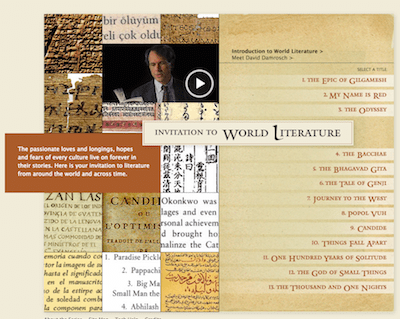
“The 13 works are well-chosen, clearly reflecting the aims of the producers. I won’t list them, as if you click on the pic of the interface you’ll get a more easily readable version. I suspect that, like me, you have a passing knowledge of a few titles (The Odyssey, Candide, The Thousand and One Nights), but what do you know about Popol Vuh? Quite a fascinating mixture across the ages, I’m sure you’ll agree. Always tricky to choose something contemporary, of course, but a goodly sample of bibliophiles would at least grudgingly agree with The God of Small Things (Arundhati Roy), I would claim. The other recent title, My Name is Red (Orhan Pamuk), is likely less well known (unless you’re Turkish!), but maybe here I’m just displaying my appalling ignorance of world literature.
The interface is clean and inviting, and the material and background resources well-chosen and lovingly presented. You can delve via the ‘Watch’, ‘Read’ or ‘Explore’ menus, each simple to navigate.”
Deep thanks, David!
A few additional tidbits to note: all the videos are online, but they are also sometimes on public television in North America (granted, they probably air at 6 a.m. on Sunday morning, that’s sort of the story of my producing life, but you can TiVo it people!).
Also, there is lots more, a college degree’s worth of courses and then some, at Learner.org from Annenberg. They have a two-fold aim, provide well-produced media-based online courses for college students (and life-long learners), and provide materials for teaching training. I have worked on many projects in both categories, and they were great experiences.
And back to World Literature–truly one of the great things, one of those “before and after” moments in my reading life–was reading Monkey, for the project, a book I didn’t know. It’s a Buddhist parable, an insight into Chinese history and culture, wacky and funny, and also profound. For me, finished on a bitterly cold night on Cape Cod six New Year’s Eves ago, it was an invitation to think about my being as both monkey and monk in a way that has kept me company ever since.
From a memoir of reading, book collecting, and libraries, Phantoms of the Bookshelves, that I, appropriately enough, picked up at the Bethesda Library.
On 1 September 1932, the Portuguese newspaper O Século carried an advertisement for the post of librarian-curator at the Condes de Castro Guimarães Museum, in Cascais a little town on the coast about thirty kilometers from Lisbon. On 16 September, the poet Fernando Pessoa sent the local authority a letter applying for the post. The six-page document was later reproduced in a book by Maria José de Lancastre, Fernando Pessoa, una fotobiografia (Fernando Pessoa: photographic documentation), published in 1981 by Imprensa Nacional-Casa da Moeda and the Centro de Estudios Pessoanos, which I bought for 500 escudos in a bookshop in Coimbra in November 1983. It was the only copy they had. In the town’s cafés in those days there was still a ledge under the table where you could put your hat, and I remember seeing a woman go past in the street with a sewing machine balanced on her head. The Portuguese text of the letter is reproduced in Fernando Pessoa in characters far too tiny for anyone without good Portuguese to decipher.
Pessoa, who was tired of translating commercial correspondence for import-export firms in Lisbon, on a wage that scarcely allowed him to survive and get (moderately) drunk every day, felt the urge to change his way of life and leave his flat at 16, Coelho da Rocha Street for a small town near Lisbon. In my copy of the book, a few pages before the letter, there is a photograph of Pessoa drinking a glass of red wine in the shop owned by the wine merchant Abel Ferreira da Fonseca. Behind him you can see casks of Clairette, Abafado, Moscatel, Ginginha and so on. This was the snapshot which Pessoa sent in September 1929 to Ophelia Queiroz, the only romantic relationship he is known to have had. The dedication reads: “Fernando Pessoa, em flagrante delitro”, or “Fernando Pessoa in flagrante with a litre”. Sending the photograph had marked the renewal of a connection broken off nine years earlier, and which would end, permanently this time, six months later. At least, it ended materially. Ophelia never married, and she recounted that shortly before his death, Pessoa, on meeting his nephew Carlos, had asked him, “How is Ophelia?”, then, his eyes filled with tears, had grasped his hands and added: “Oh what a fine soul, a fine soul!”
The lovely opening…evocative of Pessoa himself, a lyrical mysterious spirit.
She cites a speculative, but plausible, view that screens are less congenial to deep, attentive reading:
Nonlinear reading might especially hurt what researchers call “deep-reading”—our in-depth reading of text that requires intense focus to fully understand it, like the works of James Joyce or Virginia Woolf. “Skimming is fine for our emails, but it’s not fine for some of the important forms of reading,” says Tufts University cognitive neuroscientist Maryanne Wolf. “If you word-spot James Joyce, you’ll miss the entire experience.”
I’ll mostly pass over the mild paradox that “linear” is not a word I would apply to such paragons of literary modernism as Joyce & Woolf. One can imagine Joyce happilyflipping his wig over a hypertext Ulysses, a book which he famously said people would still be trying to decode centuries later. If ever there were a book you go “in” rather than through it’s that one.
But I take the point; there is a quietness and materiality to reading on paper (and writing on paper) as well as a slowing down, and perhaps a bit more intentionality. When you are using a digital device, all kinds of processes & gizmos beckon, and instead of a reader, you are a bartender with a bunch of obstreperous patrons. (FB message? email, that long download that was supposed to be finished, and “oops, where is that power cable again? I’m down to 5%”). None of these particular distractions plague books. Also–and I think, though simple, this is key–a book has a self-evident way of telling you where you are, and how to find things without need of digital search. A book is a book-shaped thing and we know how it works intrinsically, because how it works is what it is. That perhaps transcends the many comparative advantages digital offers. A minor practical example: there’s something delicious about peeking ahead to see whether there are 5 or 20 pages left in the chapter, and whether you should wait to make your tea or not. (A vision into the kinds of exciting questions that animate my daredevil lit’rery life.)
William Morris says, “put that laptop away, young man.”
Given that I work all day on screen, it’s probably not surprising that my book reading is on paper. (Although perversely, I did read News from Nowhereon my iPad, something I can’t imagine William Morris would heap approbation on.) I have been on a Trollope tear recently and can’t imagine reading him except on paper. But he’d probably be ridiculously enjoyable in any format, he’s also drolly wise, so gets tonight’s last word:
“The habit of reading is the only enjoyment I know in which there is no alloy. It lasts when all other pleasures fade. It will be there to support you when all other resources are gone. It will be present to you when the energies of your body have fallen away from you. It will last you until your death. It will make your hours pleasant to you as long as you live.” – Anthony Trollope
The books we read in adolescence often have an extraordinary effect on our lives. They are, among other things, an attempt at regime change. In Freud’s language we could say that we free ourselves of our parents’ ideals for us by using the available culture to make up our own ego-ideals, to evolve a sense of our own affinities beyond the family, to speak a language that is more our own. In the self-fashioning of adolescence, books (or music or films) begin really to take, to acquire a subtle but far-reaching effect that lasts throughout a person’s life. We should, therefore, take seriously Freud’s adolescent passion for Don Quixote, a story about a ‘madman’ – as he is frequently referred to in the book – whose life is eventually entirely formed by his reading, in his case the reading of chivalric romances. He is a man who inhabits, lives in and through, the fictions about knights errant that he has consumed, a fictional character who makes himself out of fictional characters.
Rings true to me that what you do in those years has a resonance that lasts (although the ability to respond with such intensity does fade, on the whole a relief, I’m glad not to be undone by a song or a poem any more.) My adolescent self was formed by a hodgepodge of often not very great music or books (I was in love with Wilkie Collins’ The Moonstone, which, though fun, is hardly Cervantes) but the idea of fashioning yourself out of those materials does seem part of what that age is about, and perhaps why it’s so unavoidable that you always measure the music (poetry, art…) that you encounter later against the template set by that ardent first discovery.
Phillips goes on to make a remarkable point about what Don Q means in the context of Freud’s theory, with the advice that we might all be a little more easy going and conversational with our super-ego.
Happy Boxing Day! Here is the report from Reginald, a creation of the satirist Saki (H.H. Munro) whose perspective on life rival’s Maggie Smith’s on Downtown.
REGINALD’S CHRISTMAS REVEL
They say (said Reginald) that there’s nothing sadder than victory except defeat. If you’ve ever stayed with dull people during what is alleged to be the festive season, you can probably revise that saying. I shall never forget putting in a Christmas at the Babwolds’. Mrs. Babwold is some relation of my father’s–a sort of to-be-left-till-called-for cousin–and that was considered sufficient reason for my having to accept her invitation at about the sixth time of asking; though why the sins of the father should be visited by the children–you won’t find any notepaper in that drawer; that’s where I keep old menus and first-night programmes.
Mrs. Babwold wears a rather solemn personality, and has never been known to smile, even when saying disagreeable things to her friends or making out the Stores list. She takes her pleasures sadly. A state elephant at a Durbar gives one a very similar impression. Her husband gardens in all weathers. When a man goes out in the pouring rain to brush caterpillars off rose-trees, I generally imagine his life indoors leaves something to be desired; anyway, it must be very unsettling for the caterpillars.
Of course there were other people there. There was a Major Somebody who had shot things in Lapland, or somewhere of that sort; I forget what they were, but it wasn’t for want of reminding. We had them cold with every meal almost, and he was continually giving us details of what they measured from tip to tip, as though he thought we were going to make them warm under-things for the winter. I used to listen to him with a rapt attention that I thought rather suited me, and then one day I quite modestly gave the dimensions of an okapi I had shot in the Lincolnshire fens. The Major turned a beautiful Tyrian scarlet (I remember thinking at the time that I should like my bathroom hung in that colour), and I think that at that moment he almost found it in his heart to dislike me. Mrs. Babwold put on a first-aid-to-the-injured expression, and asked him why he didn’t publish a book of his sporting reminiscences; it would be SO interesting. She didn’t remember till afterwards that he had given her two fat volumes on the subject, with his portrait and autograph as a frontispiece and an appendix on the habits of the Arctic mussel.
It was in the evening that we cast aside the cares and distractions of the day and really lived. Cards were thought to be too frivolous and empty a way of passing the time, so most of them played what they called a book game. You went out into the hall–to get an inspiration, I
Wee MacGreegor was a creation of John Joy Bell, and no doubt a concoction too sweet for Saki.
suppose–then you came in again with a muffler tied round your neck and looked silly, and the others were supposed to guess that you were “Wee MacGreegor.” I held out against the inanity as long as I decently could, but at last, in a lapse of good-nature, I consented to masquerade as a book, only I warned them that it would take some time to carry out. They waited for the best part of forty minutes, while I went and played wineglass skittles with the page-boy in the pantry; you play it with a champagne cork, you know, and the one who knocks down the most glasses without breaking them wins. I won, with four unbroken out of seven; I think William suffered from over-anxiousness. They were rather mad in the drawing-room at my not having come back, and they weren’t a bit pacified when I told them afterwards that I was “At the end of the passage.”
“I never did like Kipling,” was Mrs. Babwold’s comment, when the situation dawned upon her. “I couldn’t see anything clever in Earthworms out of Tuscany–or is that by Darwin?”
Of course these games are very educational, but, personally, I prefer bridge.
On Christmas evening we were supposed to be specially festive in the Old English fashion. The hall was horribly draughty, but it seemed to be the proper place to revel in, and it was decorated with Japanese fans and Chinese lanterns, which gave it a very Old English effect. A young lady with a confidential voice favoured us with a long recitation about a little girl who died or did something equally hackneyed, and then the Major gave us a graphic account of a struggle he had with a wounded bear. I privately wished that the bears would win sometimes on these occasions; at least they wouldn’t go vapouring about it afterwards. Before we had time to recover our spirits, we were indulged with some thought-reading by a young man whom one knew instinctively had a good mother and an indifferent tailor–the sort of young man who talks unflaggingly through the thickest soup, and smooths his hair dubiously as though he thought it might hit back. The thought-reading was rather a success; he announced that the hostess was thinking about poetry, and she admitted that her mind was dwelling on one of Austin’s odes. Which was near enough. I fancy she had been really wondering whether a scrag-end of mutton and some cold plum-pudding would do for the kitchen dinner next day. As a crowning dissipation, they all sat down to play progressive halma, with milk-chocolate for prizes. I’ve been carefully brought up, and I don’t like to play games of skill for milk-chocolate, so I invented a headache and retired from the scene. I had been preceded a few minutes earlier by Miss Langshan-Smith, a rather formidable lady, who always got up at some uncomfortable hour in the morning, and gave you the impression that she had been in communication with most of the European Governments before breakfast. There was a paper pinned on her door with a signed request that she might be called particularly early on the morrow. Such an opportunity does not come twice in a lifetime. I covered up everything except the signature with another notice, to the effect that before these words should meet the eye she would have ended a misspent life, was sorry for the trouble she was giving, and would like a military funeral. A few minutes later I violently exploded an air- filled paper bag on the landing, and gave a stage moan that could have been heard in the cellars. Then I pursued my original intention and went to bed. The noise those people made in forcing open the good lady’s door was positively indecorous; she resisted gallantly, but I believe they searched her for bullets for about a quarter of an hour, as if she had been an historic battlefield.
I hate travelling on Boxing Day, but one must occasionally do things that one dislikes.
For today, the last ghost story for this Halloween, M.R. James’ “The Mezzotint,” a “prints and photographs” chiller (which I think Rod Serling’s Night Gallery riffed on.)
Monte James‘ elegant ghost stories were influenced by his day job as an archivist and a medievalist. They often have books or historical artifacts that turn out to be sinister, and his tone manages to combine the cozy and genuinely creepy. The central object in “The Mezzotint” betrays a story of a long-ago crime via the form of a seemingly innocuous print of a country house.
A taste:
“It was by this time rather late in the evening, and the visitors were on the move. After they went Williams was obliged to write a letter or two and clear up some odd bits of work. At last, some time past midnight, he was disposed to turn in, and he put out his lamp after lighting his bedroom candle. The picture lay face upwards on the table where the last man who looked at it had put it, and it caught his eye as he turned the lamp down. What he saw made him very nearly drop the candle on the floor, and he declares now that if he had been left in the dark at that moment…”
And for a bit of bewitching music, here is Liszt in a Mephistophelean and melancholy mode:
First Boris Berezovsky in Liszt’s Mephisto Waltz #1.
(With a camera person who was asleep at the wheel in the last moments, or perhaps so dazzled by the virtuosity that he forgot to get the Boris’ bow in frame?)
and Lang Lang playing the Liszt “Romance”
His performance is lovely, the video production is overwrought, and yet Liszt would likely have loved it.
Today, the start of Dickens, “To Be Taken with a Grain of Salt.” Notable because the ghost is nearly omnipresent in the story, which concerns the trial of a murderer. Dickens’ style always seems a bit too cozy to deliver that final shock that a good short story can (Shirley Jackson still is supreme in my book for this), but he’s such fun to read.
I have always noticed a prevalent want of courage, even among persons of superior intelligence and culture, as to imparting their own psychological experiences when those have been of a strange sort. Almost all men are afraid that what they could relate in such wise would find no parallel or response in a listener’s internal life, and might be suspected or laughed at. A truthful traveller who should have seen some extraordinary creature in the likeness of a sea-serpent, would have no fear of mentioning it; but the same traveller having had some singular presentiment, impulse, vagary of thought, vision (so-called), dream, or other remarkable mental impression, would hesitate considerably before he would own to it. To this reticence I attribute much of the obscurity in which such subjects are involved. We do not habitually communicate our experiences of these subjective things, as we do our experiences of objective creation. The consequence is, that the general stock of experience in this regard appears exceptional, and really is so, in respect of being miserably imperfect.
In what I am going to relate I have no intention of setting up, opposing, or supporting, any theory whatever. I know the history of the Bookseller of Berlin, I have studied the case of the wife of a late Astronomer Royal as related by Sir David Brewster, and I have followed the minutest details of a much more remarkable case of Spectral Illusion occurring within my private circle of friends. It may be necessary to state as to this last that the sufferer (a lady) was in no degree, however distant, related to me. A mistaken assumption on that head, might suggest an explanation of a part of my own case – but only a part – which would be wholly without foundation. It cannot be referred to my inheritance of any developed peculiarity, nor had I ever before any at all similar experience, nor have I ever had any at all similar experience since.
It does not signify how many years ago, or how few, a certain Murder was committed in England, which attracted great attention. We hear more than enough of Murderers as they rise in succession to their atrocious eminence, and I would bury the memory of this particular brute, if I could, as his body was buried, in Newgate Jail. I purposely abstain from giving any direct clue to the criminal’s individuality.
When the murder was first discovered, no suspicion fell – or I ought rather to say, for I cannot be too precise in my facts, it was nowhere publicly hinted that any suspicion fell – on the man who was afterwards brought to trial. As no reference was at that time made to him in the newspapers, it is obviously impossible that any description of him can at that time have been given in the newspapers. It is essential that this fact be remembered.
Unfolding at breakfast my morning paper, containing the account of that first discovery, I found it to be deeply interesting, and I read it with close attention. I read it twice, if not three times. The discovery had been made in a bedroom, and, when I laid down the paper, I was aware of a flash – rush – flow – I do not know what to call it – no word I can find is satisfactorily descriptive – in which I seemed to see that bedroom passing through my room, like a picture impossibly painted on a running river. Though almost instantaneous in its passing, it was perfectly clear; so clear that I distinctly, and with a sense of relief, observed the absence of the dead body from the bed.
It was in no romantic place that I had this curious sensation, but in chambers in Piccadilly, very near to the corner of Saint James’s Street. It was entirely new to me. I was in my easy-chair at the moment, and the sensation was accompanied with a peculiar shiver which started the chair from its position.
For today’s choice, a selection from Roald Dahl’s Book of Ghost Stories,Cynthia Asquith’s “The Corner Shop.” In his (typically smart-ass) intro, Dahl mentions meeting Asquith, the grand dame of the English Ghost story, and getting a ghostly reading list from her, many of which he found bad to unreadable (seemingly the more famous the writer, the weaker the story correlated for many cases.)
He did find a set worth anthologizing, including one by Asquith herself. A nicely folded example of the “haunted shop” genre. (Complete with a critique of neo-liberal economics.)
Here’s the opening (full text does not seem to be available, but it’s likely in your local library).
The Corner Shop
Peter Wood’s executors found their task a very easy one. He had left his affairs in perfect order. The only surprise yielded by his methodical writing-table was a sealed envelope on which was written: ‘Not wishing to be bothered by well-meaning Research Societies, I have never shown the enclosed to anyone, but after my death all are welcome to read what, to the best of my knowledge, is a true story.’
The manuscript which bore a date three years previous to the death of the writer was as follows.
‘I have long wished to record an experience of my youth. I won’t attempt any explanation. I draw no conclusions. I merely narrate certain events.’
‘One foggy evening, at the end of a day of enforced idleness…’








 A Few Reasonable Words
