Then moved o’er the waters by might of the wind
that bark like a bird with breast of foam,
till in season due, on the second day,
the curved prow such course had run
that sailors now could see the land,
sea-cliffs shining, steep high hills,
headlands broad. Their haven was found,
their journey ended. Up then quickly
the Weders’ clansmen climbed ashore,
anchored their sea-wood, with armor clashing
and gear of battle: God they thanked
for passing in peace o’er the paths of the sea.
Theatrical distances, bronze shadows heaped
On high horizons, mountainous atmospheres
Of sky and sea.
It was her voice that made
The sky acutest at its vanishing.
–Wallace Stevens
Sunset view across Monhegan Harbor, August 2015, my photo
(Salt)

A LOBSTER.
           Once out of the box
           The wooden box
           The metal box
           The box, the box, the box
           Dragged up from the salt

           Things don't feel too bad

           And then they do

           And then they don't

(And waves)
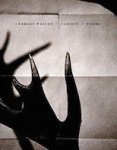
Enjoying poet Charles Wright’s 2014 collection Caribou, notably the poem “Ducks.”
Gasoline smell on my hands, perfume
From the generator’s toothless mouth,
Opening swallow from the green hose,
Sweet odor from the actual world.
There’s an old Buddhist saying I think I read one time:
Before Enlightenment, chop wood and carry water.
After Enlightenment, chop wood and carry water.
The ducks, who neither carry nor chop,
Understand this, as I never will,
Their little feet propelling them, under the water,
Serene and stabilized,
from the far side of the pond
Back to the marsh grasses and cattails.
I watch them every night they’re there.
Serenitas. I watch them.
Acceptance of what supports you, acceptance of what’s
Above your body,
invisible carry and chop,
Dark understory of desire
Where we should live,
not in the thrashing, dusk-tipped branches—
Desire is anonymous,
Motoring hard, unswaying in the unseeable.
Two favorite poets and their somewhat cracked take on ars poetica. Wendy Cope is mostly known for her humorous verse (she has a wonderful collection called “Making Cocoa for Kingsley Amis”) and Frank O’Hara for his personal New York-y testimonials, (the “I do this, I do that” poems that in his hands in are often droll wonders, but have a low success rate for others). But these two suggest you could switch views around: Wendy as the serious one, offering the testimony of a closely observant outsider, and Frank going for grin and giggle.
The Uncertainty of the Poet
—Wendy Cope
I am a poet.
I am very fond of bananas.
I am bananas.
I am very fond of a poet.
I am a poet of bananas.
I am very fond.
A fond poet of ‘I am, I am’-
Very bananas.
Fond of ‘Am I bananas?
Am I?’-a very poet.
Bananas of a poet!
Am I fond? Am I very?
Poet bananas! I am.
I am fond of a ‘very.’
I am of very fond bananas.
Am I a poet?
Why I Am Not A Painter
–Frank O’Hara
I am not a painter, I am a poet.
Why? I think I would rather be
a painter, but I am not. Well,
for instance, Mike Goldberg
is starting a painting. I drop in.
“Sit down and have a drink” he
says. I drink; we drink. I look
up. “You have SARDINES in it.”
“Yes, it needed something there.”
“Oh.” I go and the days go by
and I drop in again. The painting
is going on, and I go, and the days
go by. I drop in. The painting is
finished. “Where’s SARDINES?”
All that’s left is just
letters, “It was too much,” Mike says.
But me? One day I am thinking of
a color: orange. I write a line
about orange. Pretty soon it is a
whole page of words, not lines.
Then another page. There should be
so much more, not of orange, of
words, of how terrible orange is
and life. Days go by. It is even in
prose, I am a real poet. My poem
is finished and I haven’t mentioned
orange yet. It’s twelve poems, I call
it ORANGES. And one day in a gallery
I see Mike’s painting, called SARDINES.
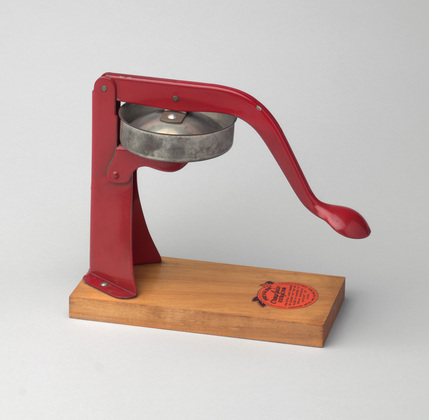
A orange juice squeezer in the collection of MoMA (where Frank O’Hara once worked).
Lyric poetry written in the first half of the seventeenth century is full of little things – Richard Lovelace has his snail and his grasshopper, Andrew Marvell his drop of dew and his glow-worms, Edmund Waller his garters, gloves and ribbons – but Robert Herrick’s appetite for the miniature was uniquely gargantuan. A brief selection of the nano-phenomena, animal, vegetable and mineral, in Hesperides (1648), his only collection of verse, might include: amber beads, ants, apple cores, beans, bees (or just their honey sacs), beetles, beets, crickets, cherries (often just their stones), cowslips, earlobes, earwigs, flies, gnats, mice, newts, nipples (usually reduced to “niplets”, one of several diminutives Herrick coined), nuts, pansies, pearls, peas, robins (Herrick liked shortening his own name to “Robin”), seeds, smallage (his herb of choice for his gravestone), spiders, tears (always singly, never in floods), violets, worms and worts. Then there are the poems themselves. Hesperides contains a massive 1,402 lyrics – 1,130 in the main body of the collection, and 272 in a second religious corpus, His Noble Numbers or Pious Pieces – but only three dozen or so are longer than fifty lines, and a mere eighty-five even get beyond twenty, while more than 1,000 come in at two quatrains or under, including 465 distichs. Poems in pentameter are hugely outnumbered by those in tetrameter or trimeter, and Herrick was not above writing whole poems in dimeter and monometer.
This extent of miniaturism can make reading through Hesperides a strange experience, at once gruelling and unsatisfying, like surfeiting on canapés or climbing an Everest of molehills. For a long time, readers ducked the challenge. …
I certainly did, at least beyond the anthologized greatest hit or two of his.
But TLS sent me back to the poems and here are a few that caught my eye.
Delight in Disorder
By Robert Herrick
A sweet disorder in the dress
Kindles in clothes a wantonness;
A lawn about the shoulders thrown
Into a fine distraction;
An erring lace, which here and there
Enthralls the crimson stomacher;
A cuff neglectful, and thereby
Ribands to flow confusedly;
A winning wave, deserving note,
In the tempestuous petticoat;
A careless shoe-string, in whose tie
I see a wild civility:
Do more bewitch me, than when art
Is too precise in every part.
The Present Time Best Pleaseth
by Robert Herrick
Praise they that will times past; I joy to see
Myself now live: this age best pleaseth me.
Matins, or Morning Prayer
by Robert Herrick
When with the virgin morning thou dost rise,
Crossing thyself come thus to sacrifice;
First wash thy heart in innocence; then bring
Pure hands, pure habits, pure, pure every thing.
Next to the altar humbly kneel, and thence
Give up thy soul in clouds of frankincense.
Thy golden censers fill’d with odours sweet
Shall make thy actions with their ends to meet.
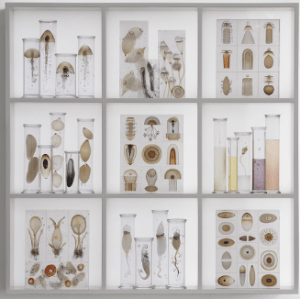
“The Cabinet of Curiosities” a glass sculpture by Steffen Dam in the collection of the Chazen Museum of Art at UW-Madison. Like Herrick, full of tiny wonders, and bigger on the inside.
Reading another in the category of those “What X Can Do For You…“, “How Y Can Change Your Life” books, but (somewhat atypically) finding it an engaging one, courtesy of Alexander McCall Smith of the gentle No. 1 Ladies’ Detective Agency mysteries, and other books (including Portuguese Irregular Verbs and The Finer Points of Sausage Dogs).
What Auden Can Do For You is his encomium to the British poet, not to me a likely choice for this self-help treatment, but Smith’s take is mostly personal, which redeems it. Here he is describing a talk he gave at a library in Perthshire, Scotland, an incident he recalls as a way of introducing his discussion of Auden’s “A Summer Day.”
It [Highland Scotland] was a place of strong religious views. The Scottish Reformation was late but had been passionate and had brought with it a commitment to setting up a school in every parish. What later came to be seen as a strong Scottish commitment to education had its roots in the late sixteenth and early seventeenth centuries. Books were the instruments of truth. Books were the means by which the poor could free themselves of what Auden once described as “the suffering to which they are fairly accustomed.” This attitude towards books has stubbornly survived in Scotland, mirroring, perhaps, the Irish attitude to music: both are consolations that will, in their individual way, always see one through.
My talk was preceded by a reception. This was held outside the converted ancient church that the library used for its meetings. A couple of open-sided tents had been erected under which drinks and snacks were prepared, and people milled about, chatting in the benign evening sunlight. In a country such as Scotland, where raw Atlantic weather blows over the land with little regard to season, a sunlit evening in which the air is still lifts the spirits. This lightening was very much in evidence in the atmosphere of the gathering: it seemed as if everybody present was an old friend, seizing the chance to catch up with one another.
I then experienced a feeling of extraordinary calm, of something that must have been joy. It was fleeting, lasting only for a minute or two, but it was unmistakable. We all have such moments in our lives, and there is no telling when they will occur. For a short time we are somehow transported into another form of consciousness, until it comes to an end: we are distracted; somebody says something, a visitor comes to the door (as happened to Coleridge, when that “person from Porlock” interrupted the writing of his visionary poem “Kubla Kahn”)–and the insight evaporates. But we know that for a short time we have seen something about the world that we do not normally see. I suddenly understood that I loved the people present in that small enclosure. I had come from Edinburgh feeling that the evening would be a chore, and now I stood on the grass and realized how grudging, how churlish that attitude had been.
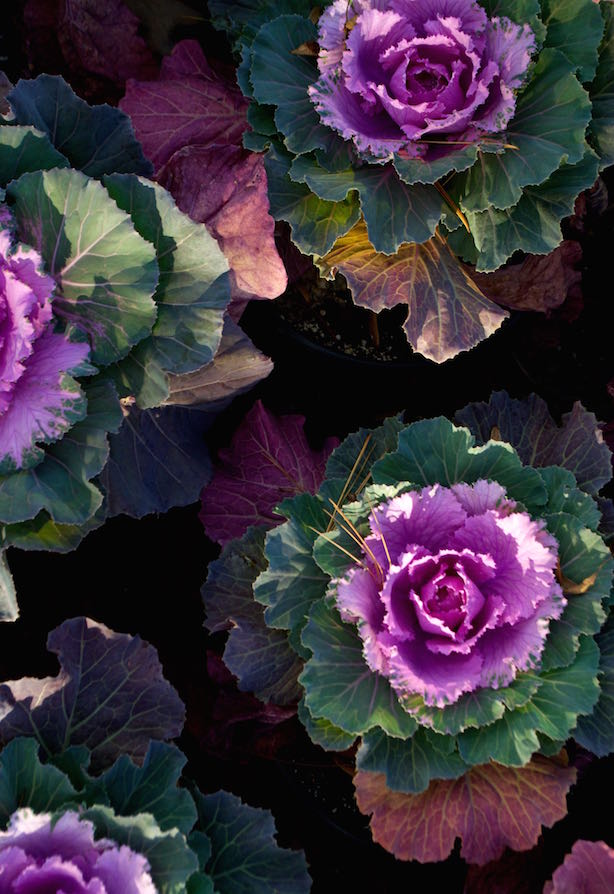
Fall, falling, fallen. That’s the way the season
Changes its tense in the long-haired maples
That dot the road; the veiny hand-shaped leaves
Redden on their branches (in a fiery competition
With the final remaining cardinals) and then
Begin to sidle and float through the air, at last
Settling into colorful layers carpeting the ground.
At twilight the light, too, is layered in the trees
In a season of odd, dusky congruences—a scarlet tanager
And the odor of burning leaves, a golden retriever
Loping down the center of a wide street and the sun
Setting behind smoke-filled trees in the distance,
A gap opening up in the treetops and a bruised cloud
Blamelessly filling the space with purples. Everything
Changes and moves in the split second between summer’s
Sprawling past and winter’s hard revision, one moment
Pulling out of the station according to schedule,
Another moment arriving on the next platform. It
Happens almost like clockwork: the leaves drift away
From their branches and gather slowly at our feet,
Sliding over our ankles, and the season begins moving
Around us even as its colorful weather moves us,
Even as it pulls us into its dusty, twilit pockets.
And every year there is a brief, startling moment
When we pause in the middle of a long walk home and
Suddenly feel something invisible and weightless
Touching our shoulders, sweeping down from the air:
It is the autumn wind pressing against our bodies;
It is the changing light of fall falling on us.
This is from The Living Fire, an anthology with fine selections from his earlier books.





 A Few Reasonable Words