Poetry Month: D. Nurske

Although I’m not posting a poem a day (as in some past years), still in honor of poetry month, one from D. Nurske.

A Rest in Our Savior’s Garden

The fat pigeons
don’t seem exhausted.
A squirrel begs
with a trace of contempt.
A tiny sparrow
walks straight up to me
wide-eyed in a trance
in the shadow of wings —

even though each crumb
that falls from my fingers
glints with fever.

Sickness with the force of miracle.
The statue of the Virgin
wears a stone veil.

I still have a few poppy seeds
in the life-line and the love-line

but now the birds are gone,
the squirrel found an acorn,
night hides the wasp
that once made my body
the center of a dazzling circle.

D. Nurkse

Cherry Blossom Time

Things are just about to burst into flower in DC.
A few haiku of Basho to observe the joys of the season…

A cloud of cherry blossoms;
The temple bell,-
Is it Ueno, is it Asakusa?

How many, many things
They call to mind
These cherry-blossoms!

Very brief –
Gleam of blossoms in the treetops
On a moonlit night.

Some more here, on a site called The Culture Trip.

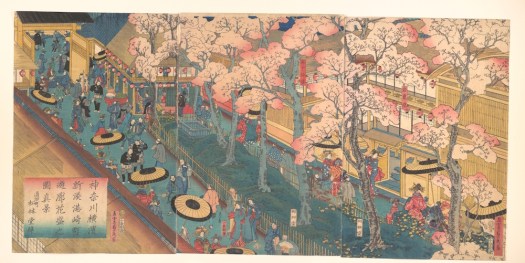
And a print from the Met on the the same theme…

True View of the Pleasure Quarters with Cherry Blossoms in Full Bloom in the Miyozki District of the New Port of Yokohama, Kanagawa

Commonplace Book: Aeneid, translated by David Ferry

Still working my way through David Ferry’s Virgil, wonder, astonishment and beauty; here’s a grim excerpt that shows the vividness and control of both author and translator.

http://www.metmuseum.org/art/collection/search/251473 Roman, Marble relief fragment with scenes from the Trojan War, 1st half of 1st century A.D., Marble, Palombino, 7 1/8 x 6 15/16 in., 1.1kg (18.1 x 17.6 cm). The Metropolitan Museum of Art, New York. Fletcher Fund, 1924 (24.97.11)

“Aurora rose, spreading her pitying light,
And with it bringing back to sight the labors
Of sad mortality, what men have done,
And what has been done to them; and what they must do
To mourn. King Tarchon and Father Aeneas, together
Upon the curving shore, caused there to be
Wooden funeral pyres constructed, and to which
The bodies of their dead were brought and placed there,
In accordance with the customs of their countries.
The black pitch smoke of the burning of the bodies
Arose up high and darkened the sky above.
Three times in shining armor the grieving warriors
Circled the burning pyres, three times on horseback,
Ululating, weeping, as they rode.
You could see how teardrops glistened on their armor.
The clamor of their sorrowing voices and
The dolorous clang of trumpets rose together
As they threw into the melancholy fires
Spoils that had been stripped from the Latins, helmets,
And decorated swords, bridles of horses,
And glowing chariot wheels, and with them, also,
Shields and weapons of their own familiar
Comrades, which had failed to keep them alive.
Bodies of beasts were thrown into the fire,
Cattle, and bristle- backed swine, brought from surrounding
Fields to be sacrificed to the god of death.

And all along the shore the soldiers watched
The burning of the bodies of their friends,
And could not be turned away until the dewy
Night changed all the sky and the stars came out.
Over there, where the Latins were, things were
As miserable as this. Innumerable
Scattered funeral pyres; many bodies
Hastily buried in hastily dug-up earth,
And many others, picked up from where they fell
When they were slain, and carried back to the fields
Which they had plowed and tilled before the fighting,
Or back into the city where they came from;
Others were indiscriminately burned,
Unnamed, and so without ceremony or honor.
The light of the burning fires was everywhere.
On the third day when the light of day came back
To show the hapless scene, they leveled out
What was left of the pyres and separated what
Was left of the bones, now cold and among cold ashes,
And covered over the ashes and the bones.

– From David Ferry’s The Aeneid

Reasonable Words: Albert Goldbarth

A bit of a literary essay from Albert Goldbarth, a poet I’ve long admired:

“Charles Dickens started work on Bleak House in 1851. If you’re like me and don’t spend all of your free time romping through the fields of etymology, you too may startle at suddenly stumbling on “ganglion” in those 900-plus pages. Like, what?—did he make a quick trip in his time chaise, and return with a shiny copy of this month’s Scientific American, set on appropriating its language? “Refrigerator” is here too: not in the sense of a kitchen appliance, but still…a frisson volts across my spine. (For a thousand more reasons than this, it’s a glorious book. Bill Matthews says, in “Le Quarte Saisons, Montreal, 1979,” “I read Bleak House / a third time, slowly, fondly.”)

Dickens, Meville, Mary Shelley…something in the nineteenth century seems to set a tiny crystal ball in the heads of certain writers. When Wordsworth stares out dolefully at London’s silhouette and frets at its burgeoning changes—the rise of the factory system and market economy; the end of cyclical time; the degradation of child labor; the first industrial pollution; and the rest—it’s almost as if his gaze is so intense, he can see it all unfold like gritted, sooty origami into the centuries ahead, until it is 2006 for him. No wonder he’s so despondent.

I like to teach his daffodils poem, “I Wandered Lonely as a Cloud.” For one thing, it’s a terrific simple example of connotation at work: we only understand the poem if we understand the difference between the negative “lonel[iness]” (line 1) and the positive “solitude” (line 22). The intervening daffodils, of course, are what alchemize one state into the other. Or rather, his recollection of the daffodils. And so it’s a terrific poem, too, for teaching the distinction between a subject (here, the joyous encounter with nature) and a theme (the healing use we can make of a memory)”

I share Goldbarth’s, and the late William Matthews’love of Bleak House too.

Formal Matters: Sestinas

A love of poetry does not necessarily require knowing much about what is going on under the hood–formal concerns, rhyme, meter, and the like. Perhaps because I was a music major, it’s always been an interest of mine: like sonata form, poetic structures have their own low key, fascinating dazzle. For example, the verse form of the sestina.

Poetry Foundation gives a definition:

A complex French verse form, usually unrhymed, consisting of six stanzas of six lines each and a three-line envoy. The end words of the first stanza are repeated in a different order as end words in each of the subsequent five stanzas; the closing envoy contains all six words, two per line, placed in the middle and at the end of the three lines. The patterns of word repetition are as follows, with each number representing the final word of a line, and each row of numbers representing a stanza:

1 2 3 4 5 6
6 1 5 2 4 3
3 6 4 1 2 5
5 3 2 6 1 4
4 5 1 3 6 2
2 4 6 5 3 1
(6 2) (1 4) (5 3)

Got that?

And yet, some poets manage to create miracles out of these ridiculous strictures:

First David Ferry, who has recently turned out a stunning version of The Aeneid.

The Guest Ellen at the Supper for Street People
By David Ferry

The unclean spirits cry out in the body
Or mind of the guest Ellen in a loud voice
Torment me not, and in the fury of her unclean
Hands beating the air in some kind of unending torment—
Nobody witnessing could possibly know the event
That cast upon her the spell of this enchantment.

Almost all the guests are under some kind of enchantment:
Of being poor day after day in the same body;
Of being witness still to some obscene event;
Of listening all the time to somebody’s voice
Whispering in the ear things divine or unclean,
In the quotidian of unending torment.

One has to keep thinking there was some source of torment,
Something that happened someplace else, unclean.
One has to keep talking in a reasonable voice
About things done, say, by a father’s body
To or upon the body of Ellen, in enchantment
Helpless, still by the unforgotten event

Enchanted, still in the old forgotten event
A prisoner of love, filthy Ellen in her torment,
Guest Ellen in the dining hall in her body,
Hands beating the air in her enchantment,
Sitting alone, gabbling in her garbled voice
The narrative of the spirits of the unclean.

She is wholly the possessed one of the unclean.
Maybe the spirits came from the river. The enchantment
Entered her, maybe, in the Northeast Kingdom. The torment,
A thing of the waters, gratuitous event,
Came up out of the waters and entered her body
And lived in her in torment and cried out in her voice.

It speaks itself over and over again in her voice,
Cursing maybe or not a familiar obscene event
Or only the pure event of original enchantment
From the birth of the river waters, the pure unclean
Rising from the source of things, in a figure of torment
Seeking out Ellen, finding its home in her poor body.

Her body witness is, so also is her voice,
Of torment coming from unknown event;
Unclean is the nature and name of the enchantment.

Of course Elizabeth Bishop could seemingly toss them off…

Miracle for Breakfast
by Elizabeth Bishop

At six o’clock we were waiting for coffee,
waiting for coffee and the charitable crumb
that was going to be served from a certain balcony
—like kings of old, or like a miracle.
It was still dark. One foot of the sun
steadied itself on a long ripple in the river.

The first ferry of the day had just crossed the river.
It was so cold we hoped that the coffee
would be very hot, seeing that the sun
was not going to warm us; and that the crumb
would be a loaf each, buttered, by a miracle.
At seven a man stepped out on the balcony.

He stood for a minute alone on the balcony
looking over our heads toward the river.
A servant handed him the makings of a miracle,
consisting of one lone cup of coffee
and one roll, which he proceeded to crumb,
his head, so to speak, in the clouds—along with the sun.

Was the man crazy? What under the sun
was he trying to do, up there on his balcony!
Each man received one rather hard crumb,
which some flicked scornfully into the river,
and, in a cup, one drop of the coffee.
Some of us stood around, waiting for the miracle.

I can tell what I saw next; it was not a miracle.
A beautiful villa stood in the sun
and from its doors came the smell of hot coffee.
In front, a baroque white plaster balcony
added by birds, who nest along the river,
—I saw it with one eye close to the crumb—

and galleries and marble chambers. My crumb
my mansion, made for me by a miracle,
through ages, by insects, birds, and the river
working the stone. Every day, in the sun,
at breakfast time I sit on my balcony
with my feet up, and drink gallons of coffee.

We licked up the crumb and swallowed the coffee.
A window across the river caught the sun
as if the miracle were working, on the wrong balcony.

And finally Donald Justice, overlooked, but one of my favorites:

Sestina: Here In Katmandu

by Donald Justice

We have climbed the mountain.
There’s nothing more to do.
It is terrible to come down
To the valley
Where, amidst many flowers,
One thinks of snow,

As formerly, amidst snow,
Climbing the mountain,
One thought of flowers,
Tremulous, ruddy with dew,
In the valley.
One caught their scent coming down.

It is difficult to adjust, once down,
To the absence of snow.
Clear days, from the valley,
One looks up at the mountain.
What else is there to do?
Prayer wheels, flowers!

Let the flowers
Fade, the prayer wheels run down.
What have they to do
With us who have stood atop the snow
Atop the mountain,
Flags seen from the valley?

It might be possible to live in the valley,
To bury oneself among flowers,
If one could forget the mountain,
How, never once looking down,
Stiff, blinded with snow,
One knew what to do.

Meanwhile it is not easy here in Katmandu,
Especially when to the valley
That wind which means snow
Elsewhere, but here means flowers,
Comes down,
As soon it must, from the mountain.


Some help on how to write your own, with yet another fine example from Anthony Hecht.

Poetic Words: Mary Oliver

A favorite from a Provincetown, MA poet.

Poppies
Mary Oliver

The poppies send up their
orange flares; swaying
in the wind, their congregations
are a levitation

Ian Britton Field of Poppies

of bright dust, of thin
and lacy leaves.
There isn’t a place
in this world that doesn’t

sooner or later drown
in the indigos of darkness,
but now, for a while,
the roughage

shines like a miracle
as it floats above everything
with its yellow hair.
Of course nothing stops the cold,

black, curved blade
from hooking forward—
of course
loss is the great lesson.

But I also say this: that light
is an invitation
to happiness,
and that happiness,

when it’s done right,
is a kind of holiness,
palpable and redemptive.
Inside the bright fields,

touched by their rough and spongy gold,
I am washed and washed
in the river
of earthly delight—

and what are you going to do—
what can you do
about it—
deep, blue night?

Shakespeare Everyday

Nosing around the web for online Shakespeare resources (full report later), found this nice list of everyday terms that are “quoting Shakespeare.”

“All our yesterdays”— (Macbeth)

“As good luck would have it” — (The Merry Wives of Windsor)

“As merry as the day is long” — (Much Ado About Nothing / King John)

“Bated breath” — (The Merchant of Venice)

“Be-all and the end-all” — (Macbeth)

“Neither a borrower nor a lender be” — (Hamlet)

“Brave new world” — (The Tempest)

“Break the ice” — (The Taming of the Shrew)

“Brevity is the soul of wit” — (Hamlet)

“Refuse to budge an inch” — (Measure for Measure / The Taming of the Shrew)

“Cold comfort” — (The Taming of the Shrew / King John)

633px-First-page-first-folio-measure-for-measure“Conscience does make cowards of us all” — (Hamlet)

“Crack of doom” — (Macbeth)

“Dead as a doornail” — (Henry VI Part II)

“A dish fit for the gods” — (Julius Caesar)

“Cry havoc and let slip the dogs of war” — (Julius Caesar)

“Devil incarnate” — (Titus Andronicus / Henry V)

“Eaten me out of house and home” — (Henry IV Part II)

“Faint hearted” — (Henry VI Part I)

“Fancy-free” — (A Midsummer Night’s Dream)

“Forever and a day” — (As You Like It)

“For goodness’ sake” — (Henry VIII)

“Foregone conclusion” — (Othello)

“Full circle” — (King Lear)

“The game is afoot” — (Henry IV Part I)

“Give the devil his due” — (Henry IV Part I)

“Good riddance” — (Troilus and Cressida)

“Jealousy is the green-eyed monster” — (Othello)

“Heart of gold” — (Henry V)

“Hoist with his own petard” — (Hamlet)

“Ill wind which blows no man to good” — (Henry IV Part II)

“In my heart of hearts” — (Hamlet)

“In my mind’s eye” — (Hamlet)

“Kill with kindness” — (The Taming of the Shrew)

“Knock knock! Who’s there?” — (Macbeth)

“Laughing stock” — (The Merry Wives of Windsor)

“Live long day” — (Julius Caesar)

“Love is blind” — (The Merchant of Venice)

“Milk of human kindness” — (Macbeth)

“More sinned against than sinning” — (King Lear)

“One fell swoop” — (Macbeth)

“Play fast and loose” — (King John)

“Set my teeth on edge” — (Henry IV Part I)

“Wear my heart upon my sleeve” — (Othello)

“Wild-goose chase” — (Romeo and Juliet)


And some nice bits on Shakespeare’s Sonnets–ever surprising works–from a recent TLS.

Writers as well as readers have found the sonnets irresistible – not only because of their quasi-autobiographical subject material, but also because of their raw exploration of why anyone would bother to write at all. These poems have indeed enjoyed extraordinarily complex and rich afterlives. Jonathan Post’s chapter on “regifting” the sonnets attends to new work by British and American poets including Jen Bervin, Carol Ann Duffy, Don Paterson, Elizabeth Bishop and Allen Ginsberg. The boorish speaker of Wendy Cope’s “Strugnell’s Sonnets”, in Making Cocoa for Kingsley Amis, keeps twisting Shakespeare’s opening lines: “The expense of spirits is a crying shame”. In an altogether different register, the American poet Alice Fulton’s collection Barely Composed contains a poem which scrambles a series of prefixes, suffixes and homonyms from Shakespeare’s Sonnet 87. As Post puts it, “how strange and barely recognisable, yet so it is”. The title of Fulton’s poem, “Peroral”, refers to the practice of taking a dose of medicine by the mouth – and this suggests, to Fulton and perhaps to Post, a new way of doing creative justice to poetry from the distant past. Reading the sonnets is no longer simply therapeutic, as if influence were a form of influenza. It seems more purposeful to work collaboratively (instead of competitively) with these poems in order to create bright new redactions

Poetic Words: Rita Dove

One of many wonderful poems inspired by Lady Day.


Canary
By Rita Dove

for Michael S. Harper

Billie Holiday’s burned voice
had as many shadows as lights,
a mournful candelabra against a sleek piano,
the gardenia her signature under that ruined face.

(Now you’re cooking, drummer to bass,
magic spoon, magic needle.
Take all day if you have to
with your mirror and your bracelet of song.)

Fact is, the invention of women under siege
has been to sharpen love in the service of myth.

If you can’t be free, be a mystery.

Poetic Words: Edward Thomas

Wanderer in the Storm by Julius von Leypold

Cold and wet in Boston and DC (my two homes). So a topical bit of Edward Thomas (doomed WWI era poet, if only he had taken Robert Frost’s invitation to come to the U.S.)


Rain

By Edward Thomas

Rain, midnight rain, nothing but the wild rain
On this bleak hut, and solitude, and me
Remembering again that I shall die
And neither hear the rain nor give it thanks
For washing me cleaner than I have been
Since I was born into solitude.
Blessed are the dead that the rain rains upon:
But here I pray that none whom once I loved
Is dying tonight or lying still awake
Solitary, listening to the rain,
Either in pain or thus in sympathy
Helpless among the living and the dead,
Like a cold water among broken reeds,
Myriads of broken reeds all still and stiff,
Like me who have no love which this wild rain
Has not dissolved except the love of death,
If love it be towards what is perfect and
Cannot, the tempest tells me, disappoint.

Poetic Words: The Printer’s Error

Will all my fussing about copyediting and usage, good to give the opposite view a chance…there is indeed something wonderful about errors, which this poem catches nicely.

Some of the world’s oldest printing presses, from the Museum Plantin-Moretus in Antwerp, one of the first commercial printing companies in Europe and now preserved as a world heritage site.

The Printer’s Error
by Aaron Fogel

Fellow compositors
and pressworkers!

I, Chief Printer
Frank Steinman,
having worked fifty-
seven years at my trade,
and served five years
as president
of the Holliston
Printer’s Council,
being of sound mind
though near death,
leave this testimonial
concerning the nature
of printers’ errors.

First: I hold that all books
and all printed
matter have
errors, obvious or no,
and that these are their
most significant moments,
not to be tampered with
by the vanity and folly
of ignorant, academic
textual editors.
Second: I hold that there are
three types of errors, in ascending
order of importance:
One: chance errors
of the printer’s trembling hand
not to be corrected incautiously
by foolish professors
and other such rabble
because trembling is part
of divine creation itself.

Two: silent, cool sabotage
by the printer,
the manual laborer
whose protests
have at times taken this
historical form,
covert interferences
not to be corrected
censoriously by the hand
of the second and far
more ignorant saboteur,
the textual editor.
Three: errors
from the touch of God,
divine and often
obscure corrections
of whole books by
nearly unnoticed changes
of single letters
sometimes meaningful but
about which the less said
by preemptive commentary
the better.
Third: I hold that all three
sorts of error,
errors by chance,
errors by workers’ protest,
and errors by
God’s touch,
are in practice the
same and indistinguishable.

Therefore I,
Frank Steinman,
typographer
for thirty-seven years,
and cooperative Master
of the Holliston Guild
eight years,
being of sound mind and body
though near death
urge the abolition
of all editorial work
whatsoever
and manumission
from all textual editing
to leave what was
as it was, and
as it became,
except insofar as editing
is itself an error, and

therefore also divine.