
For a further dispatch on the already noted incursion of big data/AI into journalism, see Tim Adams’ good piece in the Guardian about the cheerful software guys who are building a “Terminator” for the workaday reporter. It’s called Quill, and it is a software program that can take raw data feeds and craft news stories without the intervention of people. It’s part of the next generation of “data journalism,” and although I’m not sure quite how widespread it is, I’m confident that it will be soon, as it partakes of the inexorable “if it can be automated it will be automated” trend.
I suppose considered as a technical problem, a newspaper is just another “front end” to fill up with content, (just as the web itself originated as kind of a “front end” for the underlying Internet). We are living in a time where computing power can dip into previously unimagined sources and craft front ends for all kinds of things instantaneously (and not just presentation or content, software can make other software. One example is “The Grid” an AI-based system that custom designs and builds your blog for you.) Perhaps the most amazing thing about Quill is it’s probably not even that hard a content challenge for a computer to turn out the average local news story, earnings report, sports extra, or even a profile of Phyllis George. Not only can a computer replace half the newsroom, it can do it without breaking a sweat. The larger question: what other content is out there waiting to be harvested and automated? Textbooks? Annual reports? TV news broadcasts? Online courses already are to some extent. Surely somebody in a dorm at Cal Tech has written a bot to craft the perfect OK Cupid profile after scraping your FB feed. It’s the work of a weekend for a sufficiently gifted and lonely programmer.
What’s more, readers don’t really know the difference between computer authors and real ones: From the story,
“Perhaps the most interesting result in the study is that there are [almost] no… significant differences in how the two texts are perceived,” Clerwall concluded. “An optimistic view would be that automated content will… allow reporters to focus on more qualified assignments, leaving the descriptive ‘recaps’ to the software.”
And it’s just begun…The computer can also craft endless localized or more detailed versions of the story, with the pieces that are relevant to a very specific reader (think Amazon suggestions, but tuned to your news interests.) The era of the reporter–or the reader–having to manually crunch the numbers or anything for that matter, may be passing by.
“Hammond fully intends to live to see the day when people look at spreadsheets and data sets as being as antiquated as computer punch cards.
What is the most sophisticated thing the machine can do in this respect now? “We can do an eight-page exegesis of one number,” Hammond says, “for example on how likely it is a company is going to default on its debt. The eight pages will be written in plain English, supported where appropriate by graphs and tables. It will show you how it got to its conclusion. It is fine to read. The most important bits of analysis are shoved to the top.”
As a person with a lot of loyalty to the somewhat battered profession of journalism, I’m a little freaked out by this, but as a techy who thinks were still at minute 1 or 2 of what we can do with data, I’m super excited. Not about these ordinary stories that will now be automated, but that lurking behind this innovation is some new and potentially much better way of getting news to people. When rich media meets big data that should set off some sparks, or when the same algorithms that write the overnight sports stories are turned on say economic news or science topics, maybe we can change the whole nature of the usually inadequate coverage in these areas. I also think a tool like Quill when thought of through an educational lens (explanatory/educational journalism rather than breaking news reporting) offers a lot.
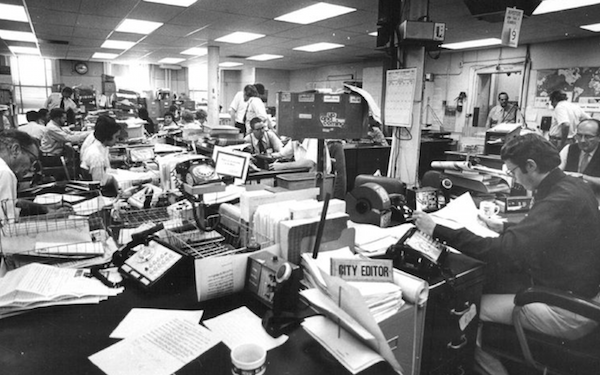
Yet, and for another day, what’s lost when doing it the old way finally fades: what an improbable and glorious human endeavor the newsroom was…


 A Few Reasonable Words
