Commonplace Book: Jacques Bonnet

BonnetStill dipping into Phantom of the Bookshelves, one of those charming books on books that show up from time to time. Chapter 7 addresses a phenomena that many readers encounter.


Chapter 7

Real People, Fictional Characters

“The best bacon omelettes I have eaten in my life have been with Alexandre Dumas.”  — Jacques Laurent

Hundreds of thousands of people live in my library. Some are real, others are fictional. The real ones are the so-called imaginary characters in the works of literature, the fictional ones are their authors. We know everything about the former, or at least as much as we are meant to know, everything that is written about a given character in a novel, a story, or a poem in which he or she figures. This character has not grown any older since the author brought him or her into existence, and will remain the same for all eternity. When we hold in our hand the text or texts in which such a person appears, it feels as if we are in possession of everything the author wanted us to know about the character’s acts, words and sometimes, thoughts. The rest doesn’t matter. Nothing is hidden from us. For us, a novel’s characters are real. We may be free to imagine what we don’t know about them, though we know quite well that these are just guesses. And we are free to interpret their words or their silences, but again these will just be interpretations. We know quite a lot about Odysseus, Aeneas or Don Quixote, correspondingly little about Homer, Virgil or Cervantes. Sometimes characters are even deprived of an author as if their creator had discreetly sipped away. Who made up the first version of Don Juan? Who invented Faust? And while we feel sure that Harpagon, Tartuffe or Monsieur Jourdain undeniably exist, what do we know in the end about a certain Jean-Baptiste Poquelin, whose stage name was Molière. Not very much, not even whether he really wrote all the plays attributed to him.

[…]

Authors are just fictional people, about whom we have a few biographical elements, never enough to make them truly real people. Whereas the biography of a literary character, even if it is incomplete–and explicitly so–is perfectly reliable: it is whatever its creator decided.

malgudi
A real map of a fictional place, R.K. Narayan’s Malgudi, which is nonetheless a place that was very real to me when I fell in love with his books in my twenties.

Thought-Provoking Words

From a fascinating review by Gregory Radick of Piers J. Hale’s
POLITICAL DESCENT
Malthus, mutualism, and the politics of evolution in Victorian England in the TLS.

Sheds light on the ideological uses made of Darwin, and many connections across realms that were surprising to me at least.

Near the end he has a side comment about eugenics, from the “future is already here and encoding inequality” beat that is truly eye-opening.

220px-DNA_replication_en.svg
Eugenics, another luxury bauble of late capitalism?

As a scientific-political programme, the deliberate breeding of better humans or, as it came to be known, “eugenics” – another period neologism, introduced by Darwin’s cousin Francis Galton in 1883 – never recovered from its association with the Nazi death camps. Until then, however, it had enjoyed broad appeal across the political spectrum. In Britain, members of the Malthusian Left who gathered in the Fabian Society, including Shaw, Wells, and Sidney and Beatrice Webb, were among the earliest supporters. Their preferred means for bringing about a eugenic future was education. The historical lesson many have drawn is that eugenics, however well intentioned, is inevitably coercive and ultimately murderous. But that is not the only possible lesson, and maybe not the best one. In 1996, after a year spent with the Human Genome Project at the behest of the US Library of Congress, the philosopher Philip Kitcher published a remarkable book, The Lives To Come, arguing that, whether we like it or not, the genetic technologies now available make eugenics inescapable, so the choice we face is about the kind of eugenics we have. In Kitcher’s view, the Nazis showed in extremis what not to do, while the Fabians offer more positive inspiration. Better, Kitcher suggests, to teach young people how to think through the social consequences of their reproductive choices, in a society committed to realizing human potential to the full, than to collude with the present regime of “laissez-faire eugenics”, in which those with enough money can buy whatever genetic improvements they can afford, and the rest can fend for themselves.

“Those with enough money can buy whatever [ …] improvements they can afford, and the rest can fend for themselves.” A well-put statement of a widespread state of affairs.

Entire review is fascinating.

Commonplace Book: Anne Enright

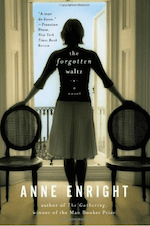
Forgotten WaltzAfter slogging through a few disappointing novels recently, decided to treat myself to Anne Enright’s The Forgotten Waltz  to reset a bit. (Reading The Gathering a few years back was one of those gobsmacking moments in a reading life, up there with my first encounter of Penelope Fitzgerald.)

Here is the narrator introducing her husband to the reader in a chapter headed, “Love is like a cigarette”:

Let’s start with Conor. Conor is easy. Let’s say he has already arrived, that afternoon in Enniskerry. When I go back into the kitchen he is there, lingering and listening, having a good time. Conor is low and burly and, in the summer of 2002, he is my idea of fun.

Conor never takes his jacket off. Under the jacket is a cardigan, then a shirt, then a T-shirt and under that a tattoo. The wide strap of his bag is slung across his chest, keeping everything tamped down. he is on the mooch. This man never stops checking around him, as though for food. In fact, if he is near food he will be eating it – but neatly, in an intelligent, listening sort of way. his eyes keep traveling the floor and if he looks up it is with great charm: he is caught by something you have said, he thinks you are funny. He might seem preoccupied, but this guy is ready for a good time.

I loved Conor, so I know what I am talking about here. He comes from a line of shopkeepers and pub owners in Youghal, so he likes to watch people and smile. I used to like this about him. And I liked the bag, it was trendy, and his glasses were trendy too, thick-rimmed and sort of fifties, and he shaved his head, which usually annoyed me but it suited him because his skin was so brown and his skull so sizeable. And his neck was large, and his back bulged and sprouted hair from the shoulders down. What can I say? Sometimes it surprised me that the person I loved was so fantastically male, that the slabs of muscle were covered in slabs of solid fat and that the whole of him – all five foot nine, God help us – was fizzed up with hair, so that he became blurred at the edges, when he undressed. No one had told me you could like that sort of thing. But I did.


If this style speaks to you, you should go read it. I assure you she manages this deft tonal control–as well as providing an extraordinary vision of a very commonplace set of human predicaments–for all 259 pages.

Reasonable Words: In Praise of Bookstores

Back from a quick trip to Belgium and Holland, and heartened by seeing bookstores in cities large in small (three even in tiny Bruges’ quaint old town).

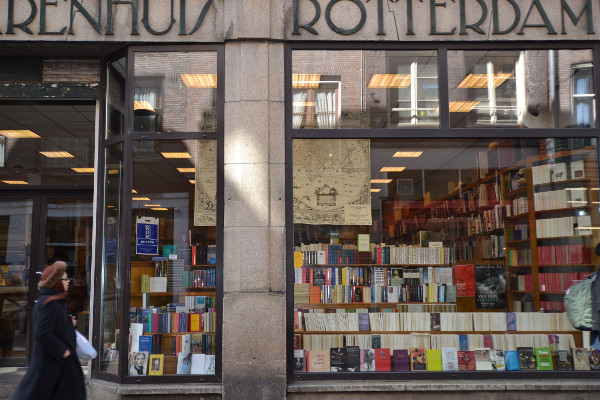
Here’s a photo of one I saw in Amsterdam.

bookstore_Amsterdam_sized DC and Boston have lost a lot of bookstores over the last 10 years: Borders and Waterstone’s are gone, but so are local favorites like Wordsworth’s in Harvard Square, or Trover Shop on Capitol Hill, which had a fascinating combo of politics and experimental fiction.

A few kind words about this endangered species:

“I had a friend once who looked at his library and discovered that even if he completely stopped filmmaking (he was a filmmaker too) and just decided to read the books he had in his library, it would take him until he was 100 years old. He was little bit panicked. But he was courageous. He went out of his house. He went to the bookstore. And he bought ten books.”
― Alain Resnais

Hugo headed off toward the door to leave, but the bookstore was warm and quiet, and the teetering piles of books fascinated him.”
― Brian Selznick, The Invention of Hugo Cabret

“Standing there, staring at the long shelves crammed with books, I felt myself relax and was suddenly at peace.”
― Helene Hanff, Q’s Legacy

“A bookstore is one of the only pieces of evidence we have that people are still thinking.”
– Jerry Seinfeld