Michael Frayn: Columnist

Before he came to fame as a novelist and playwright (one of a small elect who mastered both forms), Frayn studied philosophy and went on to be a newspaper columnist.  In 1964, at the height of debate about the pill, he wrote a wicked parody of theological musings about it–transposed to driving, and with the made up sect of the Carthanginian Monolithic Church, with their view of the natural way of things–which is to get bumped into from the back, while driving.

Of course, I don’t think the actual Catholic Church ever accepted The Box, (that is, The Pill).

Don’t Look Back

By Michael Frayn

It is with a close and warmly sympathetic interest that all men of good will, whatever their creed, are following the vigorous debate now going on within the Carthaginian Monolithic Church on the vexed question of rear-view mirrors. It has long been the teaching of the Church that looking backwards while travelling forwards is categorically and explicitly forbidden by God, since it was for doing this that He visited instant fossilization upon Lot’s wife.

In this context “looking back” has always been interpreted as frustrating the natural forward gaze of the traveler, whether by turning the head (visus interruptus), or by the interposition of a mechanical device such as a mirror.

Carthaginian Monolithic theologians claim that looking back is not only divinely prohibited, but can also be seen by the light of reason to be contrary to natural law, since it is patently interfering with nature to inhibit the inherent tendency of fast-moving objects to collide, and is frustrating the natural consequences of the act of driving—the possibility that an heir may succeed to the driver’s estate.

Moreover, they argue, there is a strong aesthetic objection to looking backward, since it must plainly detract from the spontaneity of the driving act, and they point out how much more insipid life becomes if the spice of the unexpected is removed altogether. It must in all fairness be pointed out that the keen interest of the monolithic clergy in preserving spontaneity and avoiding insipidity is entirely altruistic, since they do not themselves drive.

Those arguments notwithstanding, the Church has long recognized the need to prevent cars crashing into the backs of one another indiscriminately, and Monolithics are permitted to avoid it by abstaining from driving altogether, or by driving only during the so-called “safe period”, between midnight and 6 a.m., when the chances of being crashed into are greatly reduced.

Nevertheless, there is a sympathetic—indeed anguished—realization among many Monolithic leaders today that self-restraint alone may be inadequate to meet the situation. The question was less crucial in the days when the main effect of the doctrine was to prohibit Monolithics from sitting with their back to the engine in railway carriages. But the increasing popularity of the motorcar is putting an intolerable burden upon the accident wards of the world’s hospitals.

There is intense sympathy, too, for the great strain undergone by Monolithic drivers who have been run into from behind perhaps 13 or 14 times already, and who now scarcely dare to drive home to see their wives if it involves turning right, or pulling out to pass a parked car.

It is to this agonizing problem that “the Box” may provide an answer. “The Box” is a rearward radar scanning device which scientists are still testing. Monolithics believe that scanning aerial cannot be said to “look” back in the natural sense of looking, and that the radar screen does not deflect the natural forward gaze of the driver, like a mirror, but is a natural part of his natural forward view.

It is emphasized that even if “the Box” were to be accepted, it could never be used for merely selfish purposes, to avoid a crash simply because a crash was not desired, but only where a driver had already had three or four crashes, and there were genuine grounds for believing that another one might have serious effects upon his health.

All the same, some authorities doubt if the box could ever be an acceptable compromise. They believe that the safe period principle is more reliable—making absolutely sure that the road behind the car was kept clear by scattering perhaps nails or broken glass, perhaps small high explosives or napalm bombs.

Non-Monolithic observers can only look on at this debate with sympathy and understanding. They may be sure that it will be carried through with utter sincerity and a genuine sense of urgency, and that everyone on both sides will do his best, and play the game according to the rules.
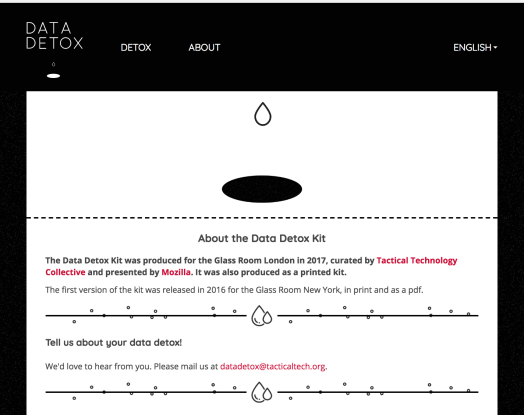
Data Detox

Tipped by a friend, I just learned about “The Data Detox,” a sequential 8-day program for reviewing, cleaning up/deleting, and rethinking the data trails you leave (and people profit from and may exploit in other ways).

As you go through each day, the detox gives quick explanations of how data tracking works, and also explains the implication of decisions you have made (or not made when you just check ‘agree’). Related: the same group has a useful rundown on whether to stay on FaceBook or to go. Not a hard one for me, I was barely on in the first place.

Gluck

Revisiting assignments from voice lessons of years ago, and was reminded of the glories of Gluck, as interpreted by the wonderful Spanish mezzo Teresa Berganza.

Sort of astonishing to me that this aria is often tackled by beginning classical voice students (certainly where I first encountered it). Granted, it’s a workout for even breath control, but finding the right expressive character, one of gentle ardor, is even more challenging.

And here is Angela Gheorghiu, who perhaps pushes it a little to much into Verdian pathos (and needs the music, seriously?), but has, despite her quirks, a surpassingly beautiful vocal line.

O del mio dolce ardor
Bramato oggetto,
L’aura che tu respiri,
Alfin respiro.

O vunque il guardo io giro,
Le tue vaghe sembianze
Amore in me dipinge:
Il mio pensier si finge
Le più liete speranze;
E nel desio che così
M’empie il petto
Cerco te, chiamo te, spero e sospiro.

I will look for someone who does it in 17th century style one of these days, until then, these true opera stars will have to do.

Our Data, Our Selves

A reporter at ProPublica took on a task a lot of us must be thinking about in light of Facebook, Cambridge Analytica and the like. He asked big tech companies for his file.  (There was a similar story in the NYTimes.)

From ProPublica
“Once you see your data, you’ll have a much better understanding of how this shadowy corner of the new economy works. You’ll see what seemingly personal information they know about you … and you’ll probably have some hypotheses about where this data is coming from. You’ll also probably see some predictions about who you are that are hilariously wrong.”

By Martin Grandjean – Grandjean, Martin (2014). “La connaissance est un réseau”. Les Cahiers du Numérique 10 (3): 37-54. DOI:10.3166/LCN.10.3.37-54., CC BY-SA 3.0

Hilariously wrong sometimes, and perhaps other times not so comical. Given where we are, is there any hope, and any technologically feasible way, to assert and protect privacy rights that are implicit linked metadata? Is there a balance between privacy and convenience, and this extraordinary power that is provided by search at scale. Once data privacy was a by-product of obscurity amplified by the difficulty of finding even public records, much less linking them. Now, a database with billions of records is, if not exactly child’s play, certainly achievable. The relative ease, and the gold-rush level riches potential, ganged up with the lack of any functional international or even national policy and regulatory regime means we are all in this data-shoot out unwillingly but inevitably.

“The right to be left alone—the most comprehensive of rights, and the right most valued by a free people.”—Supreme Court Justice Louis Brandeis, 1928

More here, including tips on your doing your own data audit: https://www.propublica.org/article/how-to-wrestle-your-data-from-data-brokers-silicon-valley-and-cambridge-analytica


Photo Thursday: Burning Man Exhibit at The Renwick

Took in the Burning Man show at the Smithsonian’s Museum of Craft, the Renwick. Not sure it was meant for me exactly, but I did find the inflating mushrooms pretty mesmerizing. A few shots…

The Broken Internet

Like many, I’ve encountered a spate of stories about the plagues of the Internet, easy to understand in this era of Cambridge Analtyica, trolling, fake news, and video bots.

New York Magazine rounded up a group of tech types (from within and without the Silicon Valley juggernaut, and with a range of political and economic ideologies).

A few quotes:

“Antonio García Martínez: I think Silicon Valley has changed. After a while, the whole thing became more sharp-elbowed. It wasn’t hippies showing up anymore. There was a lot more of the libertarian, screw-the-government ethos, that whole idea of move fast, break things, and damn the consequences. It still flies under this marketing shell of “making the world a better place.” But under the covers, it’s this almost sociopathic scene.”

Jaron Lanier: We wanted everything to be free, because we were hippie socialists. But we also loved entrepreneurs, because we loved Steve Jobs. So you want to be both a socialist and a libertarian at the same time, which is absurd.

Tristan Harris: We cannot afford the advertising business model. The price of free is actually too high. It is literally destroying our society, because it incentivizes automated systems that have these inherent flaws. Cambridge Analytica is the easiest way of explaining why that’s true. Because that wasn’t an abuse by a bad actor — that was the inherent platform. The problem with Facebook is Facebook.

A long way from the idealistic global network of the Internet or the Web in the 90s, so hopeful, and in retrospect the briefest of golden ages.

Opera vs. Musicals

Read a great review of conductor John Mauceri’s memoir cum instruction manual, Maestros and their Music. It includes a quote I love, “‘Carmen’, he says, ‘is my favourite musical and Carousel is my favourite opera.’” –Something that has made me go off and buy the book.

I am in complete agreement with Carousel as a favorite opera (Carmen has always been more ‘meh’ for me, but as a musical it certainly is less of a bore). As examples to prove both points, here is the “If I Loved You” scene from Carousel (with appropriate Broadway and opera royalty respectively in Kelli O’Hara and Nathan Gunn).

This is as beautifully crafted as any Verdi  scene and aria and gets me every time.

In contrast, Carmen almost never moves me. (My fault I fear.) But the odd, problematic, yet compulsively watchable film adaptation,Carmen Jones works as a musical in some sense that opera doesn’t. Both can’t dodge a certain campy excess, but the movie, despite its faults, doesn’t over stay its welcome like the opera, and has wit and spirit (something that most productions of the opera, at least the ones I have seen, sadly lack).

The thing they have in common? Oscar Hammerstein II.