Commonplace Book: The Way of All Flesh

Enjoying Samuel Butler’s The Way of All Flesh, no doubt he would approve of not giving it a try before age 50, as it is full of hard-won personal wisdom. Three bits among many I like…

“My boy,” returned my father, “you must not judge by the work, but by the work in connection with the surroundings. Could Giotto or Filippo Lippi, think you, have got a picture into the Exhibition? Would a single one of those frescoes we went to see when we were at Padua have the remotest chance of being hung, if it were sent in for exhibition now? Why, the Academy people would be so outraged that they would not even write to poor Giotto to tell him to come and take his fresco away. Phew!” continued he, waxing warm, “if old Pontifex had had Cromwell’s chances he would have done all that Cromwell did, and have done it better; if he had had Giotto’s chances he would have done all that Giotto did, and done it no worse; as it was, he was a village carpenter, and I will undertake to say he never scamped a job in the whole course of his life.”

“But,” said I, “we cannot judge people with so many ‘ifs.’ If old Pontifex had lived in Giotto’s time he might have been another Giotto, but he did not live in Giotto’s time.”


“I tell you, Edward,” said my father with some severity, “we must judge men not so much by what they do, as by what they make us feel that they have it in them to do. If a man has done enough either in painting, music or the affairs of life, to make me feel that I might trust him in an emergency he has done enough. It is not by what a man has actually put upon his canvas, nor yet by the acts which he has set down, so to speak, upon the canvas of his life that I will judge him, but by what he makes me feel that he felt and aimed at. If he has made me feel that he felt those things to be loveable which I hold loveable myself I ask no more; his grammar may have been imperfect, but still I have understood him; he and I are en rapport; and I say again, Edward, that old Pontifex was not only an able man, but one of the very ablest men I ever knew.”


“Yet when a man is very fond of his money it is not easy for him at all times to be very fond of his children also. The two are like God and Mammon. Lord Macaulay has a passage in which he contrasts the pleasures which a man may derive from books with the inconveniences to which he may be put by his acquaintances. “Plato,” he says, “is never sullen. Cervantes is never petulant. Demosthenes never comes unseasonably. Dante never stays too long. No difference of political opinion can alienate Cicero. No heresy can excite the horror of Bossuet.” I dare say I might differ from Lord Macaulay in my estimate of some of the writers he has named, but there can be no disputing his main proposition, namely, that we need have no more trouble from any of them than we have a mind to, whereas our friends are not always so easily disposed of. George Pontifex felt this as regards his children and his money. His money was never naughty; his money never made noise or litter, and did not spill things on the tablecloth at meal times, or leave the door open when it went out. His dividends did not quarrel among themselves, nor was he under any uneasiness lest his mortgages should become extravagant on reaching manhood and run him up debts which sooner or later he should have to pay.”


To me it seems that youth is like spring, an overpraised season—delightful if it happen to be a favoured one, but in practice very rarely favoured and more remarkable, as a general rule, for biting east winds than genial breezes. Autumn is the mellower season, and what we lose in flowers we more than gain in fruits. Fontenelle at the age of ninety, being asked what was the happiest time of his life, said he did not know that he had ever been much happier than he then was, but that perhaps his best years had been those when he was between fifty-five and seventy-five, and Dr Johnson placed the pleasures of old age far higher than those of youth. True, in old age we live under the shadow of Death, which, like a sword of Damocles, may descend at any moment, but we have so long found life to be an affair of being rather frightened than hurt that we have become like the people who live under Vesuvius, and chance it without much misgiving.

Art and Work

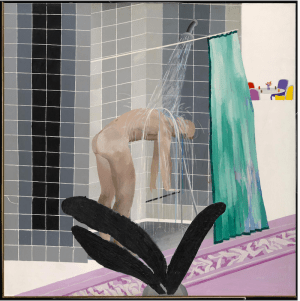
In a swing by the National Museum of American Art and National Portrait Gallery to see the wonderful new paintings of the Obamas, I caught a show on work, The Sweat of their Face. Lots of arresting images, perhaps none more than a riff on a David Hockney painiting from 1964, Man Taking a Shower in Beverly Hills, http://www.tate.org.uk/art/artworks/hockney-man-in-shower-in-beverly-hills-t03074. First the original,

Next, Ramiro Gomez’s response a few decades on, “Woman Cleaning Shower in Beverly Hills”

Yes, an obvious point, but still, something overlooked. Put me in mind of the Brecht poem,  “A worker reads history,”

A Worker Reads History

Who built the seven gates of Thebes?
The books are filled with names of kings.
Was it the kings who hauled the craggy blocks of stone?
And Babylon, so many times destroyed.
Who built the city up each time? In which of Lima’s houses,
That city glittering with gold, lived those who built it?
In the evening when the Chinese wall was finished
Where did the masons go? Imperial Rome
Is full of arcs of triumph. Who reared them up? Over whom
Did the Caesars triumph? Byzantium lives in song.
Were all her dwellings palaces? And even in Atlantis of the legend
The night the seas rushed in,
The drowning men still bellowed for their slaves.

Young Alexander conquered India.
He alone?
Caesar beat the Gauls.
Was there not even a cook in his army?
Phillip of Spain wept as his fleet
was sunk and destroyed. Were there no other tears?
Frederick the Greek triumphed in the Seven Years War.
Who triumphed with him?

Each page a victory
At whose expense the victory ball?
Every ten years a great man,
Who paid the piper?

So many particulars.
So many questions.


And the original,  accessible if you have a little German

FRAGEN EINES LESENDEN ARBEITERS

Wer baute das siebentorige Theben?
In den Büchern stehen die Namen von Königen.
Haben die Könige die Felsbrocken herbeigeschleppt?
Und das mehrmals zerstörte Babylon,
Wer baute es so viele Male auf ? In welchen Häusern
Des goldstrahlenden Lima wohnten die Bauleute?
Wohin gingen an dem Abend, wo die chinesische Mauer fertig war,
Die Maurer? Das große Rom
Ist voll von Triumphbögen. Über wen
Triumphierten die Cäsaren? Hatte das vielbesungene Byzanz
Nur Paläste für seine Bewohner? Selbst in dem sagenhaften Atlantis
Brüllten doch in der Nacht, wo das Meer es verschlang,
Die Ersaufenden nach ihren Sklaven.

Der junge Alexander eroberte Indien.
Er allein?
Cäsar schlug die Gallier.
Hatte er nicht wenigstens einen Koch bei sich?
Philipp von Spanien weinte, als seine Flotte
Untergegangen war. Weinte sonst niemand?
Friedrich der Zweite siegte im Siebenjährigen Krieg. Wer
Siegte außer ihm?

Jede Seite ein Sieg.
Wer kochte den Siegesschmaus?
Alle zehn Jahre ein großer Mann.
Wer bezahlte die Spesen?

So viele Berichte,
So viele Fragen.


The Health Value of Choral Singing

As a long-time choral singer, I appreciated these tidbits that came across my reading last week:

1) Philosopher J.D. Trout on one way he managed to stay out of trouble during a tough adolescence.

The Tanglewood Festival Chorus, the all-volunteer group that supports the Boston Symphony Orchestra

I was able to steer clear of trouble in part because I was involved in activities that crowded out a lot of the unpleasantness that kids face. Choral singing is incredibly wholesome, and doing it well imposes a discipline that frustrates the temptations of idleness in a permissive world. I know that sounds Victorian, and it is, in a way. But it is also a contingent fact about humans that they form (mal)adaptive preferences, learning to like the often objectively bad practices in their orbit. Staying busy with work and singing, and having thoughtful, captivating, and funny friends, left little time or desire for idle, pointless wondering about whether my life could be better if I learned to steal money, enjoy cocaine, or sleep till noon. None of that ever sounded very fun to me, nor was I much in the orbit of its pull.

From the interesting series, “What’s it Like to Be a Philosopher?”


2.  Daniel Pink, who has praise for choral singing in his new book on timing, When.

Q: Share with us a striking insight from your research on timing.

Pink: Let me offer two:

  • People are twice as likely to run their first marathon at age 29 as they are at age 28 or age 30. Forty-nine-year-olds are three times more likely to run a first marathon than 50-year-olds. Endings—simply being aware of an end—dramatically shape our behavior.

  • Choral singing is the new exercise. Research shows that the benefits of singing in a choir (not singing alone, but singing together) are massive: higher pain thresholds and reduced need for pain medication, increased production of infection-fighting immunoglobulin, reduced symptoms of depression, increased sensitivity toward others, improved mood, and much more. There’s something about synchronizing in time with others that is profoundly human. 

Three by Dvořák

A little Dvořák to end the weekend:

First, the autumnal glow of the Romance for Violin and Orchestra, in the capable hands of Kyung-Wha Chung and Riccardo Muti’s Philadelphians. (Sorry about the bad break in the file…when it goes to 2 of 2.)

Next, the folk-inflected slow movement of his Sonatina for Violin, played by violinist Josef Suk, Dvorak’s great-grandson, and Rudolf Firkušný, not a household name, but revered by pianists.

And the third movement from his Symphony No. 8, Allegro Grazioso, a tender dance, gentle shimmering nostalgia, Manfred Honeck and Frankfurt Radio Symphony Orchestra.

Dwyer plays Debussy

Gramophone (a classical music monthly from England) devotes its cover story to Debussy this month, and mentions in passing a wonderful performance of one of his most familiar pieces, Prélude à l’après-midi d’un faune, reminding me of Doriot Anthony Dwyer, the principal flute of the Boston Symphony, one of the first female principals in any orchestra and a magical player.

Peter Hujar

One of the amazing things about the last 30 years is how underground artists are now old masters (I guess it was ever so).

Case in point Peter Hujar, now a prize of that most august of cultural institutions, the Morgan Library : http://www.themorgan.org/exhibitions/peter-hujar


One additional sign of his acclaim, the recent (and not very appetizing) novel that used one of his photos as a signature image.

And there was a sympathetic and wonderfully written review in the NYTimes that brought back what it was like to encounter him a generation ago.

“It’s hard to say which is more surprising: that Peter Hujar’s photographs of 1970s and ’80s underground life in New York life have found their way to the Morgan Library & Museum, or that this Classically-minded institution has become unbuttoned enough to exhibit them in a heartbreaker of a show called “Peter Hujar: Speed of Life.”

Words and Music: Sondheim on Lyrics

The Guardian has a nice feature called “How we made…” quick interviews of creators of cultural milestones.  Here is a bit from the West Side Story one, Stephen Sondheim on the lyrics he wrote for Leonard Bernstein’s songs.

When we worked together, Lenny would sketch out something that was purple prose not poetry. It screamed: “Look at me! I’m being poetic!” I’d learned from Oscar Hammerstein, my mentor, that the whole point is to underwrite not overwrite because music is so rich an art itself. Poetry makes, generally, very poor lyrics unless you’re dealing with a certain kind of show. It’s too allusive, that’s not what you want. When Lenny failed, he failed big. He was always jumping off the top of the ladder. When you’re young, you want to take chances but you get discouraged by failure. I learned, as a composer, to be less square – that you don’t always have to write in four-bar phrases.

https://www.theguardian.com/stage/2017/sep/18/how-we-made-west-side-story-stephen-sondheim-chita-rivera-musicals

I have some quibbles with the “the whole point is to underwrite” assertion, but the mix of text and music is no mean art, and achieving that elusive balance is rare, particularly when you weigh the narrative, dramatic, and formal elements. But it  is achieved often in West Side Story. (Here’s Something’s Coming…)

Here is the excerpt from Romeo and Juliet that inspires this…Romeo and pals have been discussing going to the Capulets’ ball.

BENVOLIO

….
Supper is done, and we shall come too late.

ROMEO

I fear, too early: for my mind misgives
Some consequence yet hanging in the stars
Shall bitterly begin his fearful date
With this night’s revels and expire the term
Of a despised life closed in my breast
By some vile forfeit of untimely death.
But He, that hath the steerage of my course,
Direct my sail! On, lusty gentlemen.

(Something’s Coming indeed.)

Another example of Sondheim’s dazzling ability with lyrics: Someone in a Tree from Pacific Overtures, reportedly one of Sondheim’s favorite songs. Certainly one of mine.

It’s the fragment, not the day.
It’s the pebble, not the stream.
It’s the ripple, not the sea
That is happening.
Not the building but the beam,
Not the garden but the stone,
Only cups of tea
And history
And someone in a tree.

Picture Wednesday

Still sort of doing the the WP University “Developing Your Eye Course.”  Today’s prompt, Day Nine: “A Pop of Color” — Incorporate Color.


Herewith my efforts:

Snow Day in Boston

“There is more to life than making it go faster.”–Attributed to Shinichi Suzuki, founder of the Suzuki method.


Best Musicals: A Contentious Argument

Of making lists there is no end. Recently, I encountered a list of the 100 best musicals by Chris Caggiano (he of the now shuttered, but still pretty great, Everything I Know I Learned from Musicals blog).

Here’s his list (a little dated).

http://www.chriscaggiano.com/the-100-best-musicals-of-all-time.html

Top 3: Gypsy, My Fair Lady, and Sweeney Todd (with which I do not largely disagree except on the order, Eliza Doolittle is first for me, followed by the Demon barber, and “Just Where Would You Be…?”comes third. There is also a certain Bernstein musical that I would put before all three.

In general I agree with Chris (while noting that it doesn’t take into consideration the last decade).

Another crowdsourced list puts Les Miz tops.  Followed by Phantom and Wicked.

That these would never be in my top 50 probably reflects age more than any more reasonable criterion. Unlike the other two, Wicked at least is great fun.

But really, when there is this to compare it to:

Is there anything more to say?