Seen & Heard: Throwbacks

gramophone
A cigarette card helpfully explains how a gramphone works.

I’m not one for musical nostalgia. (Or any nostalgia for that matter: using the past to spank the present is a default trope in many areas, but one that throws off more heat than light, particularly corrosive in education.)

But musical pasts are fascinating in their own right and today three examples of “old style” (although not all from old musicians).

Jorge Bolet was a virtuoso in the old mold (which includes sometimes less than total adherence to the letter of the score), championing the romantics and playing with what piano expert Blake Morrison calls “epic virtuosity….fleet and lavish.” At the same time, he was dour in his stage manner, something that perhaps worked against his achieving the kind of fame that more demonstrative communicators like Horowitz and Rubinstein achieved.

Here he is in a Chopin Nocturne, with hands and a technique that fascinate. (What’s the deal with that left thumb?!) But so much to marvel at: the range of dynamics, control and poetry…how he puts forth the drama of the piece: moving from shadow/light, small scale/large scale, simplicity/elaboration. It’s hard not to imagine you are listening to a time capsule of a great pianist of the late 19th century.

Next a more complicated throw back: the Baroque cellist Anner Bylsma playing Duport études. Bylsma, like many musicians over the last 30 years, aims to recover the performance approaches and styles that prevailed when the piece was first composed. (Bach as Bach would have played and heard it, etc. A sort of musical ‘originalism’ that fomented much resistance and debate in the 80s, but has now settled down.)

Whatever your view of merits of this approach, it is eye, ear, and repertoire expanding. To me this Bylsma here evokes an almost folk music feel, which is an association that the 18th century classical tradition doesn’t usually prompt.

Finally, a musical argument for re-incarnation. How on earth does Javier Camarena sing like this…golden age style, glowing tone, manner, and timbre? Complete with a messa di voce that would make Donizetti smile.

Seleh and happy Tuesday.

Silly Words: Lesser-Known Ethical Dilemmas

Amsterdam Sculpture
Sculpture I spotted above Amsterdam’s canals. Are they contemplating the categorical imperative?

Via McSweeny’s a Monday morning giggle:

LESSER-KNOWN TROLLEY PROBLEM VARIATIONS

BY KYLE YORK

– – – –
The Time Traveler

There’s an out of control trolley speeding towards a worker. You have the ability to pull a lever and change the trolley’s path so it hits a different worker. The different worker is actually the first worker ten minutes from now.

The Cancer Caper

There’s an out of control trolley speeding towards four workers. Three of them are cannibalistic serial killers. One of them is a brilliant cancer researcher. You have the ability to pull a lever and change the trolley’s path so it hits just one person. She is a brilliant cannibalistic serial killing cancer researcher who only kills lesser cancer researchers. 14% of these researchers are Nazi-sympathizers, and 25% don’t use turning signals when they drive. Speaking of which, in this world, Hitler is still alive, but he’s dying of cancer.

The Suicide Note

There’s an out of control trolley speeding towards a worker. You have the ability to pull a lever and change the trolley’s path so it hits a different worker. The first worker has an intended suicide note in his back pocket but it’s in the handwriting of the second worker. The second worker wears a T-shirt that says PLEASE HIT ME WITH A TROLLEY, but the shirt is borrowed from the first worker.

The Ethics Teacher

There’s an out of control trolley speeding towards four workers. You are on your way to teach an ethics class and this accident will make you extremely late. You have the ability to pull a lever and change the trolley’s path so it hits just one person. This will make you slightly less late to your class.

The Latte

There’s an out of control trolley speeding towards five workers. You’re in a nearby café, sipping on a latte, and don’t notice. The workers die.

The Dicks

There’s an out of control trolley speeding towards two workers. They’re massive dicks. You have the ability to pull a lever and change the trolley’s path so it hits just one person. He’s an even bigger dick.

The Business Ethics Version

There’s an out of control trolley speeding towards three workers. You have the ability to pull a lever and change the trolley’s path so it hits a teenager instead. At a minimum, the three workers’ families will receive a $20,000 insurance payoff each, and the families will no doubt sue the company, which in this scenario you represent. The trolley driver seemed to die instantly from a freak aneurism, so your company might not be faulted for negligence under the FELA and might come out okay. The teenager’s parents, on the other hand, make a total of $175,000 a year, and can afford a pretty decent lawyer.

The Real Stinker

There’s an out of control trolley speeding towards four workers. You have the ability to pull a lever and change the trolley’s path so it hits just one worker instead. But get this: that one worker? It’s your fucking mom. Bet you weren’t expecting that shit, were you?

The Surrealist Version

There’s an out of control trolley speeding towards four workers. You have the ability to pull off your head and turn it into a Chinese lantern. Your head floats into the sky until it takes the place of the sun. You look down upon the planet. It is as small as the eye of a moth. The moth flies away.

The Meta-Ethical Problem

There’s an out of control trolley speeding towards Immanuel Kant. You have the ability to pull a lever and change the trolley’s path so it hits Jeremy Bentham instead. Jeremy Bentham clutches the only existing copy of Kant’s Groundwork of the Metaphysic of Morals. Kant holds the only existing copy of Bentham’s The Principles of Morals and Legislation. Both of them are shouting at you that they have recently started to reconsider their ethical stances.

Tech & Humanities Watch: Hackers and Hacks

For a further dispatch on the already noted incursion of big data/AI into journalism, see Tim Adams’ good piece in the Guardian about the cheerful software guys who are building a “Terminator” for the workaday reporter. It’s called Quill, and it is a software program that can take raw data feeds and craft news stories without the intervention of people. It’s part of the next generation of “data journalism,” and although I’m not sure quite how widespread it is, I’m confident that it will be soon, as it partakes of the inexorable “if it can be automated it will be automated” trend.

I suppose considered as a technical problem, a newspaper is just another “front end” to fill up with content, (just as the web itself originated as kind of a “front end” for the underlying Internet). We are living in a time where computing power can dip into previously unimagined sources and craft front ends for all kinds of things instantaneously (and not just presentation or content, software can make other software. One example is “The Grid” an AI-based system that custom designs and builds your blog for you.) Perhaps the most amazing thing about Quill is it’s probably not even that hard a content challenge for a computer to turn out the average local news story, earnings report, sports extra, or even a profile of Phyllis George. Not only can a computer replace half the newsroom, it can do it without breaking a sweat. The larger question: what other content is out there waiting to be harvested and automated? Textbooks? Annual reports? TV news broadcasts? Online courses already are to some extent. Surely somebody in a dorm at Cal Tech has written a bot to craft the perfect OK Cupid profile after scraping your FB feed. It’s the work of a weekend for a sufficiently gifted and lonely programmer.

What’s more, readers don’t really know the difference between computer authors and real ones: From the story,

“Perhaps the most interesting result in the study is that there are [almost] no… significant differences in how the two texts are perceived,” Clerwall concluded. “An optimistic view would be that automated content will… allow reporters to focus on more qualified assignments, leaving the descriptive ‘recaps’ to the software.”

And it’s just begun…The computer can also craft endless localized or more detailed versions of the story, with the pieces that are relevant to a very specific reader (think Amazon suggestions, but tuned to your news interests.) The era of the reporter–or the reader–having to manually crunch the numbers or anything for that matter, may be passing by.

“Hammond fully intends to live to see the day when people look at spreadsheets and data sets as being as antiquated as computer punch cards.

What is the most sophisticated thing the machine can do in this respect now? “We can do an eight-page exegesis of one number,” Hammond says, “for example on how likely it is a company is going to default on its debt. The eight pages will be written in plain English, supported where appropriate by graphs and tables. It will show you how it got to its conclusion. It is fine to read. The most important bits of analysis are shoved to the top.”

As a person with a lot of loyalty to the somewhat battered profession of journalism, I’m a little freaked out by this, but as a techy who thinks were still at minute 1 or 2 of what we can do with data, I’m super excited. Not about these ordinary stories that will now be automated, but that lurking behind this innovation is some new and potentially much better way of getting news to people. When rich media meets big data that should set off some sparks, or when the same algorithms that write the overnight sports stories are turned on say economic news or science topics, maybe we can change the whole nature of the usually inadequate coverage in these areas. I also think a tool like Quill when thought of through an educational lens (explanatory/educational journalism rather than breaking news reporting) offers a lot.

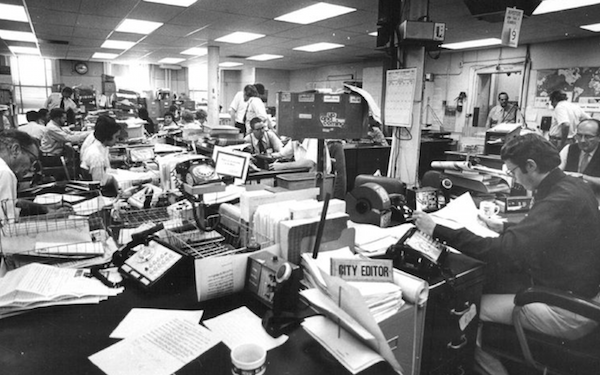
Yet, and for another day, what’s lost when doing it the old way finally fades: what an improbable and glorious human endeavor the newsroom was…

Human-based Content Creation & Management, once upon a time. The Denver Post newsroom in the 1970s.

Commonplace Book: Charles Wright

caribouEnjoying poet Charles Wright’s 2014 collection Caribou, notably the poem “Ducks.”

Gasoline smell on my hands, perfume
From the generator’s toothless mouth,
Opening swallow from the green hose,
Sweet odor from the actual world.

There’s an old Buddhist saying I think I read one time:
Before Enlightenment, chop wood and carry water.
After Enlightenment, chop wood and carry water.
The ducks, who neither carry nor chop,

Understand this, as I never will,
Their little feet propelling them, under the water,
Serene and stabilized,
                                         from the far side of the pond
Back to the marsh grasses and cattails.

I watch them every night they’re there.
Serenitas. I watch them.
Acceptance of what supports you, acceptance of what’s
Above your body,
                                 invisible carry and chop,

Dark understory of desire
Where we should live,
                                         not in the thrashing, dusk-tipped branches—
Desire is anonymous,
Motoring hard, unswaying in the unseeable.

buddha

Masculinities: Gay Lingo, Voices, and Personas

Spurred by a trailer for a new film, “Do I Sound Gay” found some interesting explorations of gay identity on the web. Three bits of video on different facets: Whosoundsgay

http://www.nytimes.com/2015/06/23/opinion/who-sounds-gay.html?_r=0


Next the fascinating world of Polari, a British gay mid-century slang, here captured in a short film.

Finally, a doc I saw a few years back called “The Butch Factor” –not about language per se, but about gay men and their relationship to masculinity, something that was once such a complicated topic (at least to my generation, or at least to me), but seems, in a welcome development, to be less fraught for many.

Seen & Heard: Music and Art Around the Web, Kirill Petrenko

A relatively unknown conductor (in the U.S. at least) has been named the next music director of the Berlin Philharmonic (the Mount Everest of classical music jobs). It’s Kirill Petrenko (a good last name for classical music, Vassily no relation, is a fine conductor in the UK and Sweden and Mikhail, also no relation, is an outstanding operatic bass.)

Kirill is, judging by YouTube excerpts and the press he has received for work in Munich and Bayreuth (hardly small-time jobs), an extraordinary music-maker. He is also about as far from the persona of the media-savvy maestro as it would seem possible to get. (This is no disrespect to the Dudamels, Nézet-Séguins, Alsops, and the rest–merely an observation.) As Tom Service notes in a smart Guardian piece, it’s an admirable & bold choice on the Berlin Phil’s part: few orchestras, and surely no US groups, would hire a chief on musicianship and musical leadership alone. (When Barenboim left Chicago, he complained about the amount of non-musical work, including schmoozing for money, was required.)  Kirill doesn’t give interviews, and describes himself as shy. Not a term I’d apply to many conductors. )

Here is a trailer of a concert with his future band in the music of Rudi Stephan (a new name to me and a composer he champions).

YouTube also has two endearing interviews with him from the Digital Concert Hall (done by musicians in the orchestra). And if you are looking for more, there’s a knockout performance of Franz Schmidt’s Symphony No. 4.

He is also the first Jewish music director of the Berlin Philharmonic. (The Forward hears a little Yiddish in his German.) This is also encouraging,  given this particular orchestra’s history.

640px-Philharmonie_1a
Hans Scharoun’s Philharmonie…one of the great halls for one of the great orchestras, future musical home of Kirill Petrenko.

Tidbits from Around the Web: Philosophy

russellA few web bits and bobs on Philosophy, a hobby of mine.

First, the unusual news (to me at least) that the French require high school students to do an essay on philosophy as part of their graduation requirements. A piece in The Week offers some praise, but much dismay as well.

An excerpt:

Finally, the essay. The Bac Philo is a four-hour essay test. But not just any kind of essay. You have to write a very specific kind of essay, une dissertation. The dissertation is a form of essay writing that is so deeply and artificially codified as to make kabuki look like an epileptic fit. Taking a stand — answering one of those questions with either “yes” or “no” — is absolutely prohibited. Instead, the author must restate what other thinkers have said about the issue, even when they contradict each other, and try to reconcile their differences (without seeming to do that).

The best essay I wrote for AP English in my senior year was an argument for offering philosophy classes in high school. Looking at some of the questions from the Bac Philo (listed by teaching and learning expert Grant Wiggins) and pondering what my 18 year-old-self would have made of them is an interesting thought experiment. I’m sure I would have been engaged by them, whether my answers would have been coherent and reasoned…probably not so much.

  • Is man condemned to create illusions about himself?
  • Can we prove a scientific hypothesis?
  • Is it our duty to seek out the truth?
  • Would we have more freedom without the state?
  • Can natural desires exist?
  • Is the only purpose of working to be useful?
  • What does one gain from working?
  • Is every belief contrary to reason?
  • Can desire be disinterested?

Probably not a one of them on the Google employment exam!

Second, tipped by Brian Leiter’s great blog, I’ve been enjoying a series called “What’s it Like to Be a Philosopher?” Fascinating people, straightforward but illuminating questions, appealing website. An excerpt of the one with Berit “Brit” Brogaard,

What do you think the goal of philosophy is or should be? How do you see the future of philosophy? Do you find any trends disconcerting?

I think the goal of philosophy should be what it always has been: to shed light on topics that cannot be fully empirically explored yet. I don’t think philosophers need to be concerned with how the heart is capable of pumping blood, because we have good scientific theories about that, theories that have been explored and tested. But there are many other problems that science has not yet been able to revolve fully, e.g. various normative issues and elusive scientific topics, such as consciousness. I don’t find any trends in philosophy disconcerting. I love variety.

What, if anything, would make you stop doing philosophy? What are your hobbies nowadays?

Nothing could ever make me stop loving philosophy. It’s my job and my hobby. I am still writing poetry, and I just wrote the script for a graphic novel. The graphic novel is about Freud. It’s semi-biographic. It’s just the script. My illustrator will have to do the illustrations on the side, and those can take a long time (a day per panel), so this book is not going to be finished anytime soon. But I am very excited about the script. My favorite graphic novel of all times is Logicomix, and our book is not unlike it.

Finally, a radio show and podcast (also discovered via a comment on Leiter Report), Philosophy Talk.

Seems unlikely, I know, but the two hosts are a sort of “Click and Clack” of philosophy; there’s a lot of friendly banter about topics that vary wildly (including going past their particular specialties.) The series has been going on a while, and is free during the current week, with many shows in the archive and a lively community. It can be hit or miss, but the best of the shows definitely give you something to chew on.