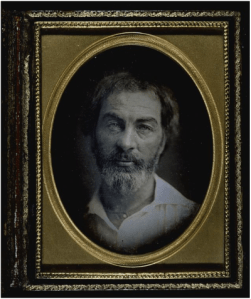
I’ve been lax and including first paragraphs instead of limiting myself to first lines. But back to that for today, with the great opening of Whitman’s Leaves of Grass.
“I celebrate myself,
And what I assume you shall assume,
For every atom belonging to me as good belongs to you.”
A poem that also includes a line I’ve always loved: “I believe a leaf of grass is no less than the journey-work of the stars…”
Today, Shirley Jackson, best known for “The Lottery,” but whose stylish, edge-wise view of life extended to many other novels and several clear-eyed (and hilarious) takes on family life.
“My name is Mary Katherine Blackwood. I am eighteen years old, and I live with my sister Constance. I have often thought that with any luck at all, I could have been born a werewolf, because the two middle fingers on both my hands are the same length, but I have had to be content with what I had. I dislike washing myself, and dogs, and noise. I like my sister Constance, and Richard Plantagenet, and Amanita phalloides, the death-cup mushroom. Everyone else in our family is dead.”
The kickoff of We Have Always Lived in The Castle.
The Web is only 25 years old, and now we’re worried about writing its obit. Mobile device use for Internet access (of the kind we once could only do on desktops) is building. And a staggering 90% of adult Americans have a cell phone (although smart phone penetration isn’t at that level yet). So is this a bad thing for the plain ole web? A recent commentator is seeing this as a zero sum, if mobile, in specific, apps, win, the web loses.
Mosaic, we hardly knew ye. They might have avoided the “tombstone” design for this historical marker at UI, although I suppose it is apt.
Jon Gruber at Daring Fireball has (as usual) an interesting take. It is, after all, all the Internet, and an open-ish ecology where there are a lot of channels, and the tool matches the task is a positive one.
Here is the beginning of Gruber’s post (which quotes Chris Dixon).
People are spending more time on mobile vs desktop. And more of their mobile time using apps, not the web.
This is a worrisome trend for the web. Mobile is the future. What wins mobile, wins the Internet. Right now, apps are winning and the web is losing.
I think Dixon has it all wrong. We shouldn’t think of the “web” as only what renders inside a web browser. The web is HTTP, and the open Internet. What exactly are people doing with these mobile apps? Largely, using the same services, which, on the desktop, they use in a web browser.
Not so often read today perhaps, but a lion (admittedly one with a sort of post-modern grin) of my youth and young adulthood, John Barth opens his “Lost in the Funhouse” thus:
“For whom is the funhouse fun? Perhaps for lovers. For Ambrose it is a place of fear and confusion.”
“It is about water. It was about water in the beginning, it will be in the end.”
This is the opening of Thomas Sanchez’ Mile Zero, a great Key West novel. It explores the figurative (and literal) “end of the road” that also inspired Wallace Steven’s extraordinary poem “The Idea of Order at Key West,” which opens,
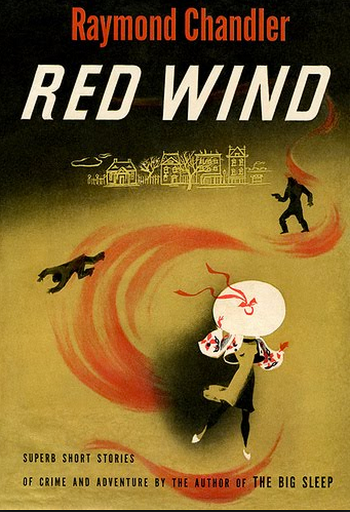
“There was a desert wind blowing that night. It was one of those hot dry Santa Anas that come down through the mountain passes and curl your hair and make your nerves jump and your skin itch. On nights like that every booze party ends in a fight. Meek little wives feel the edge of the carving knife and study their husbands’ necks. Anything can happen.”
There are many ways for a novel to pass the “first line test” (in short, does it keep you hooked? ). A commonplace turned on its head is one, and nicely done here.
“Every summer Lin Kong returned to Goose Village to divorce his wife, Shuyu.”
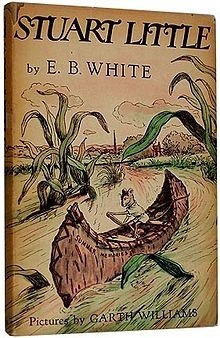
Today’s first line if from E.B. White’s Stuart Little:
“When Mrs. Frederick C. Little’s second son arrived, everybody noticed that he was not much bigger than a mouse.”
White managed the rare feat of being a fine essayist–his lean prose style, gently humorous, yet fierce, set a standard for American mid-century prose–and writing two children’s classics; I loved them (and even liked his third) and also spent many years trying, fruitlessly, to catch the rhythm of his lines.
From “Twelfth Night” the wonderful opening of a most musical play:
If music be the food of love, play on;
Give me excess of it, that, surfeiting,
The appetite may sicken, and so die.
That strain again! it had a dying fall:
O, it came o’er my ear like the sweet sound,
That breathes upon a bank of violets,
Stealing and giving odour!
From a later hilarious scene: “Thy yellow stockings!”

 I’ve been lax and including first paragraphs instead of limiting myself to first lines. But back to that for today, with the great opening of Whitman’s Leaves of Grass.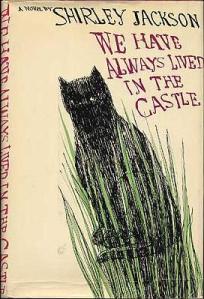






 A Few Reasonable Words