Arts and Technology: Reasonable Words?

Various inbox bits of late have two interests of mine overlapping. In no particular order and with only scant kibbitzing from me (more to come, no doubt):

1. Ludwig von MOOC

Coursera has teamed up with pianist Jonathan Biss to give a MOOC course  on the big 32!

Screen Shot 2013-07-15 at 12.30.37 PM

Interesting to see if these kinds of “monuments of music” courses will work online. (Some music profs I know don’t like teaching them, as they create a kind of audience problem around prerequisites, the most obvious being can you read music or not and are you a pianist?) But the blurb invites everybody, and the musicians among the crowd can read Charles Rosen’s books and have their own section. Whether anybody could shed more light than Rosen is a question, but that’s a question that would dog an in-person class. I wonder if Biss will perform live as part of the MOOC? Could be quite thrilling if so. He’s a wonderful pianist.

2. Britten the iPad App

Benjamin Britten’s “Young Person’s Guide to the Orchestra” (fetchingly featured in a recent Wes Anderson movie) has its own iPad app. Free, and nice design. Haven’t played with it yet.

Young Person's Guide to the Orchestra

3. BBC Tweets the Proms

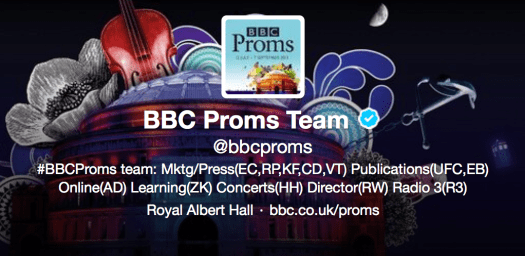
Unless you’re in London, you can’t attend PROMS concerts in person (and you can’t watch them here in the U.S, at least not officially). But in addition to taking in the feast that is the world’s largest classical music festival via the BBC Radio 3 Web site, you can join the 25K twitter followers for the feed.  A nice path through the riches, wherein you can find things like the “Doctor Who Prom.” (5 days to listen left.) Screen Shot 2013-07-15 at 12.51.14 PM
Beautiful Data: We Are Data @ Watchdogs.com

Data visualization, data journalism and the ethical & societal implications of big data are the questions of the moment, and likely to be with us for a long time. (In one sense, Snowden/Wikileaks/NSA is a big data story.) It would be interesting to have a taxonomy of the technologies and interfaces by which big data does its work: maybe some industrious grad student out there has already done one. Visualization and aggregation are reasonable categories to have, and “gamification” seems to be what a site called “We Are Data” adds to the mix.
Screen Shot 2013-07-12 at 7.51.01 AM
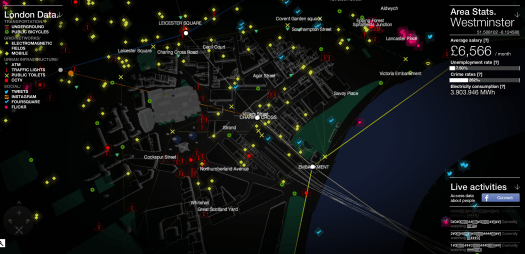
I’d never heard of WatchDogs, a game from UBI Soft. It immerses you in a fictional Chicago, with dashboards full of data about what is going on from a city under the full range of modern surveillance and social media feeding the web with info.

Now some developers have taken that idea to three real cities. From their web site:

In the video game Watch_Dogs, the city of Chicago is run by a Central Operating System (CTOS). This system uses data to manage the entire city and to solve complex problems,such as traffic,crime, power distribution and more…

This is not fiction anymore. Smart cities are real, it’s happening now. Huge amounts of data are collected and managed every day in our modern cities, and this data is available to anyone.

Watch_Dogs WeareData is the first website to gather publicly available data about Paris, London and Berlin, in one location. Each of the three towns is recreated on a 3D map, allowing the user to discover the data that organises and runs modern cities today, in real time. It also displays information about the inhabitants of these cities, via their social media activity.

What you will discover here are only facts and reality.

Watch_Dogs WeareData gathers available geolocated data in a non-exhaustive way: we only display the information for which we have been given the authorization by the sources. Yet, it is already a huge amount of data. You may even watch what other users are looking at on the website through Facebook connect.

If you are interested in this subject, we’d love to get your feedback about the website and about our connected world.

Everyone has their part to play and their word to say.


Screen Shot 2013-07-12 at 7.43.58 AMLots of provocative ideas here: the notion of a city having an “operating system” in the game, and visualizing something that aggregates it somehow (even though it doesn’t exist per se.) There’s also a “down the rabbit hole” line of thought about personal statistics, how we are partaking of the sum of all these numbers and bits that we are moving through for example, as we walk down a street in London.

It’s also quite beautiful. I could do without the anodyne music, but it is inspired by a video game, so that’s kind of required.

Beautiful Music: Handel’s Theodora

Listening to lots of oratorio recently, and of course that means Handel. Here is a morning helping from Theodora, which even by his high standards abounds in gorgeous music.

With the late and much missed Boston-based singer, Lorraine Hunt Liberson from a Glyndebourne production in 1996.

Quotable Words: Quotable Words: Everyone is now a data Practitioner

A video review of three new books on data from The Economist with some interesting points.


Among things mentioned in the review, which I found via Flowing Data, is the evocative Wind Map, done by data visualization experts from Google, but as an art project, that ended up at MOMA in fact.  Perhaps there’s a corollary to the famous Arthur C. Clark line,  “Any sufficiently advanced technology is indistinguishable from magic.” To wit: “Any sufficiently sophisticated data visualization is indistinguishable from art.”

Screen Shot 2013-07-10 at 6.20.33 AM
Zooming in on Cape Code portion of the “Wind Map” real-time visualization of weather data.

Quotable Words: John Mortimer

Novelist, playwright and wit John Mortimer:

The three towering geniuses of European culture, Shakespeare, Mozart and Leonardo da Vinci were not allowed to appear on the euro note as they might, in their separate ways, cause offense: Mozart because he was a “womanizer,” Shakespeare because he wrote “The Merchant of Venice,” a play judged to be anti-Semitic, and Leonardo because he was reported to fancy boys. Now the euro note carries a picture of a rather dull bridge.


Screen Shot 2013-07-08 at 7.06.32 PM
Could its dullness be the secret reason reason the EU currency is such a mess?


Poetic Words: Donald Justice

Starting the week off with a poem by the great, if little-known, Donald Justice.

Encountered in the Poetry Foundation’s 100 Poems, 100 Years volume.

MEN AT FORTY

Men at forty
Learn to close softly
The doors to rooms they will not be
Coming back to.

At rest on a stair landing,
They feel it moving
Beneath them now like the deck of a ship,
Though the swell is gentle.

And deep in mirrors
They rediscover
The face of the boy as he practices tying
His father’s tie there in secret

And the face of that father,
Still warm with the mystery of lather.
They are more fathers than sons themselves now.
Something is filling them, something

That is like the twilight sound
Of the crickets, immense,
Filling the woods at the foot of the slope
Behind their mortgaged houses.

—Donald Justice

Screen Shot 2013-07-08 at 8.12.02 AM
Lee Friedlander’s photo “Haverstraw, New York.”

Independence Day: Jefferson’s Debt to Euclid

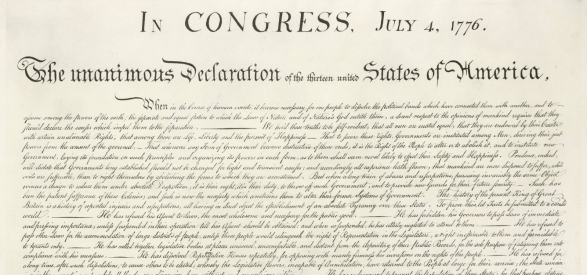
Everybody’s busy reading the Declaration of Independence today. NPR talked to some people on the National Mall about it and what it means, with this sweet result.

Screen Shot 2013-07-04 at 1.21.27 PM

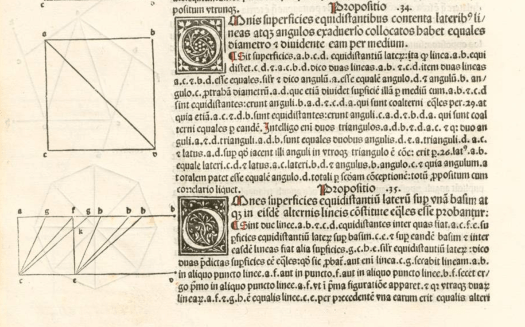
Interesting (and little-known) fact about the Declaration. Jefferson (and his fellow founders) were influenced by Euclid’s Elements, the collection of mathematical knowledge from 300 BCE, which, among other things, lays out the idea of reasoning from postulates. (Anybody recall 10th grade geometry, with its definitions, postulates, theorems, proofs, etc.? I, of course, loved every minute of it.) Jefferson, like students before and since, studied Euclid, and historians have picked up on how the Declaration is structured like a proof, (or as it would be termed in the Elements, a construction).

The “postulates” are those famous “Self-Evident Truths.” Once those are stated, assertions with justification follow in a long line, and everything is wrapped up by a rousing conclusion, Q.E.D.

Screen Shot 2013-07-04 at 1.16.07 PM
Pages from a Venetian edition of Euclid’s Elements. You can view the text at the Digital Collections of the Munich State Library.
More background and details via an interesting article at Lablit (itself an interesting site about science and literature). Oceanographer Seelye Martin talks about the Jefferson Euclid connection, and also about whether another bit of towering American rhetoric, The Gettysburg Address of 1863, could reflect the development of non-Euclidean geometry in the intervening years.
Happy 4th!

Commonplace Book: Dickensian Rain

Steady rain for hours in DC now…and brings to mind Bleak House, which I read during a time I had a long subway commute to a tech job in Reston. The novel’s convoluted plot has mostly faded from my memory, but the images stick around. Early in (Chapter II) we get that great Victorian specialty, weather, setting the scene for the gloomy and soggy world of Chesney Wold, which Lady Dedlock haunts:

An arch of the bridge in the park has been sapped and sopped away. The adjacent low-lying ground for half a mile in breadth is a stagnant river with melancholy trees for islands in it and a surface punctured all over, all day long, with falling rain. My Lady Dedlock’s place has been extremely dreary. The weather for many a day and night has been so wet that the trees seem wet through, and the soft loppings and prunings of the woodman’s axe can make no crash or crackle as they fall. The deer, looking soaked, leave quagmires where they pass. The shot of a rifle loses its sharpness in the moist air, and its smoke moves in a tardy little cloud towards the green rise, coppice-topped, that makes a background for the falling rain. The view from my Lady Dedlock’s own windows is alternately a lead-coloured view and a view in Indian ink. The vases on the stone terrace in the foreground catch the rain all day; and the heavy drops fall—drip, drip, drip—upon the broad flagged pavement, called from old time the Ghost’s Walk, all night. On Sundays the little church in the park is mouldy; the oaken pulpit breaks out into a cold sweat; and there is a general smell and taste as of the ancient Dedlocks in their graves. My Lady Dedlock (who is childless), looking out in the early twilight from her boudoir at a keeper’s lodge and seeing the light of a fire upon the latticed panes, and smoke rising from the chimney, and a child, chased by a woman, running out into the rain to meet the shining figure of a wrapped-up man coming through the gate, has been put quite out of temper. My Lady Dedlock says she has been “bored to death.”

You can read the whole book on Project Gutenberg of course.

Screen Shot 2013-07-03 at 10.21.33 AM
Photo by Denny Pewsey

Reasonable Words: Busy Monday Edition

G.B. Shaw’s advice on happiness (many years before the “happiness movement.”)

The only way to avoid being miserable is not to have enough leisure to wonder whether you are happy or not.

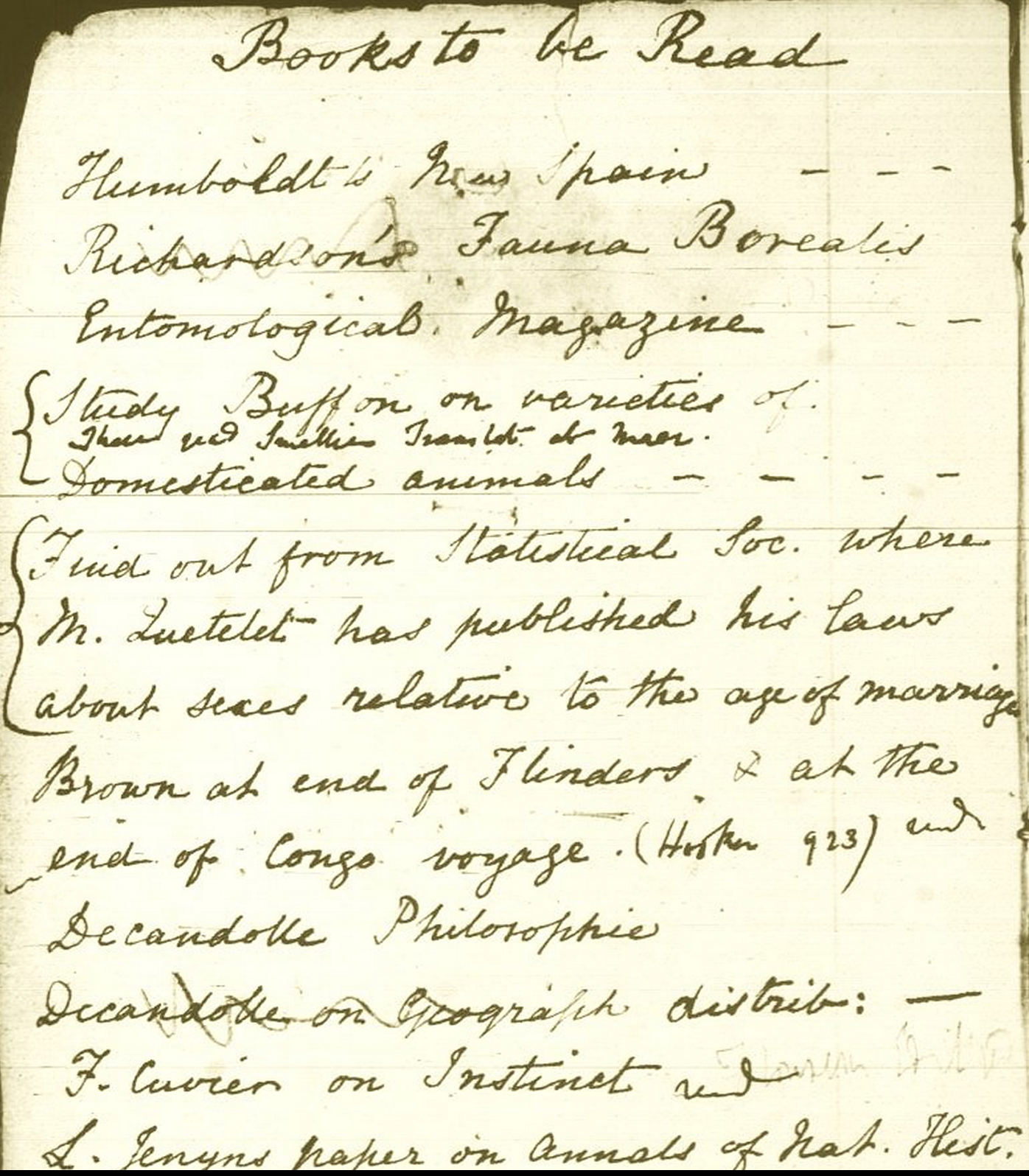
Seems like reliable advice. You can always keep busy with books. Here’s Charles Darwin’s “books to be read” list:

Screen Shot 2013-07-01 at 11.09.55 AM