List-o-Mania

Jessica Helfand has a wonderful piece on lists over at Design Observer, asking among other evocative questions, are Google search results not a list? (For that matter, why not consider the Internet as a list?)

She doesn’t touch on the list as a rhetorical form, and yet so much writing is list making (sometimes skillfully, sometimes not).  The Declaration of Independence is a list (and is also modeled on a Euclidean deductive proof, “from these premises with these steps, we establish that…”) For that matter, Euclid made lists, of a certain kind and flavor, but lists none the less.

Yet writing classes don’t seem (or mine didn’t, at least) to focus on this regularly encountered, humble constituent of writing. The big forms: comparison and contrast, argumentation, narrative, definition, cause and effect get all the air play. Yet each of these rhetorical moves is likely to have lists embedded in them. Of course, perhaps the craft is hiding the “listy” quality of writing; making something with smooth transitions and the lilting rhythm of a good essay requires hiding lists. Plunking through ideas as if they were practice exercises on the piano would not seem to be a promising, although beautiful literary lists abound.

William Gass (not mentioned by Helfand) has rounded up a bunch in an essay called “I Have a Little List” in his book Tests of Time (a beautiful, complex read and not as daunting as his fictions.) Among the many gems he reprints, the famous classification of animals from “a Chinese encyclopedia” and recorded by Jorge Luis Borges,

Attributed to a certain Chinese encyclopaedia entitled ‘Celestial Empire of benevolent Knowledge’. In its remote pages it is written that the animals are divided into: (a) belonging to the emperor, (b) embalmed, (c) tame, (d) sucking pigs, (e) sirens, (f) fabulous, (g) stray dogs, (h) included in the present classification, (i) frenzied, (j) innumerable, (k) drawn with a very fine camelhair brush, (l) et cetera, (m) having just broken the water pitcher, (n) that from a long way off look like flies.

Such older works seem happy to have their lists in the open. Helfand mentions lists in Gilgamesh, and then there are the many “begats” that open the New Testament in the King James version. (“Begat” is so much better a kickoff for the IMAX, Real3D level of the events to come in later pages than ‘became the father of’ used in later translations, which rings of a dreary Updike novel.)

Shakespeare’s Olivia has a wonderful list in Twelfth Night, when she is sparring with Viola, disguised as Cesario, who has a wonderful list of his/her own:

Viola: Excellently done, if God did all.

Olivia. ‘Tis in grain, sir; ’twill endure wind and weather.

Viola. ‘Tis beauty truly blent, whose red and white
Nature’s own sweet and cunning hand laid on:
Lady, you are the cruell’st she alive,
If you will lead these graces to the grave
And leave the world no copy.

Olivia. O, sir, I will not be so hard-hearted; I will give
out divers schedules of my beauty: it shall be
inventoried, and every particle and utensil
labelled to my will: as, item, two lips,
indifferent red; item, two grey eyes, with lids to
them; item, one neck, one chin, and so forth. Were
you sent hither to praise me?

Viola. I see you what you are, you are too proud;
But, if you were the devil, you are fair.
My lord and master loves you: O, such love
Could be but recompensed, though you were crown’d
The nonpareil of beauty!

Olivia. How does he love me?

Viola. With adorations, fertile tears,
With groans that thunder love, with sighs of fire.

Olivia. Your lord does know my mind; I cannot love him:
Yet I suppose him virtuous, know him noble,
Of great estate, of fresh and stainless youth;
In voices well divulged, free, learn’d and valiant;
And in dimension and the shape of nature
A gracious person: but yet I cannot love him;
He might have took his answer long ago.

Viola. If I did love you in my master’s flame,
With such a suffering, such a deadly life,
In your denial I would find no sense;
I would not understand it.

Olivia. Why, what would you?

Viola. Make me a willow cabin at your gate,
And call upon my soul within the house;
Write loyal cantons of contemned love
And sing them loud even in the dead of night;
Halloo your name to the reverberate hills
And make the babbling gossip of the air
Cry out ‘Olivia!’ O, You should not rest
Between the elements of air and earth,
But you should pity me!

Olivia. You might do much.

(Twelfth Night, Act I, Scene 5)

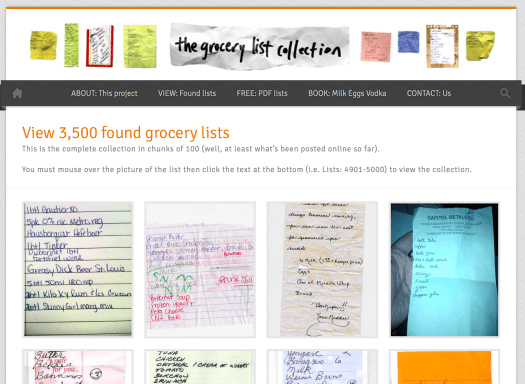
Back to the mundane and everyday, tipped by the original article I mentioned, here’s a charming compendium of lists, grocerylists.org. And now I’m off to make a few of my own. Milk, Eggs, Vodka and Work.
Screen Shot 2013-05-09 at 7.48.55 AM

http://www.grocerylists.org/portfolio-page/view-the-lists/

Saul Bass, Modernist Design, and Psycho

Today’s “Google Doodle” is a tribute to Saul Bass, the graphic designer who did the title sequences for many films–including one of my favorites, Hitchcock’s Vertigo.

A while back, Bard prof, Pat Kirkham made interesting points about Bass’s contribute to the most famous of Hitch’s scenes, that famous shower. From her long, but engrossing piece in Design Observer.

But Truffaut presumably asked the question about Bass’s contribution to the shower scene in the first place because he, like most informed people in the film world at the time, understood that Bass had visualized it; after all, Bass had been given the U.S. industry’s first public credit as a pictorial consultant. Film director Billy Wilder, who knew both Bass’s and Hitchcock’s work inside out, had little patience with those who could not see the difference between the overall style of the film and that of the shower scene. He told me, “Like most people in Hollywood you knew who did what if you were in the industry, especially if great stuff was involved. Everybody talked about that scene. Right from the beginning I understood that Saul did it. Everybody knew. Everybody knew Saul was brilliant. Who questioned it until those remarks of Hitchcock? . . . You only have to look at the sequence and look at the film and think. Think for one minute. You see the shower scene and you see it is not at all like Mr. Hitchcock — King of the Long Shot.”[10]

and later in the same piece

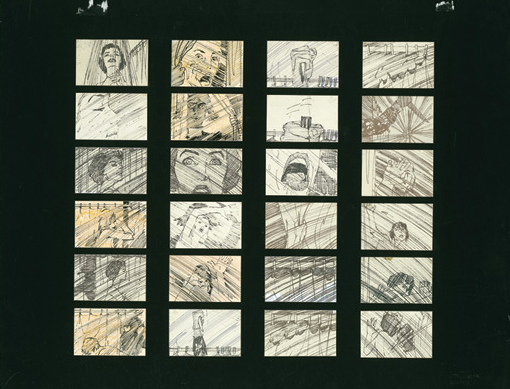
The “silent” clip began immediately, and when it finished I wrote something like, “All I kept thinking was ‘This is modernist design. I cannot get this out of my mind.’” What I had just seen was the shower scene from Psycho (see image below). An interesting discussion followed in which filmmaker Michael Eaton said that I had hit upon a key point because the scene was designed by Saul Bass. To those conversant with design as well as film — such as Wilder and Eaton — here is a sequence completely different from the rest of the film in the same way that the stunning montages by designers Charles and Ray Eames of the construction of Charles Lindberg’s airplane are from the rest of The Spirit of St. Louis, directed by their good friend Billy Wilder and released three years before Psycho. No one had problems crediting the Eameses either at the time or since, or believed that their input took away anything from Wilder. I’d like the Bass montage in Psycho to be thought of in a similar way.

Screen Shot 2013-05-08 at 10.45.05 AM

Operatic Style: Bergonzi & Cappuccilli

There’s been a real dearth of opera on the blog (although not in my life, given the Met broadcasts of the Ring, Dialogues, and Julius Caesar). And I know you’ve all been clamoring for it!

To remedy, here are two exemplars of Verdian style, Carlo Bergonzi and Piero Cappuccilli singing the big duet from Don Carlo. Vocal vigor, commitment to the text, and stunning voices.


And just to prove the that I’m not exclusively hung up on old singers, Alagna and Terfel doing that sure fire number from The Pearl Fishers, “Au fond du temple saint.”


Winogrand and Wall: Photography untidy and neat

SF Moma has a Garry Winogrand show up. The Bronx-born photographer is best known for capturing everyday life in candid, spur of the moment portraits. This photo (from the Met’s collection, not sure if it’s in the SF Moma show or not) is from the NYC nightclub El Morroco in 1955. The Met annotation describes W’s style aptly, “intuitive,” “street smart,” “direct.” I would add instantaneous to the mix, which perhaps relates to the photographer’s own gnomic remark on why he takes pictures, “I photograph to see what the world looks like in photographs.” A given instant, an illusion. All at once and quickly over. Like short stories, his pix often leave you with a little stabbing twist at the end. NYTimes has a good preview of the show up. Screen Shot 2013-05-07 at 8.01.44 AM

I learned about Winogrand by reading Arthur C. Danto’s (to me, somewhat soggy) book about Mapplethorpe from the era of the flap over “The Perfect Moment.” Danto compared Mapplethorpe to Winogrand to the latter’s disadvantage. (I think it was about formalism, which I always thought ruined a lot of Mapplethorpe’s work, but Danto, and many others, liked that aspect.)

In those days, I was also floored by the works of Canadian photographer Jeff Wall, who has a show up in Sydney (but one that I think started at NY’s MOMA). I first saw his big theatrical and backlit photographs at the Hirshhorn, where they took up an entire wall, and pulled you in, not like a short story, but like a big rich novel (one with strong art historical roots). MOMA put up an online exhibition, which doesn’t really give you a sense of the scale, or of the meticulous cinematographic preparation (casting, lighting, stage set, etc.) but is still worth checking out. Anything but a stolen moment of street life, captured in an instant, a la Winogrand. Wall’s shoots presumably take days, and the results, like Cindy Sherman’s work,  are panoramic slices of an epic movie. Virtuosic playing with time, which photography does to such bewildering and delightful cognitive effect.

Screen Shot 2013-05-07 at 9.12.22 AM

Library Words: Digital Public Library of America

A bunch of libraries of various stripes: public, academic, institutional, etc. have come together to form The Digital Public Library of America. It seems like my kind of idea (“digital” and “library” what’s not to love?).  Still, there’s a whiff of a “solution in search of a problem” here. As there has before, to wit the “World Digital Library,” launched in 2009, and not something that seems to have caught fire.
Screen Shot 2013-05-06 at 10.01.33 PM
Just for giggles, I tried a couple of searches in DPLA. Not a fair test in these early days, perhaps. Looking for anything on the British poet Stephen Spender, I got Guide to the Utah State University. Faculty. Publications of the faculty, 1955-2008, which did not strike me as particularly edifying. I also tried “scordatura” (alternate tuning of a stringed instrument, encountered in the Baroque repertoire, as well as other eras.

That yielded nothing.

Perhaps these kinds of searches are not what the service is for, although the help page does say, “Type whatever you’re looking for—a subject, a name, a place—into the search box at the top of any page on the DPLA website and either click the magnifying glass to the right or hit return/enter on your keyboard.” (Note to the copy writers: it’s 2013, we know what to do! Also, you might want to fix “comprised of” in the History Page.) What then, really, is it for, however?

Both searches got results in my own public library catalog, DC’s Martin Luther King Library. And plain old “type your search in the box in Google” and got me gobs, of course, including the link below to baroque violinist Andrew Manze explaining and demonstrating scordatura in the music of the wonderful 17th century composer HIF Biber. Brought to you by the “Public Library of Arthur.”

Hear a Little Song: Gota

Most weeks I listen to the BBC Radio show The Choir. This week’s was “The Art of A Cappella,” and had a lot of good stuff. Among the selections was Gøta, written by Peder Karlsson for The Real Group. Fair warning, it has a “get stuck in your head” main tune. If you go to the YouTube instance of the video, check out the fun comments about basses coming to despair on that low D on the bass line.

Commonplace Book: David Hume on Happiness

“… reading and sauntering and lounging and dosing, which I call thinking, is my supreme happiness. I mean my full contentment.” David Hume, in a letter in 1767.

Screen Shot 2013-05-03 at 10.01.21 AM
Our cat, Van, (named after Vannevar Bush, of course), has the dosing right. He saunters quite fetchingly as well.

Beautiful Garden: Dumbarton Oaks

Dumbarton Oaks, the former home of Robert Woods Bliss and Mildred Barnes Bliss, is a museum and public garden nestled in the heart of Georgetown. The museum collection has Byzantine and pre-Columbian artworks (turns out to be an agreeable combo), and the gardens are quietly spectacular, particularly on a May afternoon when they are mostly free of visitors. Photos below are from my visit late afternoon yesterday. The garden plan hasn’t changed much since I first started visiting in 1984, but there is one recent addition, an installation called Cloud Terrace by Cao/Perrot. This is a mesh of crystals in one of the gazebos, and I didn’t really get it when I went last fall. But yesterday, with sunlight slanting late, it was a dazzling centerpiece to the garden, a welcome bit of costume jewelry gaudy in the middle of pure elegance. (Sorry that the photos don’t really do it justice.)

Some Washington pundit (Joe Alsop maybe?) said that despite the fact that everybody comes to DC in April for cherry blossoms and school trips, it’s May that is glorious here, so much so that it makes up for August in Washington, which is saying something.

Quotable Words: TLS reviewing Gass, Quoting Stein

Screen Shot 2013-05-03 at 9.37.20 AM
Sister Bernadette’s Barking Dog: The Quirky History and Lost Art of Diagramming Sentences by Kitty Burns Florey

From a review of William Gass’ new novel “Middle C” in the TLS, (may be behind the paywall, sorry).

In “The Music of Prose”, Gass quotes Gertrude Stein: “I really do not know that anything has been more exciting than diagramming sentences.”

As compact an entry point to literary modernism as you could ask for!

Reasonable Words: Stephen Sparks on Marcel Schwob

Screen Shot 2013-05-03 at 9.12.21 AMFrom 3:AM MAGAZINE, “What Ever It Is, We’re Against It,” a blog that buzzes around literature and philosophy, happy to sting both, a fine piece by writer and bookseller Stephen Sparks about the perpetually forgotten Marcel Schwob (23 August 1867 – 12 February 1905). His name is new to me, and seemingly somebody Borges would have had to create had he not lived. Astonishingly learned, a library denizen, he had one tragic love affair, a disastrous sea voyage, and managed to pump out a few books, also leaving behind a tantalizing list of unfinished works.

Sparks quoting Schwob’s credo on art.

Contrary to history, art describes individuals, desires only the unique… consider a leaf with its intricate nerve system, its color variegated by shade and sun; the imprint of a raindrop; the tiny mark left by an insect; the silver trace of a snail; or the first mortal touch of autumn gold. Search all the forests of the earth for another leaf exactly like it. I defy you to find one.

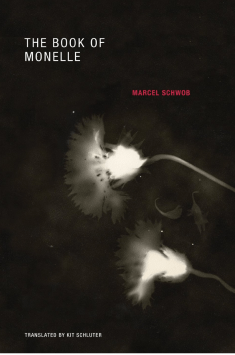
The piece closes with a summary and appreciation of The Book of Monelle, one of the works Schwob did manage to publish during a short, painful life. It sounds amazing.