National Poetry Month: Poems About Music, 12/30

The Polish poet Adam Zagajewski on the baritone member of the string family:

Screen Shot 2013-04-01 at 11.00.53 PM
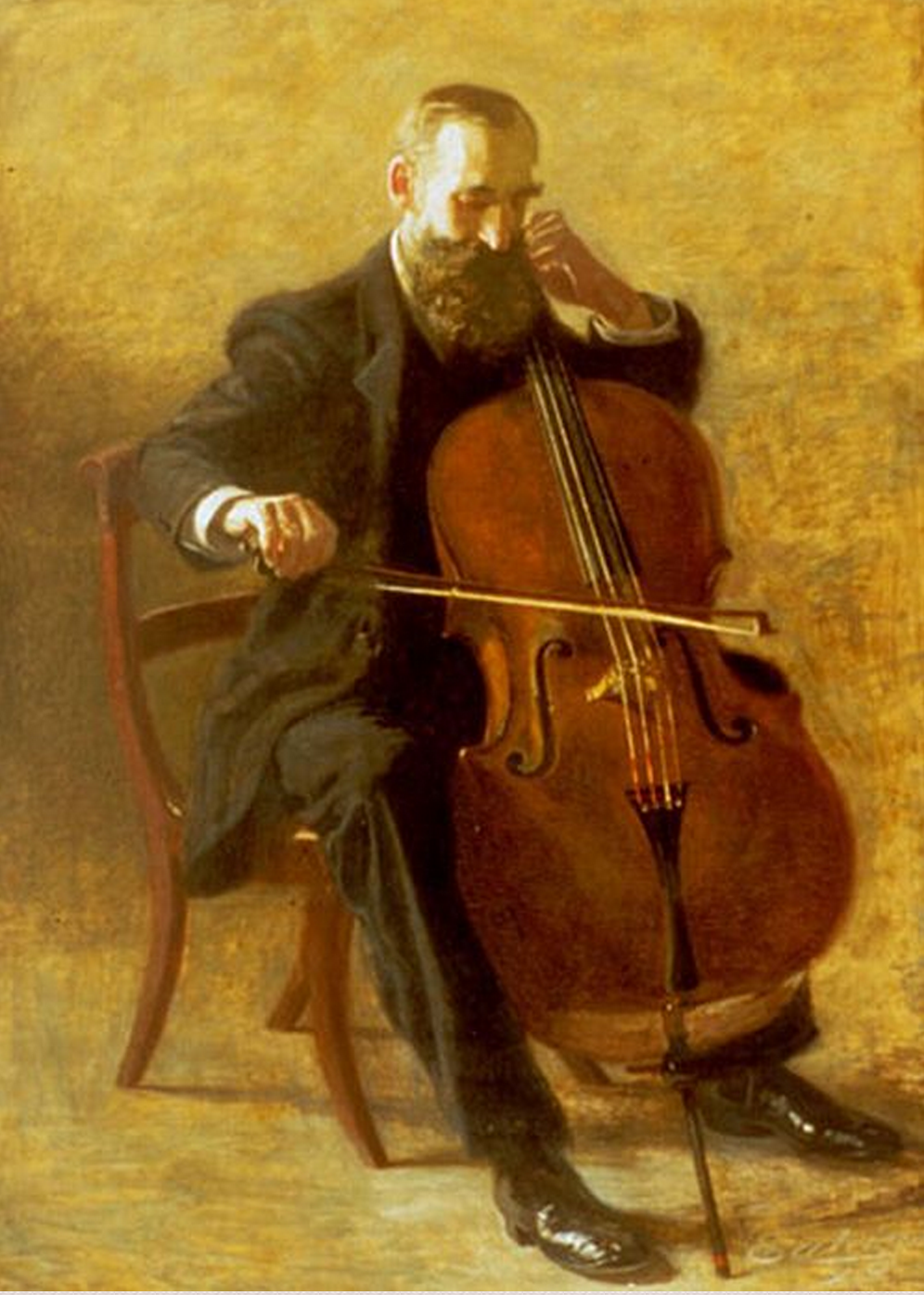
Thomas Eakin’s “The Cello Player”

“Wiolonczela”
Adam Zagajewski

Niechętni jej mówią: to tylko
skrzypce, które przeszły mutację
i zostały usunięte z chóru.
To nieprawda.
Wiolonczela ma niejeden sekret,
ale nigdy nie płacze,
tylko śpiewa grubym głosem.
Nie wszystko jednak zamienia się
w śpiew.Czasem można usłyszeć
jakby szmer albo szept:
jestem samotna,
nie mogę zasnąć.


“Cello”
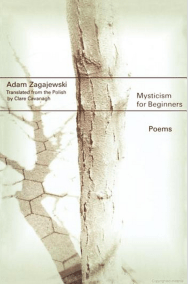
Adam ZagajewskiScreen Shot 2013-04-01 at 10.34.23 PM

Those who don’t like it say it’s
just a mutant violin
that’s been kicked out of the chorus.
Not so.
The cello has many secrets,
but it never sobs,
just sings in its low voice.
Not everything turns into song
though. Sometimes you catch
a murmur or a whisper:
I’m lonely,
I can’t sleep.

Translated from the Polish by Clare Cavanagh

Seems like the appropriate tie in is to the gorgeous slow movement of Chopin’s Sonata for Cello and Piano, here played by a supremely relaxed Gregor Piatigorsky. (I think this clip is from what looks like a truly goofy movie called “Carnegie Hall” of 1947.)

National Poetry Month: Poems About Music, 11/30

At a Solemn Music

by John Milton

Blest pair of Sirens, pledges of Heav’ns joy,
Sphear-born harmonious Sisters, Voice, and Vers,
Wed your divine sounds, and mixt power employ
Dead things with inbreath’d sense able to pierce,
And to our high-rais’d phantasie present,
That undisturbed Song of pure concent,
Ay sung before the saphire-colour’d throne
To him that sits theron
With Saintly shout, and solemn Jubily,
Where the bright Seraphim in burning row
Their loud up-lifted Angel trumpets blow,
And the Cherubick host in thousand quires
Touch their immortal Harps of golden wires,
With those just Spirits that wear victorious Palms,
Hymns devout and holy Psalms
Singing everlastingly;
That we on Earth with undiscording voice
May rightly answer that melodious noise;
As once we did, till disproportion’d sin
Jarr’d against natures chime, and with harsh din
Broke the fair musick that all creatures made
To their great Lord, whose love their motion sway’d
In perfect Diapason, whilst they stood
In first obedience, and their state of good.
O may we soon again renew that Song,
And keep in tune with Heav’n, till God ere long
To his celestial consort us unite,
To live with him, and sing in endles morn of light.

Four lines of which were set by Handel in the glorious soprano aria, “Let the Bright Seraphim,” from the his opera Samson. Here is Joan Sutherland, “La Stupenda,” singing it.

Dartmouth has a helpful gloss on the poem.

National Poetry Month: Poems About Music, 10/30

Cover of the Elizabethan SongbookThe Lowest Trees Have Tops

The lowest trees have tops, the ant her gall,
The fly her spleen, the little spark his heat;
And slender hairs cast shadows, though but small,
And bees have stings, although they be not great;
Seas have their source, and so have shallow springs;
And love is love in beggars and in kings.

Where waters smoothest run, deep are the fords;
The dial stirs, yet none perceives it move;
The firmest faith is in the fewest words;
The turtles cannot sing, and yet they love;
True hearts have eyes and ears, no tongues to speak;
They hear, and see, and sigh, and then they break!

————————————————————

Today’s poem is a little outside the brief of “poems on music” but I learned about it, as probably others have, through the lute songs of John Dowland. A taste of Sting’s (much maligned) recording of the song.

National Poetry Month: Poems About Music, 9/30


Music to Me is Like Days

Les Murray

Once played to attentive faces
music has broken its frame
its bodice of always-weak laces
the entirely promiscuous art
pours out in public spaces
accompanying everything, the selections
of sex and war, the rejections.
To jeans-wearers in zipped sporrans
it transmits an ideal body
continuously as theirs age. Warrens
of plastic tiles and mesh throats
dispense this aural money
this sleek accountancy of notes
deep feeling adrift from its feelers
thought that means everything at once
like a shrugging of cream shoulders
like paintings hung on park mesh
sonore doom soneer illy chesh
they lost the off switch in my lifetime
the world reverberates with Muzak
and Prozac. As it doesn’t with poe-zac
(I did meet a Miss Universe named Verstak).
Music to me is like days
I rarely catch who composed them
if one’s sublime I think God
my life-signs suspend. I nod
it’s like both Stilton and cure
from one harpsichord-hum:
penicillium –
then I miss the Köchel number.
I scarcely know whose performance
of a limpid autumn noon is superior
I gather timbre outranks rhumba.
I often can’t tell days apart
they are the consumers, not me
in my head collectables decay
I’ve half-heard every piece of music
the glorious big one with voice
the gleaming instrumental one, so choice
the hypnotic one like weed-smoke at a party
and the muscular one out of farty
cars that goes Whudda Whudda
Whudda like the compound oil heart
of a warrior not of this planet.
————-Screen Shot 2013-03-27 at 9.40.50 AM
Australian Les Murray gets at how ubiquitous music is now, you can listen to Bach’s B-Minor Mass while you shave, or cue up Les Troyens, a piece Berlioz was never able to hear performed in his lifetime, while you drive to beach. No doubt a mixed blessing. Something haunting about that line of Murray’s “they lost the off switch in my lifetime.” Not just on Muzak, either.

National Poetry Month: Poems About Music, 8/30

Whitman on Opera: after denouncing the art form as too foreign and highfalutin, he was won over by the stream of great Italian singers bringing the works of Bellini, Donizetti and Verdi to New York, later saying he could not have written Leaves of Grass without having had the experience of opera.

There are more than a few references to opera (and to music generally) in his poetry. Here’s an excerpt from Proud Music of the Storm

All songs of current lands come sounding ’round me,
The German airs of friendship, wine and love,
Irish ballads, merry jigs and dances—English warbles,
Chansons of France, Scotch tunes—and o’er the rest,
Italia’s peerless compositions.

Across the stage, with pallor on her face, yet lurid passion,
Stalks Norma, brandishing the dagger in her hand.

I see poor crazed Lucia’s eyes’ unnatural gleam;
Her hair down her back falls loose and dishevell’d.

I see where Ernani, walking the bridal garden,
Amid the scent of night-roses, radiant, holding his bride by the hand,
Hears the infernal call, the death-pledge of the horn.

To crossing swords, and grey hairs bared to heaven,
The clear, electric base and baritone of the world,
The trombone duo—Libertad forever!

From Spanish chestnut trees’ dense shade,
By old and heavy convent walls, a wailing song,
Song of lost love—the torch of youth and life quench’d in despair,
Song of the dying swan—Fernando’s heart is breaking.

Awaking from her woes at last, retriev’d Amina sings;
Copious as stars, and glad as morning light, the torrents of her joy.

(The teeming lady comes!
The lustrious orb—Venus contralto—the blooming mother,
Sister of loftiest gods—Alboni’s self I hear.)

You can find the full poem here and there’s a nice summary of Whitman and opera here, including the fact that some of his poems are organized like operatic scenes, with recit and aria, something I didn’t know.

Screen Shot 2013-03-26 at 11.03.08 AM
The Astor Place Opera House in New York City, Broadway and East 8th, as it was in 1850, when Whitman would have been attending.

National Poetry Month: Poems About Music, 7/30

Introit & Fugue
By D. Nurkse

After death, my father
practices meticulously
until the Bach is seamless,
spun glass in a dream,
you can no longer tell
where the modulations are,
or the pedal shifts
or the split fingerings . . .

if he rests
it’s to wind the metronome
or sip his cup of ice . . .

but who is the other old man
in the identical flannel gown,
head cocked, listening
ever more critically,
deeper in the empty room?

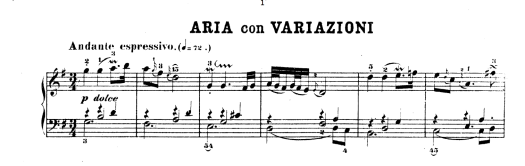
Screen Shot 2013-03-23 at 2.29.27 PM
The first line of the Goldberg Variations.

National Poetry Month: Poems About Music, 6/30

Howard Moss mines the seemingly thin topic of practicing to gently humorous and perceptive effect:

Piano Practice
By Howard Moss

For Frances Dillon Hayward

1
Such splendid icecaps and hard rills, such weights
And counter-weights, I think I scale the heights
When pentatonic Chinese crewmen start
Up in a cold sweat from the bottom of the keyboard
Only to arrive at some snow-stormed valley
To dissolve in steam-holes and vanish out of sight.

2
The left hand’s library is dull, the books
All read, though sometimes, going under velvet,
An old upholsterer will spit out tacks,
Turn them into sparks and smartly hurl them
Up and down the loudest bowling alley—
His pressure of effects can last all night.

3
Two bird notes endlessly repeat themselves.
Or are they fish scales—iridescent, hard?
Mica into marble back to mica?
No images in trills. They’re formal. Take
Your foot off the pedal. You’re in a wood
Near the sea. And every tree and wave is fake.

4
An underwater haircut by Debussy?
Oh, that’s too easy. Astringent lotions
Let the swimmer down by easy stages
Down among the flashy soda fountains
Down to the bottom where the light bulbs waver
Down where all the mirrors eat their hearts out.

5
Grammar becoming poetry is what
You’re after—say, a rational derangement
Requiring that you forget technique
And concentrate on what is harder like
A fireplace that burns pine needles only,
Before which spills the gore of Persian rugs.

6
A vial of antiseptic meant for Schubert,
One modest, flat meticulous translation
Of Chopin’s lightning undercurrent Spanish—
These are the mere necessities of travel.
Someone you must meet is Dr. Czerny.
Then, through him, Domenico Scarlatti.

7
Seizure are occurring. Despite snow-lightning,
The black keys are bent on mountain climbing—
All of it against a doctor’s warning.
Soon they’re descending like the black dots of
A wirephoto in transmission. An
Erotic black wing hovers up above.

8
Bach is more like opening an ember
And digging hard into the heart of fire.
The heart of fire is another fire.
When it comes to Mozart, just say nothing.
Think of it as milk, and drink it slowly.
Slowly you will taste the cream of angels.

9
This black and white’s deceptive. Underneath
The spectrum rages. Did you ever see
The calmest waters quickly come to life
Because a minnow’s tinfoil flash in sun
Had rent them suddenly? It came. And went.
We take two thousand takes before we print.

10
Don’t try to catch that lion by Rousseau.
Before you wake, he’ll eat you up. If you
Should meet the sleeping gypsy, let her sleep.
Tomorrow they’ll be gone without a trace,
Half fact and half enigma. Now your hands
Are on the mysteries of the commonplace.

Henri_Rousseau_010

National Poetry Month: Poems About Music, 5/30

Concerto for Double Bass
He is a drunk leaning companionably
Around a lamp post or doing up
With intermittent concentration
Another drunk’s coat.

He is a polite but devoted Valentino,
Cheek to cheek, forgetting the next step.
He is feeling the pulse of the fat lady
Or cutting her in half.

But close your eyes and it is sunset
At the edge of the world. It is the language
Of dolphins, the growth of tree-roots,
The heart-beat slowing down.
John Fuller

Contrabbasso

I first encountered this poem in Poems on the Underground, which I found in a London bookstore. Poems on trains and buses are one of the many perks of being a public transportation fan. And here is some “edge of the world” Bach courtesy of the London Symphony Orchestra double-bass player Rinat Ibragimov.

National Poetry Month: Poems About Music, 4/30

It’s a cliché to say that poets don’t make good novelists (and vice versa). If you paint Fabergé eggs for a living, using the slenderest of sable brushes, can you really cope with slopping paint on the side of a barn with a roller, which is what most novels read like, and possibly how they are written.

But that “most” leaves us a sizable escape hatch, and among the writers who walk through it comfortably is Thomas Hardy, to whom I came to first through a set of poems that I heard sung in arrangements by Benjamin Britten. (Like another Britten piece on poetry and music, it hit me like a thunderclap, and became “mine” in some ineffable but continuing way.) Here is one of the poems, and a link to a performance of the set.

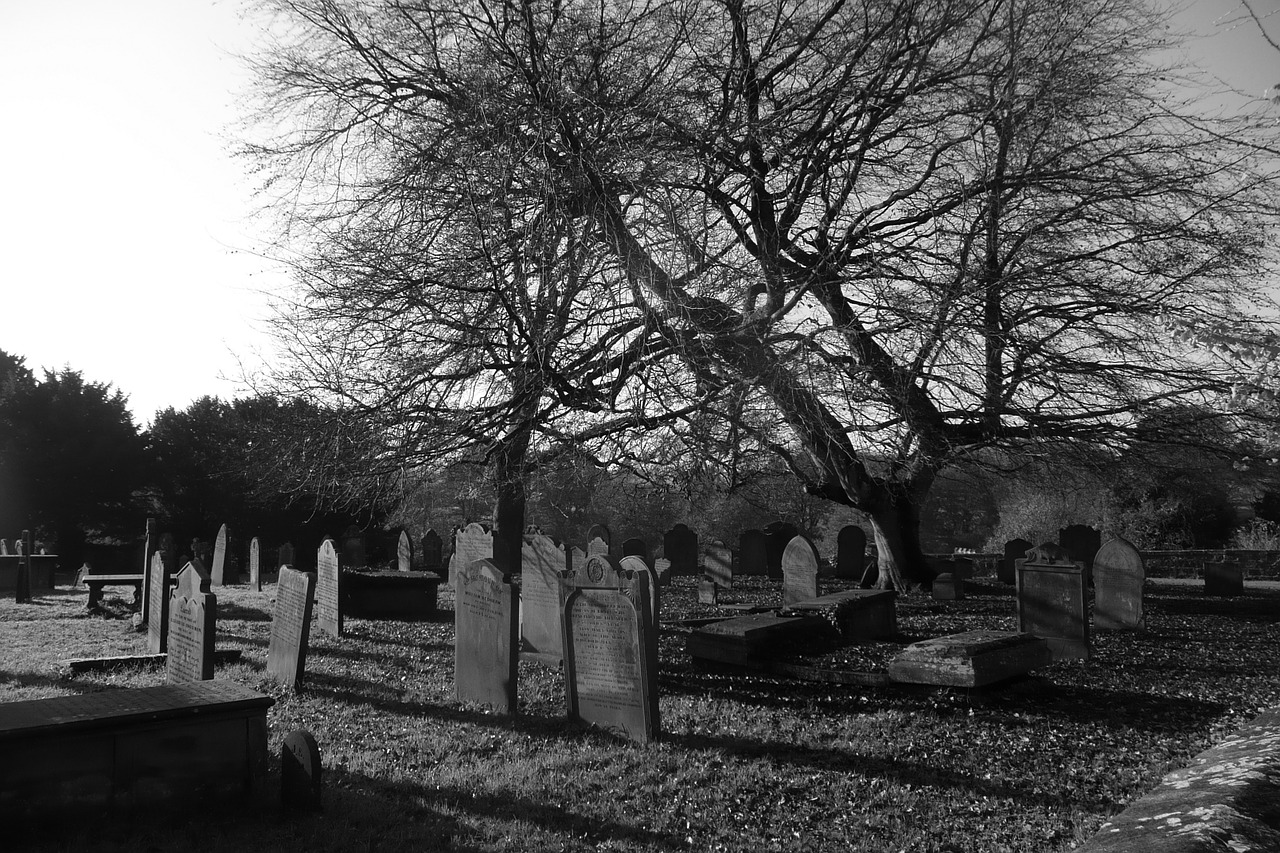
cemetery-20005_1280Thomas Hardy: The Choirmaster’s Burial

He often would ask us
That, when he died,
After playing so many
To their last rest,
If out of us any
Should here abide,
And it would not task us,
We would with our lutes
Play over him
By his grave-brim
The psalm he liked best—
The one whose sense suits
“Mount Ephraim”—
And perhaps we should seem
To him, in Death’s dream,
Like the seraphim.

As soon as I knew
That his spirit was gone
I thought this his due,
And spoke, thereupon.
“I think,” said the vicar,
“A read service quicker
Than viols out-of-doors
In these frosts and hoars.
That old-fashioned way
Requires a fine day,
And it seems to me
It had better not be.”

Hence, that afternoon,
Though never knew he
That his wish could not be,
To get through it faster
They buried the master
Without any tune.

But ’twas said that, when
At the dead of next night
The vicar looked out,
There struck on his ken
Thronged roundabout,
Where the frost was graying
The headstoned grass,
A band all in white
Like the saints in church-glass,
Singing and playing
The ancient stave
By the choirmaster’s grave.

Such the tenor man told
When he had grown old.

Thomas Allen singing this song from Britten’s set, Winter Words

And as for Hardy’s novels, they have been one of the great rewards of a reading life. Like Beckett, it’s easy to take what he saying, but he’s not lying to you.


National Poetry Month: Poems About Music, 3/30

Three verses from Shakespeare (of his many) on music:

If music be the food of love, play on;
Give me excess of it, that, surfeiting,
The appetite may sicken, and so die.
That strain again! it had a dying fall:
O! it came o’er my ear like the sweet sound
That breathes upon a bank of violets,
Stealing and giving odour.
(Twelfth Night, 1.1.1-7)

Thou remember’st
Since once I sat upon a promontory,
And heard a mermaid on a dolphin’s back
Uttering such dulcet and harmonious breath,
That the rude sea grew civil at her song,
And certain stars shot madly from their spheres
To hear the sea-maid’s music.
(A Midsummer Night’s Dream, 2.1.153-9)

Where should this music be? i’ the air or the earth?
It sounds no more: and sure, it waits upon
Some god o’ the island. Sitting on a bank,
Weeping again the king my father’s wreck,
This music crept by me upon the waters,
Allaying both their fury and my passion
With its sweet air: thence I have follow’d it,
Or it hath drawn me rather. But ’tis gone.
No, it begins again.
(The Tempest, 1.2.452-60)

Orpheus’ lute was strung with poets’ sinews,
Whose golden touch could soften steel and stones,
Make tigers tame and huge leviathans
Forsake unsounded deeps to dance on sands.
(The Two Gentlemen of Verona, 3.2.79-82)

Two “Gentlemen of Broadway” doing (somewhat crude) honor to the bard, courtesy of Cole Porter.