Reasonable Words: Books, their woes, dangers, and relevance

Keeping with my streak of bookish posts, an interesting piece from the Chronicle of Higher Ed (how long it will be outside the paywall, I knoweth not) musing on the book. Nice to have the historical context. From a prof at McGill who has written, of course, a book on the subject.

The manuscript scroll of Jack Kerouac’s On The Road, now on the London leg of its world tour!

Redundancy is thus not something that only belongs to “primitive” cultures; it is a basic condition of communicative reliability, of producing mutual understanding. Indeed, as the field of bioinformatics has more recently taught us, it is an elementary condition of life itself.The significance of redundancy for human communication is to my mind one of the most persuasive reasons why the printed book should still matter to us today. But it is also a compelling argument for the importance of new forms of electronic reading. Expanding the number of channels through which our ideas circulate makes those ideas potentially richer. That was the lesson of numerous medieval manuscript illustrations that highlighted the intersection of books, scrolls, and human speech to achieve a greater sense of understanding. More aspects of communication are not just quantitatively different. They are also qualitatively different. These multiple channels synthesize into something greater than the sum of their parts. The aggregation, and not the singularization, of communication is the condition of more complex thought. It is the condition of our humanity.

…..

The story of the book’s dominance in the 19th century should stand as an important reminder to us today. As we are overrun by computation, much in the same way as we were once overrun by books, we need to remember that what makes us unique as a species is not just our ability to communicate in complex ways through words. It is our ability to layer—or more artisanally understood, to weave—different modes of communication with one another to give those same words a deeper, more profound meaning.

How do you organize your books?

The Kansas City Public Library facade: does one use LC or Dewey for facades?
Fun piece from Geraldine Brooks on how she organizes her book collection. (A task I’ve officially given up on beyond keeping the poetry away from the cookbooks.)

Brooks organizes them based on whether the authors would like each other:

Claire Messud and Alice Munro? I’m sure they’d get on. But Norman Mailer and Anne Michaels? I think not. Best move the poetic and exquisitely sensitive Michaels next to Andre Makine — a much better match. Mailer can slide back along the shelf to sit beside D.H. Lawrence. If nothing else, they can always brag to one another about their sex lives.

No Twain next to Austen I guess. But R.K. Narayan and V.S. Pritchett would be fast friends I bet.

Reasonable Words: Frank Bruni on Gay Marriage Votes

From Today’s NYTimes:

Tuesday night was what history looks like: the passage, for the first time, of same-sex marriage by popular vote; the reelection of the president who became the first to support same-sex marriage; the first-ever election of an openly gay or lesbian person to the U.S. Senate.

….

But the trajectory is clear, and on Tuesday night, as marriage-equality advocates here in Washington absorbed the news from the East, cheers went up. I saw tears in people’s eyes. And I recalled a visit I made early last month to an 80-year-old gay man in Maine who was stunned — just stunned — at the prospect of his fellow citizens affirming his identity at the polls. He’d lived through so many decades of lesser regard, of undignified treatment.

He compared a successful referendum for same-sex marriage to a man setting foot on the moon: something once unthinkable, something wondrous, something exhilarating, not a step but a leap.

We took a big leap on Tuesday night. It was wondrous and exhilarating indeed and—trust me—more of a beginning than an end.

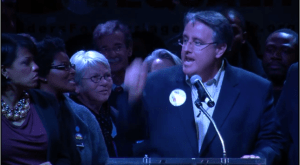
Maryland State Senator Rich Madaleno (and college friend of Jim’s) speaking at the rally.

I’m thrilled, even though though my personal views on marriage are that it’s antiquated and has a kind of unsavory past (dynastic property rights, anyone?). But Bruni makes the point that the whole argument over same-sex marriage changes when it’s a vote rather than a court battle. It’s a institution that everybody should have access to, even grumps like me.

Funny Words

Having nothing to offer this political day, I share this math joke courtesy of Jim. Makes me long for Boston, where this would not be uncommon at all.

“Two mathematicians, Joe and Bob, are in a restaurant. Joe is talking about how he feels that math education has really improved in his lifetime.

Bob is a grumpy old man. He disagrees. Strongly.

Joe says, “You know, I bet the average person on the street even knows a little calculus.” Bob laughs.

Bob goes to the bathroom. While he’s gone, Joe calls their waitress over and tells her: “Listen, I’m going to ask you to come over here in about five minutes. When you do, I’ll ask you a question. I want you to answer “One-third x cubed.” If you do, I’ll leave an extra $5 in the tip.”

The waitress blinks at him. “One thir-dex cue?”

“Sure, close enough.”

Bob comes back from the bathroom and Joe says, “Look, I’ll bet our waitress knows the integral of x squared.”

Bob scoffs. Joe bets him $10.

They call the waitress over and Joe asks her the integral of x squared. As instructed, she answers “One third x cubed”.

And as she’s walking away, she calls back over her shoulder, “plus a constant.”

Via the The The Listserve email lottery.

RIP: Elliot Carter

The great American composer Elliott Carter died Monday at age 103. He lived through cataclysmic changes in classical music (think about it: he was age 4 when “Le Sacre du Printemps” inspired a riot in Paris in 1913) and stayed true to a modernist idiom that demanded (and rewarded) attention. One highlight of my Boston time was getting to hear James Levine conducting the Boston Symphony Orchestra in Carter works, including pieces commissioned for his 100th birthday. The reports don’t mention it, but I bet he was composing until the end of his life.

A wire service story has appeared on the NYTimes (busy night around there, I’m sure) and many tributes to follow, no doubt.

His “Enchanted Preludes” courtesy of YouTube.

From the Times piece:

As he turned 100, he recalled a visit to the hall in 1924 to see the New York premiere of Igor Stravinsky’s revolutionary work “The Rite of Spring.”

“I thought it was the greatest thing I ever heard, and I wanted to do like that, too,” Carter recalled. “Of course, half the audience walked out, which was even more pleasant to me. It seemed much more exciting than Beethoven and Brahms and the rest of them.”

Reasonable Words: Carl Zimmer: Science Writing is Not Pole Dancing

Science writer Carl Zimmer has a thoughtful response to the whole Jonah Lehrer mess (the New Yorker writer who resigned after admitting he faked quotes). Prompted by reporting by Boris Kachka in New York Magazine, Zimmer reflects on the challenges (but also the necessity) of writing about science for the general public, and the “talking past each other” that occurs when the culture of journalism meets the culture of science. A journalist friend of mine calls this phenomenon a “glimp,” her coinage I think. Would be good to name, as it happens in all kinds of contexts.

Zimmer:

As for the other side of the story–the culture that fostered Lehrer–I appreciate that Kachka avoided silly sweeping generalizations–that all popular writing about neuroscience has become the worst form of self-help, that speaking about science in public is the intellectual equivalent of pole-dancing. Kachka instead reflects on the trouble that arises when a science writer reduces complex science to a glib lesson. He’s right to zero in on Lehrer’s 2010 New Yorker article “The Decline Effect and the Scientific Method” as an example of this error. For years, a lot of scientists and science writers alike have grown concerned that flashy studies often turn out to be wrong. But Lehrer leaped to a flashy conclusion that science itself is hopelessly flawed.

American Composer Aaron Copland once comments about non-musicians writing on music:

“If a literary man puts together two words about music, one of them will be wrong.” Swap “science” for “music”?

In other science news, Library Link of the Day tips a Guardian piece about scientific fraud that leads with

“Science is broken. Psychology was rocked recently by stories of academics making up data, sometimes overshadowing whole careers. And it isn’t the only discipline with problems – the current record for fraudulent papers is held by anesthesiologist Yoshitaka Fujii, with 172 faked articles.”

The piece is by two scientists, but exhibits some of the journalistic lambasting and selective citation of data that might give Zimmer pause. Comments are lively, including a trope about just how to find that perhaps notional  distinction between academic fraud and mere academic bullshit.

Reasonable Words: Elizabeth Gilbert on Rejection

Tipped by Long Reads, Elizabeth Gilbert before she won the book lottery with Eat, Pray, Love:

MAD Magazine’s rejection letter. Nicely in character.

Gilbert: “I was just so committed, and I did have six years of rejection letters. And it really didn’t break my heart. Some of them made me really excited because some of them had little handwritten notes at the bottom. Pretty good, but not our thing. And I was like, I got a really great handwritten note from Harper’s! And I would hang it on my wall, like, That’s such a great rejection letter! I don’t know why I felt like I had the right to do it. I don’t know. I’ve always been really surprised—and I really remain very surprised—at people who don’t think they have the right to do their work, or feel like they need a permission slip from the principal to do it, or who doubt their voice. I’m always like, What? What? Fucking do it! Just fucking do it! What’s the worst that could happen?! You fucking fail! Then you do it again and you wear them down and they get sick of rejecting you. And they get tired of seeing your letters and they just give up. They don’t have any choice. So part of it was real confidence, and part of it was fake confidence, and part of it was insecurity. It was a combination of all them.”

Dumbarton Oaks

This slideshow requires JavaScript.

Photos from a visit to one of my favorite haunts in Washington, the gardens at Dumbarton Oaks. My first visit in 15 years, and it is as magical as I remembered, and has a beautiful modern addition in the form of an installation by the landscape artists Cao | Perrot.

Probably Preposterous Words & Sounds: The Late Quartet

More evidence for my minor but persistent grumble about the fact that on those rare occasions classical music turns up as a plot line in the movies it’s often a watch word for arch melodrama or villainous perversion To wit: in any horror movie, it’s the guy who listens to Verdi or Wagner who did it. Hannibal Lechter famously blissed out to Mozart. Another post will take up Woody Allen’s highly personal (and longtime) use of opera as coding for bad guys.

The latest effort, “Late Quartet,” avoids the horror card, but otherwise seems to hit ever cliché of the genre. From the trailer (haven’t dragged myself to see it yet) seems overwrought and a little joyless. (Contrary opinion here.) Still, there are bound to be a few yuks courtesy of Christopher Walken trying to mime playing the cello. Reportedly they worked and worked to make it seem plausible that the four were professional string players. It didn’t work. (In fairness, that probably doesn’t matter, they are great actors, which great string quartet players wouldn’t be.)


More after I see the full movie.

For a taste of Beethoven’s Op. 131 in the flesh, check this clip from The Endellion Quartet out. It is something to hear.

Skeptical Word: Laura Miller on Novel Writing Month

From Salon, a few years back, the book critic Laura Miller suggests, not so gently, that the world doesn’t need more novelists, it needs more readers.

The Kings James Bible’s warning for novelists: “And further, by these, my sonne, be admonished: of making many bookes there is no end, and much studie is a wearinesse of the flesh.” Ecclesiastes Chapter 12, Verse 12. (Cool site, you can browse the 1611 printing!)

Miller: So I’m not worried about all the books that won’t get written if a hundred thousand people with a nagging but unfulfilled ambition to Be a Writer lack the necessary motivation to get the job done. I see no reason to cheer them on. Writers are, in fact, hellishly persistent; they will go on writing despite overwhelming evidence of public indifference and (in many cases) of their own lack of ability or anything especially interesting to say. Writers have a reputation for being tormented by their lot, probably because they’re always moaning so loudly about how hard it is, but it’s the readers who are fragile, a truly endangered species. They don’t make a big stink about how underappreciated they are; like Tinkerbell or any other disbelieved-in fairy, they just fade away.

Rather than squandering our applause on writers — who, let’s face it, will keep on pounding the keyboards whether we support them or not — why not direct more attention, more pep talks, more nonprofit booster groups, more benefit galas and more huzzahs to readers? Why not celebrate them more heartily? They are the bedrock on which any literary culture must be built. After all, there’s not much glory in finally writing that novel if it turns out there’s no one left to read it.

Consider turning away from the self-aggrandizing frenzy of NaNoWriMo and embracing the quieter triumph of Kalen Landow and Melissa Klug’s “10/10/10″ challenge: These two women read 10 books in 10 categories between Jan. 1 and Oct. 10, focusing on genres outside their habitual favorites. In her victory-lap blog post, Klug writes of discovering new favorite authors she might otherwise never have encountered, and of her sadness on being reminded that “most Americans don’t read ANY books in a given year, or just one or two.” Instead of locking herself up in a room to crank out 50,000 words of crap, she learned new things and “expanded my reading world.” So let me be the first to say it: Melissa and Kalen, you are the heroes.

Earlier in the piece Miller makes the same point that Stephen King makes, if you want to be a writer, read. Oddly, I’ve never met would-be writers who don’t read. But perhaps they do exist. Statistics about reading seem almost as shaky as statistics about sex.