Anatomy of a Hack

Found Via Daring Fireball: Tech writer Mat Honan (Wired and elsewhere) describes a destructive hack, with this observation about the state of security for cloud users:

Moreover, if your computers aren’t already cloud-connected devices, they will be soon. Apple is working hard to get all of its customers to use iCloud. Google’s entire operating system is cloud-based. And Windows 8, the most cloud-centric operating system yet, will hit desktops by the tens of millions in the coming year. My experience leads me to believe that cloud-based systems need fundamentally different security measures. Password-based security mechanisms — which can be cracked, reset, and socially engineered — no longer suffice in the era of cloud computing.

Makes a good case for using two-factor authentication at a minimum, in particular, to protect your Google account.

More Zagajewski: Music and Words

I keep saying I’ll stop with the Adam Zagajewski bits, and better before it becomes precious (if that hasn’t already happened).

But two more:

“When asked if European music has core , that is, if one work or another might be called its heart, B. answered, “Yes, of course, the aria ‘Erbarme Dich’ from Bach’s Passion According to St. Matthew. (Text is “Have mercy on me ” and is Peter’s realization that he has betrayed Jesus.)

Here’s Marilyn Horne pouring that opulent tone of hers all over it, and but still haunting and backwards looking.

Nice performances by Christa Ludwig and Michael Chance on YouTube as well.

I agree with B, and it’s diverting to think of other musical genres or art forms that have “a heart” in a single work –jazz, graphic novels, fashion?  The “core” of 90s television would be Seinfeld.

Another quip of Zagajewski’s from later in the book:

“Good writers package the unknown in the known. Bad writers put the unknown on top.”

Botanical Gardens

I continue to try to learn how to use my DSLR… Slow progress, but amazed at the macro function.


Jenny Diski on The Sixties

Found in the Bethesda Public Library (mostly a disappointment, I guess the Newton Free Library has set the bar too high for suburban library overachievement), was a little book by Jenny Diski on The Sixties. She’s always rewarding to read in the LRB (including even her recent dissent from the chorus of approval for Downton Abbey). Here’s the opening of her Sixties book:

“Now that it has gone the twentieth century has become an idea. The past is always an idea that people have about it after the event. Those whose job it is to tell the story of the past in their own present call it history. To generations born later, receiving recollections from their parents or grandparents, or reading the historians, the past is a story, a myth handily packaged into an era, bound by a particular event–a war, a financial crisis, a reign, a decade, a century–anything that conveniently breaks the ongoing tick of time into a manageable narrative. Those who were alive during the period in question, looking back, call it memory, memory being just another instance of the many ways in which we make stories. But although the past always belongs to the present and future, the later third of the twentieth century we know as the Sixties was one of those particular periods that was an idea to many even before it became the past. The Sixties were an idea in the minds, perhaps even more powerful than the experience, of those who were actually living through them.”

The idea of the Sixties shaped me (Diski has the period extending through the mid-70s, my adolescence) as surely as The Great Depression era shaped my parents. She makes the connection between the 60’s take on the way of the world and the its affinity with the Thatcher/Regan era that followed (at the time seen like a counter-revolution or at least a disinfecting). Her thesis that they were the same in key ways (the obsession with the individual and with recasting freedom and liberty, the distrust of government, and radical ideas about “society” as a sort of category error) has been written about before, but Diski anatomizes it all with a witty scalpel, leaving any partisan on the “left” or “right” pondering the large cost of unintended consequences that the era bequeathed us.

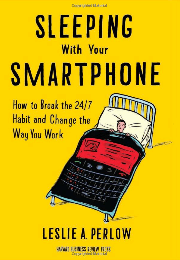
Sleeping with Your Smart Phone

Harvard Biz School prof Leslie Perlow took on the 24/7, always on, AOMO culture at its most intense, the world of management consulting, and made a simple, but startling suggestion:

From a Forbes piece on her work (Sleeping with Your Smart Phone? Here’s the Cure):

Perlow started with a simple, minor — and ingenious — change to one small team’s routine. Instead of working late every night, she said, what if each consultant vowed to wrap up early one night a week. Do anything except work, she said. Play golf. Have dinner with your kids. See a movie. Pick your diversion; just find some way to reconnect with the rest of the world.

Consultants trembled. “What if my clients need me?” they asked. Get a colleague to cover for you, Perlow replied. And start holding weekly meetings where team members figure out how to divide up work more effectively. That way some part of the team can be available around the clock without requiring everyone to be on call.

Gradually her approach took hold. Consultants discovered that they liked a little time off. They felt better about their jobs. They were less likely to quit. Most strikingly, they and their bosses rated their work more highly. Something about these pauses was making consulting more efficient, more team-oriented or maybe even more creative.

A little like the technology sabbath idea, but perhaps easier to do? Some how I missed this year’s “National Day of Unplugging” and was late for my “technology detox.” Damn smart phone reminders must have been turned off.

Fine Pictures: Bellows at NGA

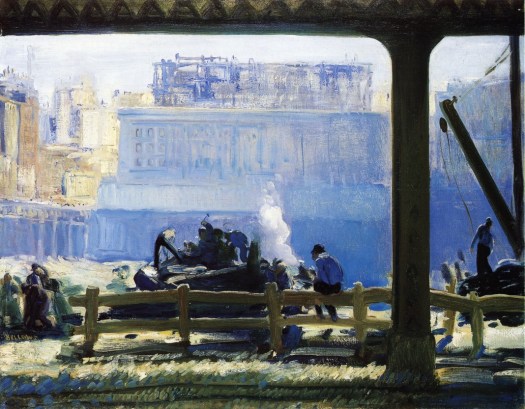
George Bellows: Blue Morning

The George Bellows show at the National Gallery has already gotten lots of comment. So no need to add my bit, beyond saying for anybody who loves American art and taking in the whole of a varied career, it makes for a rewarding afternoon.

The NGA show has the iconic Bellows canvases of course: the fight paintings like “Stag at Sharkey’s,” something to see in person, and those sinewy urban impressionist images of New York, like “Blue Morning” (above), one of a series about building Penn Station that focus on forms and people, not monumental architecture. But he also did many portraits, most of women, vast amounts of political art (varied in quality), including covers for the socialist monthly The Masses. An interesting, but disturbing, room is given over to his anti-German lithographs from the WWI era. They are violent and ham-fisted propaganda (if you go with the kids skip that gallery).

All these pop with energy and people, but he also did some stunning landscapes, including of Monhegan Island (inevitable, perhaps, since his teacher was Robert Henri who painted there.) His take on Monhegan’s neighbor island, Manana, (below) is a high point of the NGA show. The painting captures the enveloping mystery of looking at this uninhabited rock, and is also a side of Bellows that is quiet and still (although not without a hint of menace).

George Bellows: An Island in the Sea

Wallace and Gromit at the Proms

Too bad we can’t see it (only audio in the U.S.), but still a lot of fun. Gromit, once again, saves the day. You also get to hear John Adams’ “Short Ride in a Fast Machine,” always a rush. Only up through Sunday. So if you need a giggle, go for it now.

Mapping Workflows: Data Deluge, Service Deluge

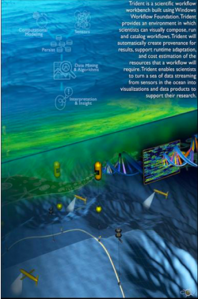
Meandering around Microsoft Research’s amazing AIDS Quilt app (subject of a future entry), I found “Project Trident: A Scientific Workflow Workbench,” which intrigued me as I thought it was for the study of workflows in general. Not quite that, but still interesting. It’s a tool for scientists to manage and visualize the workflows that inform their research. From their site:

With Project Trident, you can author workflows visually by using a catalog of existing activities and complete workflows. The workflow workbench provides a tiered library that hides the complexity of different workflow activities and services for ease of use.

An increasing number of tools and databases in the sciences are available as Web services. As a result, researchers face not only a data deluge, but also a service deluge, and need a tool to organize, curate, and search for services of value to their research. Project Trident provides a registry that enables the scientist to include services from his or her particular domain. The registry enables a researcher to search on tags, keywords, and annotations to determine which services and workflows­—and even which data sets—are available. Other features of the registry include:

  • Semantic tagging to enable a researcher to find a service based on what it does, or is meant to do, and what it consumes as inputs and produces as outputs.
  • Annotations that allow a researcher to understand how to operate the registry and configure it correctly; the registry records when and by whom a service was created, records its version history, and tracks its version.

Would have to see it in action to understand it, but an intriguing idea. Arts and humanities researchers would probably balk–starting with the word workflow–but they have a similar deluge of data/services problem.

Reasonable Words: “Aristotle looked Askance”

The Polish poet Adam Zagajewski on why he’s a poet and not a philosopher:

I realized early on that I’d probably never be a real scholar, an archivist, an academic. I didn’t read my way scrupulously through the assigned texts—which weren’t just Soviet, hence scarred from birth by the sins of shoddiness, duplicity, and monotony—but also included classics of philosophy. I didn’t stroll slowly and sedately through the lanes of printed pages, snaring key quotes with the aid of a pencil before transferring them to a notebook or index cards, the indispensable carapace of the true student. I daydreamed, dropped the book, forgot it, and drifted on to something new, and when I came to, I found myself in another place and time, in Portugal or Chile, on the shores of the Mediterranean, in the Middle Ages or the first decade of the nineteenth century.

And so my assigned reading dragged on at a snail’s pace. I never finished anything. I wasn’t a good student. Descartes lost patience, Aristotle looked askance. They already knew that this was no young philosopher poring for hours over the pages of their immortal tracts. It was only a poet, a dabbler who couldn’t refine a concept or elaborate new nuances in existing categories if his life depended on it. The poet is the philosopher’s older brother. Older, but treated for all that with a certain indulgent hauteur; men of learning view him as frivolous, flighty. A person who doesn’t spend ten hours a day in stuffy reading rooms can’t possibly be taken seriously. A person who makes things up as he goes along. Writes out of thin air instead of cobbling new books from old quotes, footnotes, rereadings of ancient texts. He sits in front of the typewriter with eyes closed, like a clairvoyant. Closer to astrology than to science. He’s prone to dubious enthusiasms; at times he sings, laughs, or cries while shut in his own room. True scholars wouldn’t do that. Scholars don’t close their eyes at their computers. Just the opposite—they prop them open.

From his notebook-like memoir, Another Beauty. Daydreaming while you are supposed to be reading philosophy is something I know well. No scholar myself, either, but every few pages of his beautiful book, I come across a passage that makes me get out my pencil and journal to copy it down.